

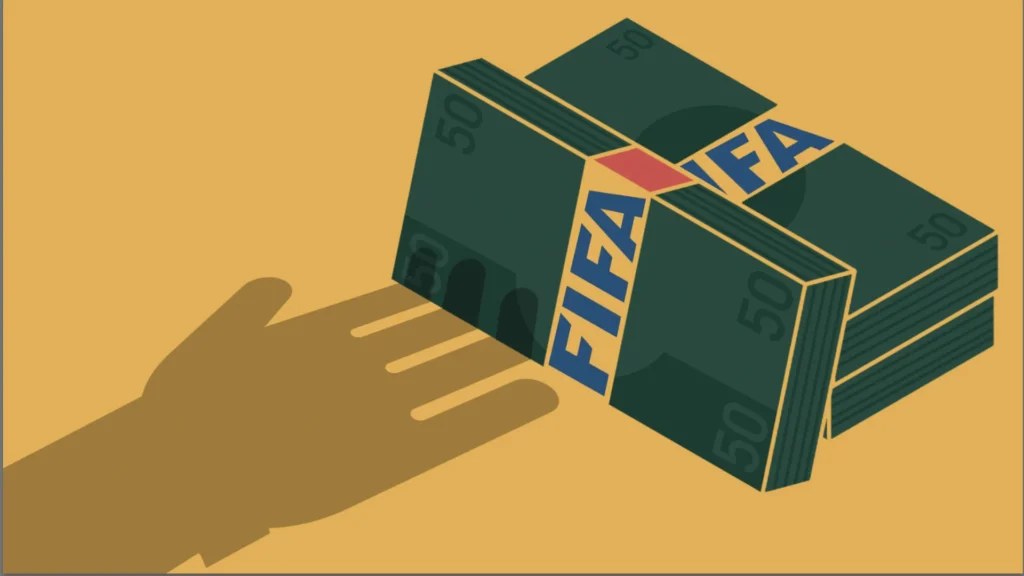
Over decades, investigative journalists and federal prosecutors have exposed a pattern of systemic corruption within FIFA.
The International Federation of Association Football (FIFA) operates as the sole governing body for global football. While the organization is officially registered as a Swiss non-profit entity, its financial operations match those of major transnational corporations. Over decades, investigative journalists and federal prosecutors have exposed a pattern of systemic corruption within FIFA.
RELATED:
Socrates Exposed the FIFA Corrupt Interests
This article explores how the business structure of international football, like FIFA, created an environment for illicit financial practices. Rather than looking at these scandals as isolated events involving individual actors, financial data and legal findings show that the organization operated with a significant lack of external oversight.
The Political Economy of FIFA’s Governing Body
Founded in 1904, FIFA established its headquarters in Zurich, Switzerland. Under Swiss law, sports governing bodies enjoyed minimal state regulation and significant tax exemptions, categorized similarly to local community associations.
This specific legal environment allowed the FIFA organization to accumulate billions of dollars in revenue from broadcasting rights and corporate sponsorships with limited public accountability or external auditing.
That means, FIFA’s financial expansion accelerated during the late 20th century as international football grew. By controlling the exclusive marketing rights to the World Cup, the executive committee gained immense economic leverage. For example, in the World Cup France 98′, FIFA raised over $US 1,900 billion, and in 2014 grew to $US 5,700 billion.
The structure of FIFA operates similarly to a mix, with a parliamentary democratic corporation. In this sense, like national football associations hold equal voting power in its presidential elections with the model “one country, one vote”. This developed a system where high-ranking officials could easily secure political loyalty.
By distributing lucrative development funds and commercial contracts to specific regional confederations, FIFA leadership maintains control while creating a closed ecosystem vulnerable to financial exploitation.
Sometimes this means, if a local football association president in a small nation wants to keep receiving their annual million-dollar FIFA grant, they must vote to keep the sitting FIFA president in power.
FIFA’s handling and President Trump’s involvement in “Balogun-Gate” have elicited no shortage of hot takes across sports, @MMcCarthyREV writes.
But in the end, Balogun and Team USA are blameless, regardless of what FIFA, politics, and the sports world have to say about it.
— Front Office Sports (@FOS) July 6, 2026
FIFA-Gate and its Machinery
The structural vulnerabilities of FIFA’s governance became public on May 27, 2015, during an event now widely known as “FIFA-Gate”. Swiss authorities, acting on warrants issued by the United States Department of Justice, conducted an early-morning raid at the luxury Baur au Lac hotel in Zurich.
FIFA-Gate resulted in the arrest of seven high-ranking football executives who were attending the annual FIFA Congress. Vice President of FIFA at that moment, Jeffrey Webb, or FIFA Executive Committee member-elect Eduardo Li, were on the list.
In this FIFA-Gate scandal, bribes and kickbacks of over US$150 million were revealed over a duration of 24 years, with 47 criminal counts, and the jurisdictions most impacted were the Confederation of North, Central America and Caribbean Association Football (CONCACAF) and the South American Football Confederation (CONMEBOL).
In exchange for these illicit payments, FIFA’s executives awarded lucrative media and broadcasting rights for major tournaments, such as the Copa América and World Cup qualifying matches, to specific sports marketing firms.
“The indictment alleges corruption that is rampant, systemic, and deep-rooted both abroad and here in the United States. It spans at least two generations of soccer officials who, as alleged, have abused their positions of trust to acquire millions of dollars in bribes and kickbacks,” explained New York, U.S. Attorney General Loretta Lynch.
The investigation revealed that the U.S. financial system had been utilized to route these FIFA illicit transactions, giving federal prosecutors the jurisdiction needed to dismantle the network.
¿Buying the World Cup?
The selection of host nations for the FIFA World Cup became the primary mechanism for financial exchange among high-ranking football officials.
Since the beginning, the voting process relied exclusively on the members of the FIFA Executive Committee, a small group of 24 individuals who wield unchecked influence over the multi-billion-dollar event.
Financial documentation unsealed during federal investigations confirmed that the right to host tournaments was repeatedly secured through direct monetary transactions. The 2010 World Cup in South Africa serves as a documented example of vote buying.
U.S. federal prosecutors revealed that the South African Football Association authorized a US$10 million payment to accounts controlled by Jack Warner, who then served as CONCACAF president. The transaction was categorized as a fund to support the development of football for the African diaspora in the Caribbean.
Bank records showed that the money was systematically routed to personal credit cards and local businesses associated with Warner. Former executive committee member Chuck Blazer admitted to helping facilitate this bribe, confirming that the US$10 million payment was the decisive factor in securing the necessary votes to award the tournament to South Africa.
The dual selection of Russia for the 2018 World Cup and Qatar for the 2022 World Cup in December 2010 further demonstrated the systemic nature of this process. For example, Mohamed bin Hammam, the former president of the Asian Football Confederation, utilized a network of private accounts to distribute over $1.8 million to football officials across Africa to ensure support for the Qatari bid.
BREAKING: The FIFA Counsil has launched investigations against president Gianni Infantino for fraud and corruption
This is after the global uproar against clear referee favoritism towards Argentina and Lionel Messi pic.twitter.com/HkMPYVqMUs
— Fanbrizio Rovaldo (@FabrizioRomaxno) July 9, 2026
Infrastructure Exploitation and Illicit Financial Flows
In FIFA, the financial scale of corruption begins when a country secures hosting rights. The financial scale of corruption expands into infrastructure development and international capital markets.
To meet strict FIFA stadium requirements, host governments relied on public funds, creating opportunities for construction cartels and corrupt state officials to manipulate budgets.
This diversion of public resources resulted in severe cost overruns across multiple tournaments. For instance, the final cost for South Africa 2010 ballooned from an initial estimate of US$1.3 billion to $3.6 billion, while Brazil’s public expenditures for the 2014 World Cup surpassed US$13 billion.
The human cost of this manipulation reached its peak during preparations for Qatar 2022, where overall infrastructure spending reached an estimated US$200 billion. To construct these projects, Qatar relied on a workforce of migrant laborers from South Asia and East Africa tied to the restrictive kafala labor system.
Human rights investigations revealed that construction firms subjected these workers to unsafe environments, unhygienic housing, and wage withholding. The extreme climate and lack of safety oversight resulted in thousands of unexplained migrant worker deaths, directly linking infrastructure graft to human exploitation.
Beyond construction inflation, this opaque, decentralized financial framework created significant intersections with transnational organized crime networks. Because tracing capital across regional confederations is complex, portions of the global football industry became accessible vehicles for money laundering and illicit gambling syndicates.
Large-scale investigations led by Interpol, such as “Operation SOGA” (Soccer Gambling), exposed how international syndicates systematically target financially vulnerable players and referees to fix match variables, like the number of yellow cards or final scores, to generate predictable betting profits in unregulated offshore markets.
Furthermore, financial regulators have scrutinized the international player transfer market. Illicit networks, including drug trafficking cartels and fraudsters, have used shell corporations registered in tax havens to purchase player registration rights.
FIFA World Cup
FIFA Israeli corruption
pic.twitter.com/ZOjtZ9mbLt
— The Saviour (@TheSaviour) July 7, 2026
The Fallacy of Internal Reform and the Path to Reclamation
Following the 2015 arrests, FIFA pledged a comprehensive restructuring under the leadership of its new president, Gianni Infantino.
FIFA introduced sweeping governance reforms in 2017, including the implementation of term limits for senior executives, the theoretical separation of political and management functions, and the creation of independent ethics and compliance committees. Presented this to the public and corporate sponsors as an internal cleansing.
However, international governance experts, human rights organizations, and legal analysts argue that these internal changes have largely failed to alter the core FIFA power dynamics.
For example, key anti-corruption rules, such as presidential term limitations, were significantly modified in 2022 to allow current leadership to extend its tenure.
Ultimately, the history of corruption within FIFA demonstrates the limitation of relying on a private, self-regulating monopoly to reform itself from within. Because the organization controls a globally significant cultural asset while operating above traditional state regulations.
Sources: Financial Times – European Comission – PBS – The Guardian – FBI – Al Jazeera – teleSUR – BBC
From teleSUR English via This RSS Feed.