

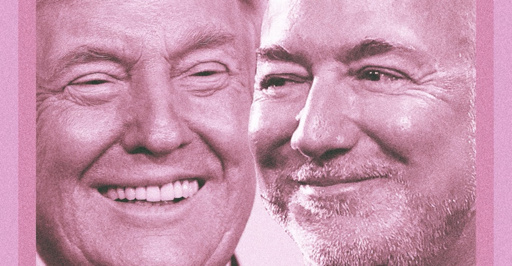
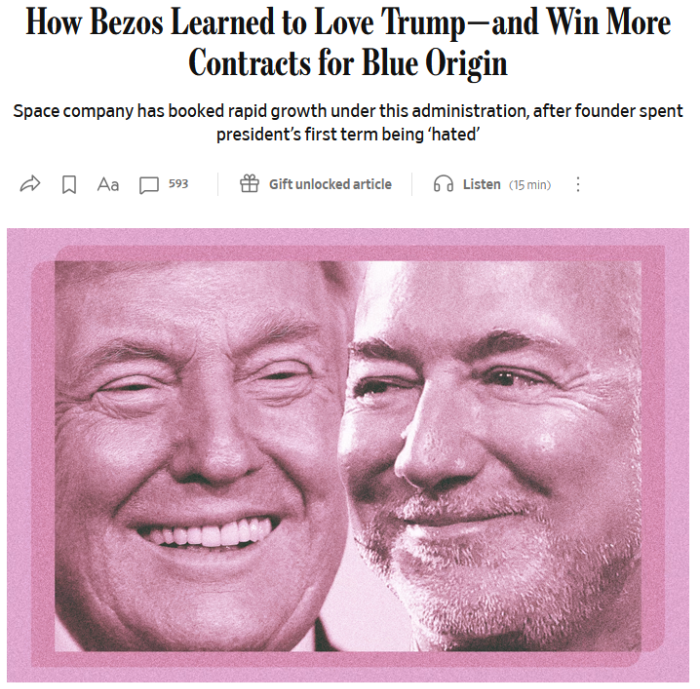
The perks of being a suck-up (Wall Street Journal, 7/2/26): “[Donald] Trump has told advisers that he wanted to see [Jeff] Bezos get to the moon with his rocket company Blue Origin and make sure it gets related contracts.”
It’s been an eventful year since Washington Post owner Jeff Bezos tapped Adam O’Neal for the prestigious job of Post Opinions editor. O’Neal was an unusual hire, a 33-year-old with little by way of managerial experience. But O’Neal had a redeeming quality: He was ready to shill for Bezos, and the man Bezos has been desperately wooing, President Donald Trump.
It’s remarkable how far Bezos has come since 2013, when he said he purchased the Post from the Graham family out of a sense of civic duty.
Bezos was still singing a similar tune nearly midway through Trump’s first term, telling Axel Springer CEO Mathias Döpfner (4/28/18), “I would be humiliated to interfere” with the Post’s coverage. “I would be so embarrassed. I would turn bright red…. It would feel icky; it would feel gross.”
But days before the 2024 election, with Trump looking like he might return to the White House, Bezos apparently got over his queasiness and personally spiked the Post’s endorsement of Kamala Harris (FAIR.org, 10/30/24). “Trump was thrilled, advisers said, and later thanked Bezos,” the Wall Street Journal (7/2/26) reported.
Bezos followed up by declaring that Post Opinions would now promote “personal liberties and free markets,” while “viewpoints opposing those pillars will be left to be published by others.” Coming a month into Trump’s second term, this came across as another gift to the president (FAIR.org, 2/28/25).
‘Unapologetically patriotic’
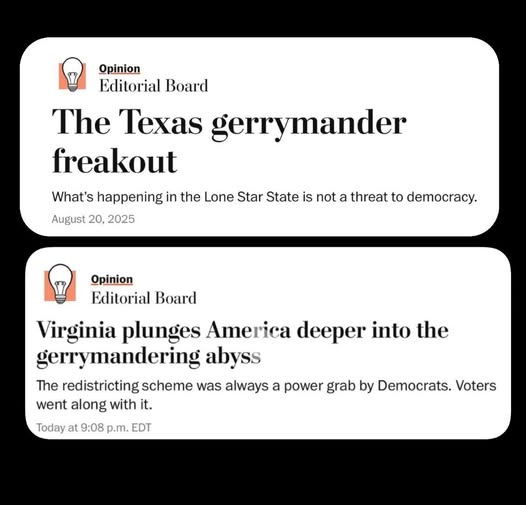
When Texas did a mid-census gerrymander in 2025, the Washington Post (8/20/25) urged Democrats to “hold the apocalyptic warnings about the end of democracy.” When Virginia followed suit in 2026, the Post‘s message (4/21/26) to Democrats was ” spare us the false sanctimony about democratic norms.”
To lead the newly oriented Opinions page, Bezos tapped O’Neal, who had been a correspondent for the Economist, editorial writer for the Wall Street Journal and executive editor at the conservative Dispatch for just one year.
In that last role—apparently O’Neal’s only newsroom managerial experience—he quickly alienated the Dispatch staff. “He was a competent editor who had no idea how to talk to another human being,” a former associate of O’Neal’s told Status (7/18/25):
He was tough on reporters, sure, but that’s common in newsrooms. He just couldn’t express even the most minor thing without being abrasive, hostile or raising his voice.
After being named to his post in June 2025, O’Neal declared that Post Opinions would be “unapologetically patriotic” and “communicate with optimism about this country.” This echoed Bezos, who declared a month into Trump’s second term, “I am of America and for America, and proud to be so.” Bezos was, of course, echoing Trump’s “America first” rhetoric.
O’Neal has demonstrated his patriotism by overseeing an editorial page that has backed Trump in destroying the East Wing of the White House (10/25/25), kidnapping the Venezuelan president (“one of the boldest moves a president has made in years”—1/3/26), militarily taking over DC (8/11/25; FAIR.org, 8/14/25), and unprecedented gerrymandering (8/20/25). (When Democrats responded in kind, the Post decried the “power grab”—4/21/26).
The Post’s pro-Trump boosterism under O’Neal has been so over the top, wrote Chris Lehmann (The Nation, 2/4/26), it’d “be a stretch for Pravda to pull off.”
“I try to avoid reading what the opinions section publishes,” a current Post staffer told Status (5/10/26). “I can’t tell if some of these arguments are being made in good faith or not. Sometimes it just seems like rage bait.”
‘Being reconciled is not enough’
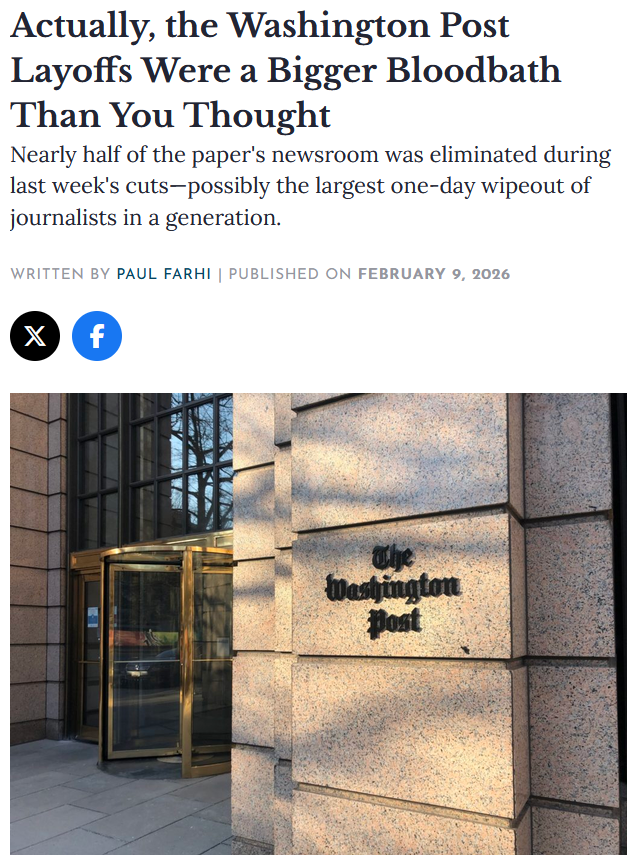
Former Washington Post media writer Paul Farhi (Washingtonian, 2/9/26) described Bezos’ layoffs as “disfiguring…with whole sections and departments—sports, books, staff photography—wiped away, and devastating cuts inflicted on its Metro section and foreign bureaus.”
While O’Neal’s predecessor, David Shipley, did everything Bezos could have asked for—spiking the Post’s Harris endorsement and a cartoon depicting Bezos and other tech moguls as Trump supplicants (FAIR.org, 1/7/25)—he did it without zeal, which Bezos found intolerable. “I suggested to him that if the answer wasn’t ‘hell yes,’ then it had to be ‘no,’” Bezos wrote, in explaining Shipley’s February 2025 resignation.
Shipley had voiced concern over the direction Bezos was taking the Post, warning the billionaire that spiking the Harris endorsement days before the election and yanking Opinions rightward could turn off subscribers. “I don’t care,” Bezos replied (New York Times, 3/14/26). (Shipley proved correct; Bezos’ interventions led to over 375,000 Post readers canceling their subscriptions—NPR, 1/30/26.)
Replacing Shipley, O’Neal wasted little time in transforming Opinions’ editorial outlook, and its personnel. In his first email to the Opinions desk, O’Neal encouraged his colleagues to get with the program or quit, mimicking Bezos’ message to Shipley. “Simply being reconciled to these changes is not enough,” O’Neal wrote. “We want those who stick with us to be genuinely enthusiastic about the new direction and focus.”
Seeing the writing on the wall, many of the Post’s centrist and left-of-center columnists took the generous buyouts on offer (which some had been contemplating since before O’Neal was hired). Gone in quick succession were Perry Bacon Jr., Philip Bump, Jonathan Capehart, Joe Davidson, Marc Fisher, Glenn Kessler, Ruth Marcus, Dana Milbank, Catherine Rampell, Eugene Robinson, Eduardo Porter and others. “It’s just an absolute exodus,” a Post staffer told Politico (7/28/25).
The paper’s last full-time Black Opinions columnist, Karen Attiah, was fired in September 2025 (Golden Hour, 9/15/25; FAIR.org, 9/23/25). (Theodore R. Johnson of New America writes roughly once a week as a contributing columnist, but is not on staff.)
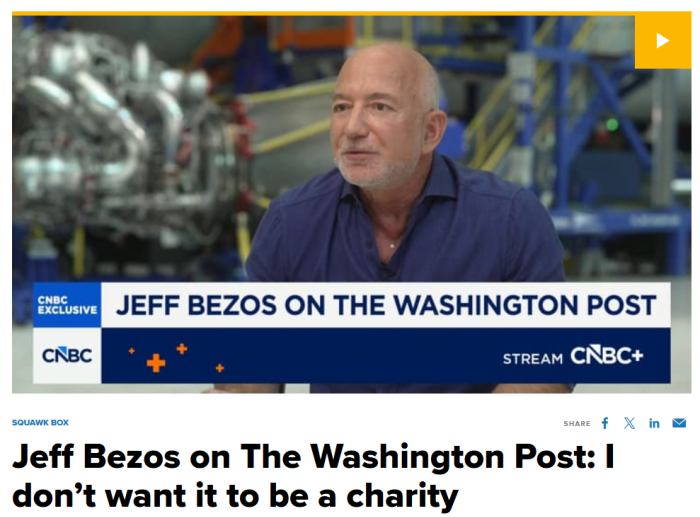
Jeff Bezos (CNBC,5/20/26): “The [Washington] Post needs to be a profitable enterprise that stands on its own two feet.” Bezos could cover the Post‘s annual losses by spending 0.04% of his wealth—the equivalent of a typical US household spending $77 a year to maintain a fishtank.
Bezos hollowed the Post out further in February when he laid off nearly half of the newsroom, in what “may have been the biggest one-day wipeout of journalists in a generation” (Washingtonian, 2/9/26).
Publicly, Bezos claimed he was doing this for the long-term viability of the paper. To be relevant, the Post has to be a “profitable enterprise that stands on its own two feet,” Bezos told Andrew Ross Sorkin (CNBC,5/20/26). Otherwise, “it would be like poetry without rhyming.”
Privately, however, Bezos told Trump that Post employees “are terrible…. They don’t listen. My other companies, they listen,” according to New York Times reporters Maggie Haberman and Jonathan Swan’s new book Regime Change.
To make the Post more like his other companies, Bezos needed “hell yes” management, like Adam O’Neal (and former publisher Will Lewis).
O’Neal, in turn, needed fellow travelers, and seems to have hired exclusively MAGA-friendly columnists. According to media critic Adam Johnson (Real News Network, 5/22/26), the Post
purged its opinion page of its actually popular writers and replaced them with charmless Economist and Wall Street Journal also-rans so they can spew libertarian cliches [and] tedious anti-woke screeds.
‘A whole bunch of incredible miracles’
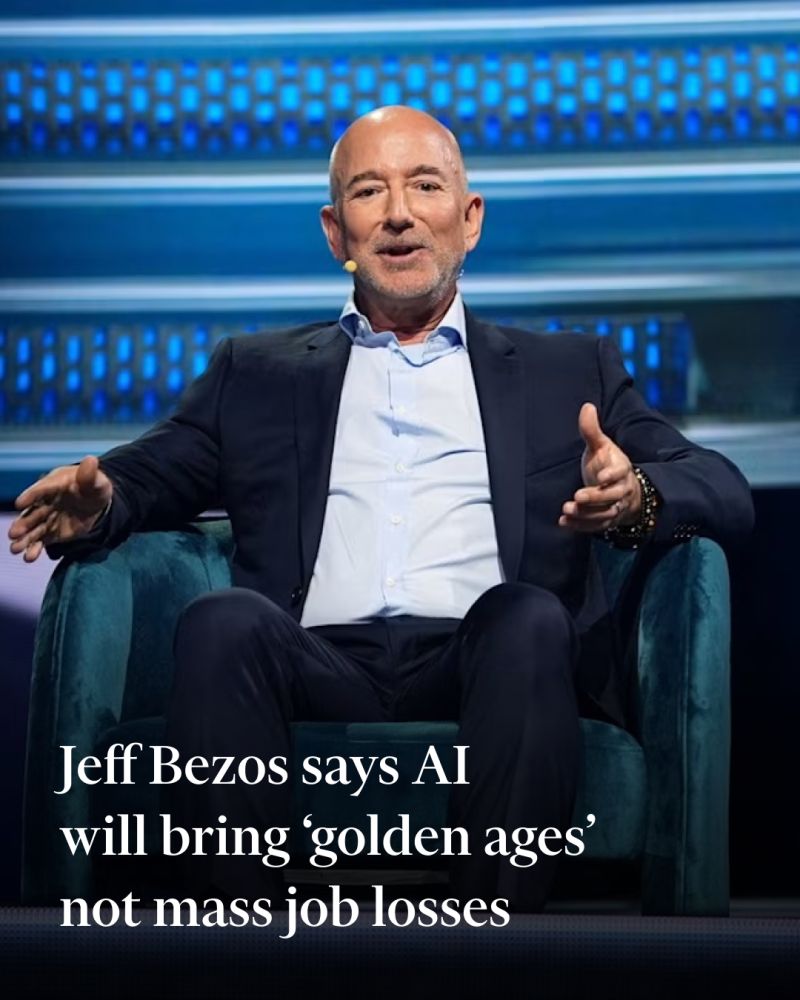
Jeff Bezos (Financial Times, 6/11/26): “Six thousand years ago, somebody invented the plow, and we all got wealthier.” Actually, the invention of agriculture impoverished most people, resulting in humans losing 5–6 inches of height due to malnutrition (Discover, 5/87).
O’Neal’s fealty to Bezos is most blatant in Opinions’ approach to artificial intelligence.
“All of the things that I work on today have something to do with AI,” Bezos told the Financial Times (6/11/26). “We’re in the middle of multiple golden ages right now, certainly with AI,” he continued, sounding every bit the snake oil salesman. “I think you’re going to see a whole bunch of incredible miracles unfold here in the next decade.”
And Bezos is banking on these miracles to expand his empire on earth and in space. Despite being worth a quarter-trillion dollars, Bezos is presently scouring the globe to raise $100 billion for a new fund that plans to buy companies in industrial sectors and improve them using AI (Forbes, 3/19/26). Bezos’ latest effort aligns neatly with his new role as co-CEO of Project Prometheus, a low-profile AI company that’s raised $18 billion in funding (Morning Brew, 6/12/26).
Meanwhile, Amazon—the company Bezos founded, where he remains the largest shareholder and executive chair—“recently placed a series of staggeringly expensive bets on artificial intelligence, audacious even by the standards of Silicon Valley’s ongoing trillion-dollar AI bacchanalia,” Bloomberg reported (5/14/26).
With so much on the line, Bezos has little patience for doomsayers who fear AI will cause mass job loss—the very thing Wall Street is salivating over. Sure, AI will be “shrinking the number of people needed by 10x,” Bezos told the Wall Street Journal (6/11/26). But the technology will in fact create “more than 10x” as many jobs, he said. The suggestion seems to be that more than 90% of us will soon be in hitherto unimagined job categories made possible by artificial intelligence. (Bezos’ fellow tech titans recently started following his lead and saying similar things about AI job losses.)
Despite Bezos’ rosy outlook, “the public isn’t so reassured,” the Journal reported (6/13/26) two days later, citing a Pew Research Center survey from March. “Only 17% of Americans say AI will have an overall positive effect on the US over the next 20 years.”
And the data centers needed to power AI fare little better. “Americans have changed their minds about data centers. Decisively,” reported the outlet Heatmap (6/2/26), which conducted a recent poll. “At least seven in 10 Americans would now oppose a data center being built near their home…a record low.”
Opposition to data centers—and their insatiable demand for power and water—has become “The Most Bipartisan Issue Since Beer,” according to a New York Times headline (5/1/26).
‘Data centers don’t deserve so much hate’
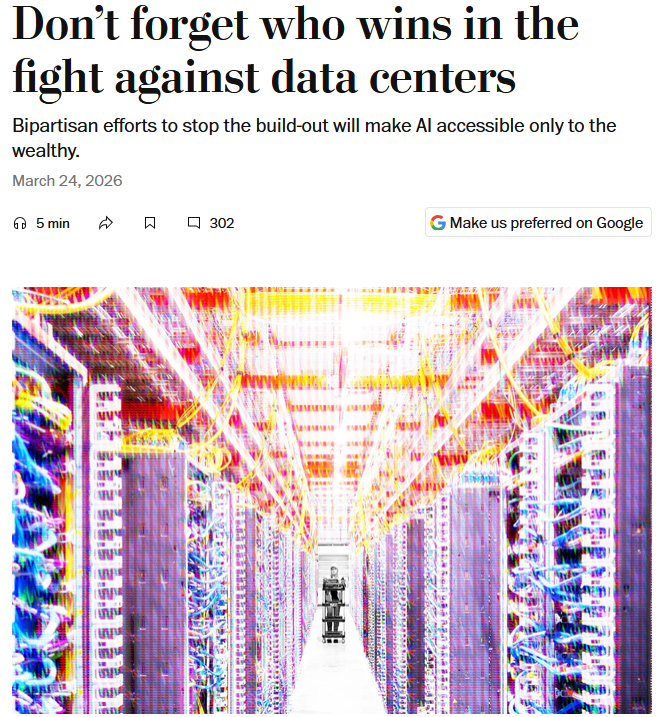
Billionaire-owned paper warns that blocking data centers will only benefit billionaires. (Original headline: “Halting Data Center Construction Will Entrench Inequality”—Washington Post, 3/24/26.)
With the American people on one side of the AI divide, and Bezos and his fellow tech oligarchs on the other, O’Neal has rushed to his boss’s rescue (FAIR.org, 11/20/25). Here are some recent Opinions headlines (a couple have been subsequently altered):
- “Why the AI Jobs Panic Is Misplaced” (2/17/26)
- “Halting Data Center Construction Will Entrench Inequality” (3/24/26)
- “High Energy Bills? Blame the Trial Lawyers” (4/24/26)
- “Blocking the Construction of Data Centers Is a National Security Risk” (5/28/26)
- “AI Backlash Threatens to Hold Kids Back” (6/21/22)
- “AI Is Sparking a Boom in Blue-Collar Jobs…” (6/22/26)
Beyond the dutiful headlines themselves, the editorials also fail to disclose Bezos’ AI ties—which is not unusual. “What the Post’s data-center cheerleading only intermittently mentions is its owner’s vested interest in the topic,” noted Paul Farhi (Washingtonian, 6/23/26), the Post’s former media reporter. “I was unable to find a single editorial or opinion column opposing [AI data centers’] construction over the past six months.”
One of O’Neal’s top deputies, James Hohmann, took things a step further (while also failing to note Bezos’ ties to AI). Hosting an episode (5/26/26) of Opinions’ new flagship podcast, Make It Make Sense—headlined “Why Data Centers Don’t Deserve So Much Hate”—Hohmann “described climate activists as a ‘cult’ and argued that the media is ‘guilty’ of fueling ‘hysteria’ over climate change,” Status (6/7/26) summarized. It’s a jarring listen; like the keys to a once-storied newspaper have been turned over to the manosphere.
Even as Bezos hollows out the rest of the Post, money is flowing to Make It Make Sense, which has a well-appointed new studio. So far, however, “the investment has produced an astonishingly small audience,” Status reported (5/11/26). “It does feel like this is just for an audience of one,” a former Post staffer told the outlet.
Bernie Sanders, ‘leading Luddite’
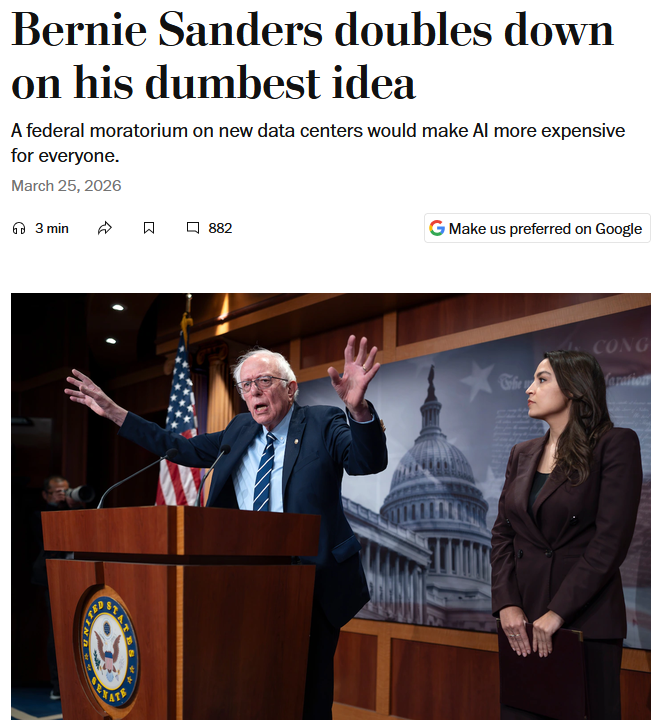
The Washington Post (3/25/26) calls Sen. Bernie Sanders “part of the lunatic fringe” because he wants “safeguards” on a technology whose developers routinely warn “could end humanity” (Nature, 4/21/26).
As grassroots fights against AI data centers spring up from coast to coast, opposition in the Senate is led by Sen. Bernie Sanders, who introduced a bill to place a two-year moratorium on the construction of new data centers.
Already a bête noire of the Post (FAIR.org, 3/8/16), Sanders’s critique of data centers has led to a renewed thrashing. In a March editorial (3/25/26) headlined “Bernie Sanders Doubles Down on His Dumbest Idea,” the Post placed Sanders at “the lunatic fringe” of society for “throwing sand into the gears of progress.” The editorial also called Sanders “the leading Luddite of the 2020s.”
Two weeks later, the Post (4/8/26) returned to the “L” word, this time in an editorial that didn’t mention Sanders, but did associate opposition to data centers with domestic terrorism:
The mob-like movement against data centers that’s been gaining traction across the country took a dark turn this week. Indianapolis Councilor Ron Gibson (D), who supports a project to build such a facility in his district, woke up early Monday to the sound of 13 gunshots fired at his home. The gunman left a note on the lawmaker’s doorstep: “NO DATA CENTERS.”
No one was injured, but the incident illustrates how opposition to artificial intelligence can metastasize into an irrational frenzy. It wouldn’t be the first time in history that deranged Luddites turn to violence to fight the advancement of frontier technology.
Later that month, the Post’s editorial page was back to attacking Sanders. Under a scowling picture of the senator, a Post editorial (4/30/26) charged that Sanders
is as naive now as he was during the Cold War. Rarely, if ever, has the socialist met an enemy of the United States who he doesn’t think he can partner with to advance his agenda. The same impulse that led Sanders to cozy up to the Soviets, the Sandinistas and Fidel Castro in the 1980s was on display again Wednesday night at the Capitol as he invited two Chinese academics to urge Americans to slow-roll our pursuit of artificial intelligence.
“Of course that’s what Beijing wants Washington to do,” the Post continued, in a brazen attempt to paint skepticism of AI data centers—a view held by most Americans—as anti-American.
The Post’s inflammatory editorial mentioned neither Bezos or Amazon, per usual.
The billionaire project
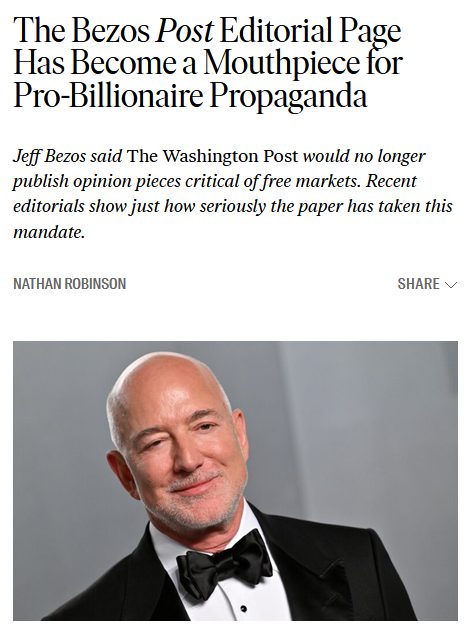
“It’s remarkable how brazen the paper is about shilling for the financial interests of its owner,” writes Nathan Robinson (The Nation, 4/21/26) . “Some of these headlines might as well read ‘Don’t Tax Jeff Bezos More,’ ‘Don’t Let Unions Threaten Jeff Bezos’ Control Over His Workers,’ ‘Don’t Stop Jeff Bezos From Building Data Centers in Your Town.’”
It’s not just Bezos’ financial interests that are advanced by O’Neal’s Opinions page, but also Bezos’ and his fellow billionaires’ broader ideological project (Real News Network, 5/22/26).
Under O’Neal’s watch, no tax on the wealthy seems to go uncensured. “The Post has weighed in on tax policy everywhere from Switzerland to Seattle, lambasting every attempt to reduce the grotesque inequality of our times,” Nathan Robinson wrote in a detailed review of the Post Opinions page for The Nation (4/21/26):
Almost no tax on the rich around the world escapes the paper’s notice—one might wonder why capital gains taxes in the Netherlands are a priority for a DC paper.
And no social program appears too small to earn O’Neal’s ire, not even diapers. In providing 400 free diapers to new parents, “California’s nanny state is taking infantilization to a new level,” decried a Post editorial (5/12/26).
Other recent Post editorials have “opposed minimum wage increases, tenant protections, social housing, rent control, free buses, caps on credit card interest rates, caps on the prices of staple foods, congestion pricing and even the Railway Safety Act,” wrote Robinson.
But when government largesse flows to the rich, the Post is more open minded. The Trump administration’s request for another $200 billion for the Iran War, as well as a $1.5 trillion Pentagon budget for next year, both received the Post’s blessing (3/21/26, 5/12/26). “Peace doesn’t come cheap,” the Post wrote.
Left unmentioned in the editorials is that Bezos’ empire—via his space company Blue Origin and Amazon’s cloud computing arm, AWS—holds billions of dollars worth of Pentagon contracts.
From FAIR via This RSS Feed.