

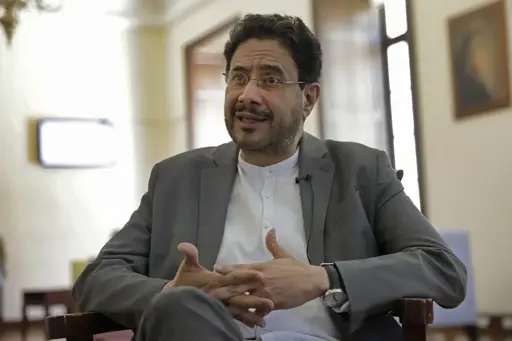
Senator Iván Cepeda warned that the security measures of President-elect Abelardo de la Espriella constitute a paramilitary government and threaten the Colombians rights .
On Wednesday, Colombian Senator Iván Cepeda criticized the first security measures announced by President-elect Abelardo de la Espriella, warning that they represent a threat to the rule of law and human rights in the country.
“Colombia is beginning to take the form of a paramilitary government,” the legislator from the Historical Pact stated in a declaration released on social media, after analyzing the president-elect’s platform.
Cepeda based his conclusion on three security initiatives proposed by De la Espriella: the creation of urban search blocs and first lines of securit made up of veterans and reservists of the Armed Forces; the reinstatement of the Mobile Anti-Disturbance Squadron (ESMAD); and the construction of private mega-prisons administered by a new prison corps also composed of reservists.
The former leftist presidential candidate argued that the creation of these security forces would delegate functions belonging to the public security forces to private individuals, thus breaking the constitutional monopoly on the use of force and reproducing historical patterns of paramilitarism.
“The result of the paramilitarism in Colombia history has never been more security, but rather more violence, more arbitrariness, and more impunity,” emphasized the Colombian leftist senator.
In this regard, Cepeda questioned the zero tolerance policy toward blockades and acts of vandalism, considering it a direct criminalization of social protest. He also rejected the intention to reinstate the ESMAD riot police unit, a force linked to serious human rights violations during previous administrations and renamed UNDEMO during Gustavo Petro’s presidency.
🙅♂️ La Organización de Funcionarios Civiles Penitenciarios (@OFUCIPE) se opone a la descentralización del Instituto Nacional de Rehabilitación tal cual está planteada en el proyecto de ley de Rendición de Cuentas y denuncia que aún no se llenaron las vacantes para el Instituto… pic.twitter.com/6fkNEawedy
— INFO CAPITAL (@InfoCapitalTV) July 7, 2026
The text reads, “The Organization of Civil Penitentiary Officials (@OFUCIPE) opposes the decentralization of the National Rehabilitation Institute as proposed in the Accountability Law bill and denounces that the vacancies for the National Rehabilitation Institute established in the National Budget Law have still not been filled.”
Regarding the prison system, he criticized the proposal to build ten mega-prisons with private sector participation, which in his opinion amounts to the privatization and paramilitarization of the penitentiary system and the National Penitentiary and Prison Institute (INPEC).
Cepeda also recalled the criminal complaint he filed weeks earlier against De la Espriella for alleged links to paramilitary organizations, maintaining that his program seeks to revive a model contrary to the Constitution. Therefore, he reiterated his call for peaceful civil disobedience in response to the announced policies.
Colombia: Left Candidate Accepts Electoral Defeat, Repudiates US Interference
Institutional Framework in the Transition ProcessThese statements come amidst the growing confrontation between the outgoing government and the incoming administration, which have made separate decisions regarding the power transition process in Colombia, which De la Espriella is scheduled to assume on August 7.
Espriella ordered the suspension of the transition process with the outgoing government of Gustavo Petro on Tuesday, July 7, in a new episode of political confrontation that strains the country’s institutions just days before he assumes office.
The newly elected president justified his decision by claiming it was to protect the country’s interests and guarantee a transition under conditions that, in his view, must be transparent and in accordance with the constitutional order, although he offered no concrete evidence to support his accusations against the outgoing administration. “My duty is to protect the interests of the Nation and guarantee a serious, transparent transition that serves Colombians, never to legitimize disaster or the disregard of the constitutional order,” he stated.
From the outgoing government, Gustavo Petro had assured that his administration would provide the required information in accordance with the law and proposed that the transition meetings be conducted transparently, even with the possibility of being broadcast publicly.
However, the relationship between the two teams deteriorated due to the president-elect’s allegations of last-minute appointments, expedited hiring, and administrative decisions that, according to his team, could compromise the next government’s administration. These accusations have not yet been supported by publicly available documentary evidence.
(teleSUR)
From Orinoco Tribune via This RSS Feed.