

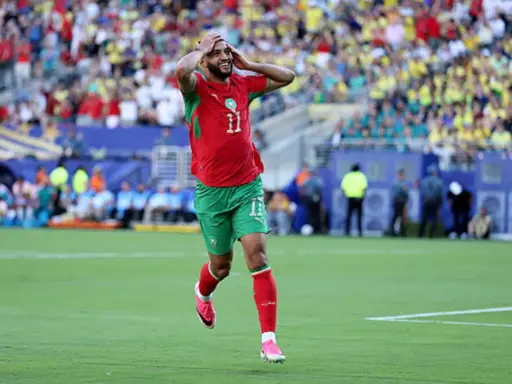
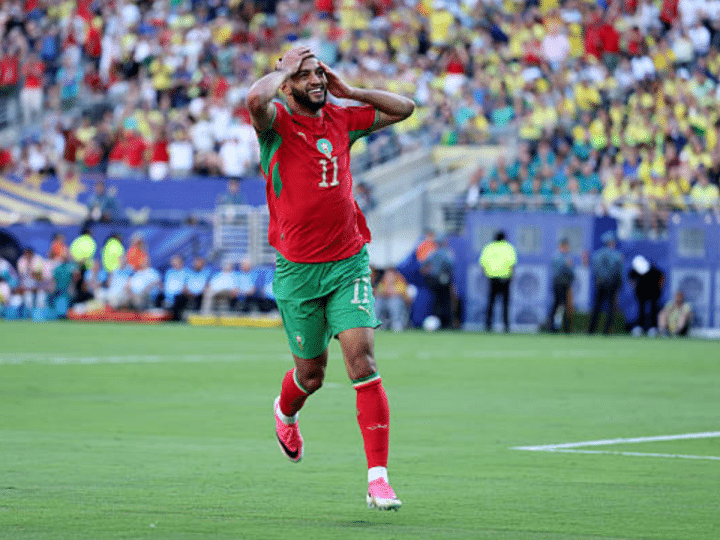
At World Cup tournaments, there are players who score goals, and there are players who create moments that remain etched in the tournament’s memory for decades. When it comes to Ismael Saibari, he has done both.
At the 2026 World Cup, the Moroccan international was not merely one of the tournament’s stars; he became the embodiment of one of the greatest individual achievements in the history of Arab and African football. Three goals propelled the “Lions of the Atlas” into the knockout stages and secured his place in the history books, as he became the first African player to score three goals in a single World Cup, and the first to find the net in three consecutive World Cup matches.
But this story did not begin in the United States, Canada or Mexico; it began many years earlier… when simply getting to a football pitch seemed like a distant dream.
When doctors doubted his future
Ismael Sibari was born in Spain to a Moroccan family who carried their connection to their homeland with them, but his childhood presented a greater challenge than any opponent he would later face on the pitch.
In his early years, he suffered from problems with his feet that caused doctors concern; some even went so far as to doubt his ability to play sport normally, let alone turn professional.
That was the first real test of his life, and between treatment and rehabilitation sessions, the Moroccan boy learnt that the path to his dreams was not determined by medical reports, but by willpower. He gradually regained his ability to walk, then returned to chasing the ball, as if he had been running ever since towards his rendezvous with history.
Talent alone does not make stars
Whilst his childhood battle had ended in victory over his illness, the start of his professional career presented a challenge no less difficult.
At the PSV Eindhoven academy, Sibari possessed everything a talented player needed, but he lacked the most important prerequisite f or success: physical fitness.
His excess weight nearly cost him his future, and warnings came thick and fast from the club’s coaches, who demanded he change his lifestyle if he wanted to remain part of the team’s plans; that was the turning point in his career.
He decided to take on the toughest challenge of his life: a battle with himself. He changed his eating habits, doubled his physical training, lost weight and completely reshaped his physique, transforming from a player at risk of losing his place into one of the best players in the Dutch league and one of the Moroccan talents most sought after by European clubs.
When the World Cup opened the doors to Bayern Munich
Within a few days of his performances in the World Cup, he went from being a player known only to fans of the Dutch league to a name dominating the headlines in European newspapers, with the biggest clubs vying to secure his future.
The question was no longer about the extent of his talent, but about which club would succeed in signing him.
The answer was not long in coming. Following his exceptional performance with Morocco, Bayern Munich secured one of the summer’s most high-profile signings, announcing the signing of Saibari after being convinced that the player who had captured the world’s attention at the World Cup possessed all the qualities needed to become a cornerstone of their new project.
His move to the Bavarian giants was not merely a reward for a successful tournament, but the culmination of a long journey that began with a child who was told that football might not be his future, continued with a player whose dream was nearly dashed by excess weight, and ended with a star taking centre stage on one of European football’s biggest stages.
For this reason, the story of Ismael Sibari cannot be summed up by three goals, nor by a major transfer deal, nor even the historic records he set at the World Cup; rather, it is the story of a player who overcame everything that might have prevented him from reaching his goal, until his name became part of World Cup history, a new face for the future of Moroccan football in Europe, and proof that the greatest victories are not forged in the moment the ball hits the net, but in the years that precede it.
Featured image via the Canary
By Alaa Shamali
From Canary via This RSS Feed.