


Nika Bartoo-Smith
Underscore Native News + ICT
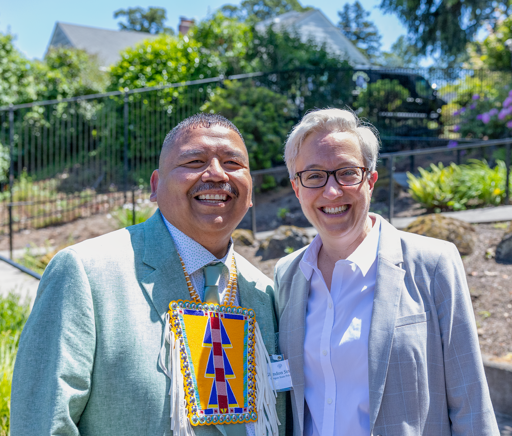
Oregon Gov. Tina Kotek presented Glendon Smith with a public service ambassador award for his work as tribal liaison for the Oregon State Police in May. Smith is the inaugural person in the role of tribal liaison for Oregon State Police, starting in 2023.
“It means that the work I’ve done at Oregon State Police has bridged some communication gaps between the nine tribes of Oregon and State Police,” Smith said, who is a citizen of the Confederated Tribes of the Warm Springs. “Before I came on board, there was no one here to do the work full time. Three years ago they passed legislation to hire someone, so here I am, and so it means a lot. It’s a great honor to have this recognition.”
Smith started in his role as the first tribal liaison for the Oregon State Police in June 2023. Prior to that, he worked for the Confederated Tribes of the Warm Springs for more than a decade holding roles including associate judge in tribal court and the secretary-treasurer and chief executive officer for tribal council.
He said that state police across the country should all have a tribal liaison position or department as a way for “tribes [to] have a person to directly communicate with and a point of contact who will understand their perspective.”
Though former Oregon Gov. John Kotzhaber passed an executive order in 1996 that mandated state agencies to communicate more routinely with Oregon tribes, no position dedicated to overseeing that government-to-government relationship existed until 2023, under Gov. Kotek.
“A lot of my background is government-to-government relations, so stepping into this job I’m really on the other end of the table from the tribes,” Smith said.
Having a background in tribal government and in the tribal courts means that Smith has an understanding of the complexities that are unique to working with three different sovereigns: tribal, state and federal, he said.
While serving as tribal liaison, Smith also earned a certificate in tribal relations from Portland State University.
A lot of his role centers on educating state troopers and other employees within Oregon State Police about working with Native nations.
Recently, he led a training about the difference between working with public law 83-280, or public law 280, tribes and those that are not PL-280, focusing on what authority state troopers have on tribal land.
Public law 280 was enacted by Congress in 1953 and requires certain states, including Oregon and Washington, to take over criminal jurisdiction and civil jurisdiction on tribal lands, allowing state law enforcement to operate on tribal lands without consent from the tribe. Recently, Oregon passed legislation establishing a clear process for retrocession of public law 280, which the Confederated Tribes of the Umatilla Indian Reservation requested in November.
Later in July, Smith is planning to lead a presentation on cultural repatriation as Oregon State Police has artifacts in evidence that need to be returned to Native nations, he said.
Smith said when it comes to the issue of Missing and Murdered Indigenous People, Oregon State Police works with other jurisdictions, such as the Portland Police Bureau, tribal police, and the federal government to address cases.
“[MMIP cases] are unique because Missing and Murdered Indigenous Persons is specific to Natives. We have a missing persons [page], but it’s kind of hard to balance because the state’s big on equity and inclusion too, so it needs to be fair to everybody,” Smith said. “I know some of the stigmatization that goes with missing and murdered Natives, they don’t get enough media attention, or public awareness, and so we try to do our best on putting notices out, working with agencies that do that, working with them, bringing more awareness for missing Natives.”
Smith said Washington state has a good program when it comes to addressing the crisis of Missing and Murdered Indigenous People and that it is on the radar in Oregon to create something similar, though he did not specify what or when that might be.
For now, Smith is the only person dedicated to facilitating government-to-government communication between Oregon State Patrol and the nine Native nations across the state.
“I’d have to hire one or two people to help do some of this work,” Smith told Underscore Native News + ICT when asked if there is a potential that his department would grow. “I have so much documents and records I’ve accumulated, and I need an administrator to maybe file some of this stuff.”
Much of the work that Smith assists on is coordinating with tribal police on cross jurisdictional issues such as fish and game, treaty rights, gaming, medical examination, cultural artifact discovery, highway patrol and Missing and Murdered Indigenous People, Smith told UNN + ICT.
“My goal is to better assist tribes where they need help,” Smith said. “I wouldn’t say I have any long-term goals, just that I want to see tribes get the help that they need, that and the resources that they don’t have, and make sure that we’re doing our best to help them.”
UNN + ICT reached out to the governor’s office for a comment.
This story is co-published by Underscore Native News and ICT, a news partnership that covers Indigenous communities in the Pacific Northwest.
The post First Oregon State Police tribal liaison ‘assist tribes where they need help’ appeared first on ICT.
From ICT via This RSS Feed.