

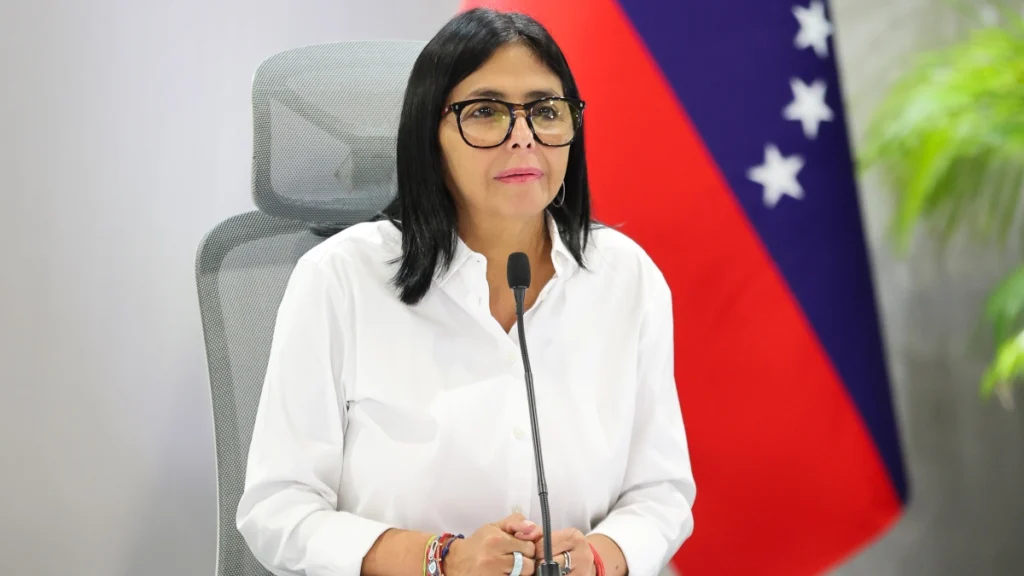
Venezuela’s Acting President Delcy Rodriguez initiated this Wednesday direct international procedures to recover over 2,000 million dollars in blocked gold to rebuild homes destroyed by the June 24 double earthquake.
During an official videoconference on July 8 with representatives managing 87 transitional camps, Venezuelan Acting President Delcy Rodríguez announced direct international legal and diplomatic procedures to rescue blocked resources belonging to the nation.
The government intends to redirect these financial assets immediately toward recovering from the severe damage caused by the double earthquake on June 24.
RELATED: Venezuela Ensures Unceasing Assistancefor Quake-Affected Families
The Acting President emphasized the urgency of recovering national patrimony to guarantee the social well-being of thousands of displaced citizens, confirming the dispatch of an official letter addressed to the King of England demanding the immediate release of national gold reserves currently retained by the Bank of England.
These sovereign assets, valued at approximately 2,000 million dollars, represent a crucial resource needed to address the tragic humanitarian consequences of the seismic disaster.
Ver esta publicación en Instagram
Una publicación compartida de teleSUR English (@telesurenglish)
Sovereign Gold Demanded
In addition to the petition sent to the British monarch, the acting president held a direct phone call with the managing director of the International Monetary Fund (IMF). During the conversation, Acting President Delcy Rodríguez urged the international financial institution to cooperate in unlocking Venezuelan funds to address the ongoing emergency. The executive administration reaffirmed that securing the safety, protection, and dignified relocation of every affected citizen remains the absolute priority of the Bolivarian Government.
The South American nation continues to face severe economic restrictions because of more than 1,000 unilateral coercive measures imposed by foreign powers.
Despite recent temporary licenses issued by the United States, critical state assets remain frozen in overseas bank accounts, directly hindering the state’s capacity to finance large-scale public infrastructure projects. In this sense, the Executive Power reiterated its call for an immediate end to the financial blockade, which severely limits the state’s ability to fund a complete national recovery.
Two Recovery Phases
To manage the crisis, the administration designed a strategic plan consisting of two recovery phases. The first immediate phase focuses on overcoming the acute humanitarian emergency and stabilizing the affected population. The subsequent second phase will guide the country toward sustainable socioeconomic development, ensuring stable employment, social protection, and high-quality education for children and youth in the reconstructed communities.
The operational coordination of the 87 transitional camps remains a combined effort between the national government, regional authorities, and communal organizations. The state is currently designing advanced, long-term housing models, including single-family and two-family residential units, under the Gran Misión Plan Venezuela Renace project. These safe structures will house citizens who suffered total property loss during the natural disaster, providing them with comprehensive social support and security.
During the virtual conference, the Venezuelan Acting President Rodriguez, explained that the South American nation formally petitioned specialized technical assistance from seismology experts in Japan, Chile and Mexico. This international cooperation aims to project new residential units under strict anti-seismic criteria to prevent future infrastructure failures in the country.
Official Emergency Balance
The President of the Staff for the Creation of Transitory Camps, Jorge Rodríguez, delivered the official balance covering the period from the June 24 disaster to July 8. According to this update, the double earthquake caused 3,811 deaths and left 16,740 people injured across the region.
Emergency rescue units have successfully extracted 462 citizens alive from the collapsed concrete structures. However, the seismic event has left 17,907 citizens homeless or facing severe damage to their primary residences, requiring immediate insertion into temporary state camps.
The physical damage to local infrastructure is substantial, with 856 buildings sustaining structural damage. Out of this total, 190 buildings completely collapsed during the main seismic movements, which has complicated the search operations in high-density urban areas.
International Relief Efforts
To assist the civilian population, the Government deployed 30,076 national officers, including members of the Armed Forces, police departments, firefighters and Civil Defense personnel. Furthermore, 4,388 international rescuers have arrived in the country to support the local efforts on the ground.
The humanitarian mobilization also relies on 28,992 registered volunteers organized into specialized brigades for rescue, relief distribution, and infrastructure evaluation, who are actively working in victim care and emergency support on the field.
State agencies have distributed 9,600 tons of food and 9,689,528 liters of water to the affected population. Since the initial double earthquake on June 24, seismologists have registered 1,102 aftershocks in the region, keeping rescue teams on high alert.
To address the mental health crisis resulting from the tragedy, authorities activated the toll-free line 0800-AYUDA-01 for psychological and psychiatric support. Furthermore, the Homeland System (Patria, in Spanish) is channeling direct economic assistance to workers who lost their employment due to the disaster.
Acting President Delcy Rodríguez urged the population to maintain hope and faith during this complex recovery phase, meanwhile she guaranteed that the state will sustain its presence in the ruined zones until every family receives a proper housing response.
From teleSUR English via This RSS Feed.