

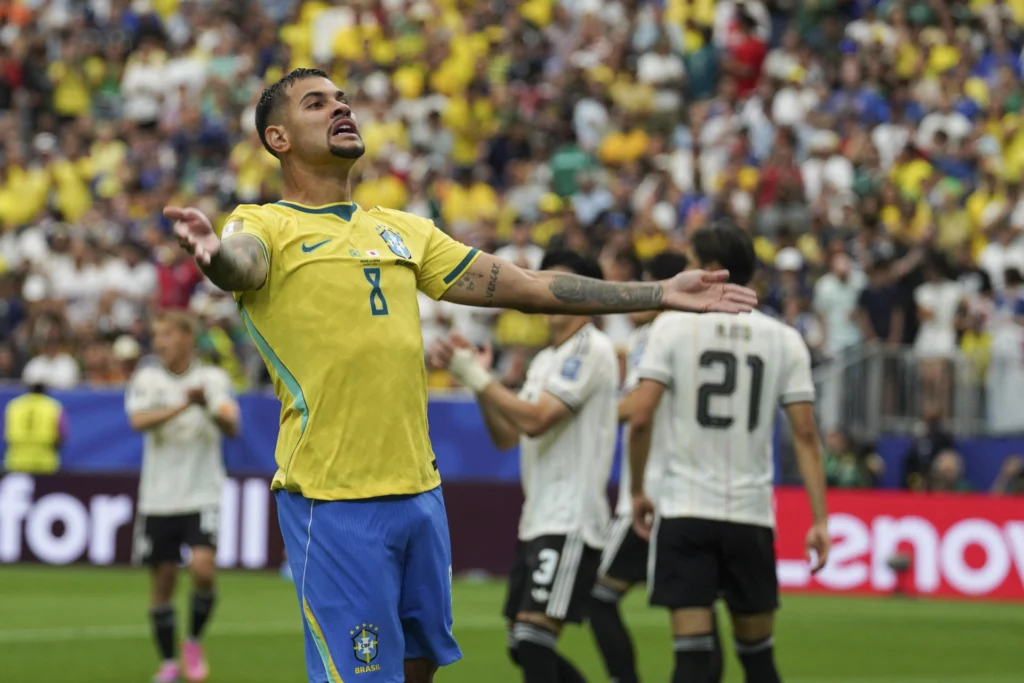
Why Brazil’s earliest World Cup exit in 36 years surprises few.
After years of waiting for a small lawsuit from a car accident to settle, I moved to Rio de Janeiro in 1991. I had never visited Brazil before, but I was not there as a tourist. As a young man, I had made a decision that I did not want to spend the rest of my life living in a country where you only got 2 weeks of vacation a year.
After a lot of informal research talking to fellow bellhops at the Palmer House in Chicago, mainly immigrants from all over the world, I decided on Rio de Janeiro.
RELATED: Trump Undermines 2026 World Cup’s Integrity
I arrived and, after blowing my small lawsuit settlement on restaurant food, drinks, and taxis in the first month, got a job teaching conversational English to business executives. There, I met a coworker from Sweden named Bo and we started having a few drinks together from time to time. One day I arrived at his apartment and he sent me up. He answered the door completely naked, in the Swedish tradition, and said, “I’m going to get ready in a few minutes. I just want to watch the end of the Flamengo game.”
“OK,” I said, “I have to admit that I’m not much of a fan of soccer, though.”
He looked shocked. “Fucking hell, Brian!” he said, “if you are seriously thinking of living in this country, you have to learn how to love football.” As the shock of sitting in the living room with a naked Swedish guy wore off, he began explaining the game to me. Bo was a former back who played professionally in the second division in England and first divisions in Sweden and Greece, whose career was cut short by a knee injury. He’d moved to Rio de Janeiro because of his psoriasis after doctors told him he needed to get more sunlight, deciding on Brazil because of its football tradition.
“Look how they move the ball up the field. The Brazilians’ problem is that they love the ball too much. A Brazilian will kick the ball four or five times before passing. If you watch the Germans play, for example, they will only kick the ball once or twice. Nevertheless, on any given year, any list of the world’s best players will be made up mostly of Brazilians. They are the best individual players in the world, and any time they get a manager who can get them to play together as a team, they win the World Cup.”
That Summer Bo made it a personal project to get me to love football. He took me to watch legendary midfielder Junior play football for fun in an amateur league, barefoot on Copacabana beach, to the delirium of the hundreds of fans who came out to cheer him on. Then, in an act that caused me to really fall in love with football, he invited me to the Brazilian championship finals in the cheap seats in Maracana stadium, where 168,000 people had come out to watch Junior lead Flamengo to victory over Botofogo in the last great game of his career.
Brazilian football was a lot different then. There was no wall separating rival fans, just hundreds of riot control military police standing in the aisles. We were in the Botofogo section near the dividing line between the two groups in solidarity with a Brazilian friend, and every time Flamengo scored, their entire fan section stood up, dancing and giving us the middle finger.
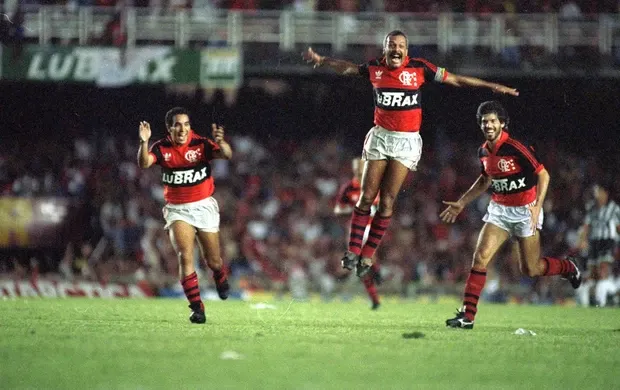
Junior jumps for joy after scoring a goal in the 1992 Brazilian championship final. I was there.
I was lucky enough to be live in Brazil for both the 1994 and 2002 World Cups, and being able to experience both of those victories on days when the entire country shut down, buses stopped running, and banks and schools closed, rank among the greatest experiences of my life.
For the first 15 years I lived in Brazil, it really did seem like Brazil always had the best individual players in the world and all it needed was a manager who could get them to play together as a team for them to win the World Cup. Then things started going awry. Here are a few things that I have observed during my decades living in Brazil that have contributed to the decline of football.
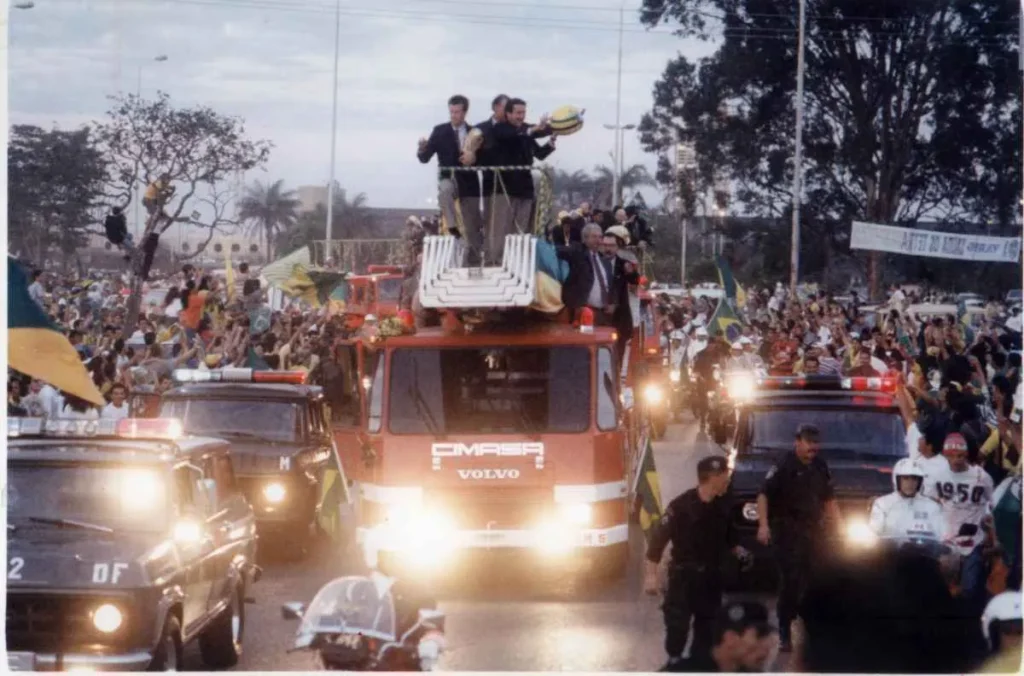
Huge crowd lines the streets in Recife, to great the returning 1994 World Cup champions
The Decline of Samba
Samba is a genre of Afro-Brazilian music that was first mentioned in the 1840s in Pernambuco that was modernized and urbanized in Rio de Janeiro in the 1920s through fusion of musical traditions of people who had migrated to the city from places like the coffee plantations in Minas Gerais and Sao Paulo and the towns and quilombos in the Sao Francisco river valley.
Over the years, it has branched out into different subgenres, and in 1991, when I first moved to Rio de Janeiro, two of its subgenres, Samba Canção and Pagode, were among the most popular forms of music. Brazilian football developed hand in hand with samba. As anyone who has ever been to a football match in Brazil knows, all of the organized fan groups have their own samba drum groups that beat out syncopated polyrhythms during entire games. It’s no exaggeration to say that Brazil’s unique flair for dribbling is closely related to samba dance steps.
In the 90s, if a player was a good dribbler, people would say he had samba no pe (samba foot). In the late 90s, a new form of romantic pagode pushed traditional samba off the radio. Developed in Sao Paulo, it was based on a simplified rhythm that removed half of the percussion instruments, and the poetic themes full of double entendres that once taught young people how to survive in the favelas and exalted Afro-Brazilian gods and goddesses gave way to sappy ballads of guys whining for their ex-girlfriends to return.
Meanwhile, as U.S.-style evangelical prosperity gospel churches sprung up in Rio’s favelas, samba gave way to Brazilian funk that exalted consumerism and double entendre-free descriptions of sex. In the rest of Brazil’s poor areas, sertanejo, once an interesting regional form of folk music, was fused with American country music. I’ve never heard anyone describe a footballer as having sertanejo foot or funk foot. Whatever one may think of those genres, their dances haven’t translated to any kind of fancy footwork on the football pitch.
As for samba, it has undergone a similar process to what happened with Jazz in the U.S. Although romantic Sao Paulo pop pagode is still capable of generating hit records, the rest of samba lives on as a niche genre primarily played by middle class music nerds.
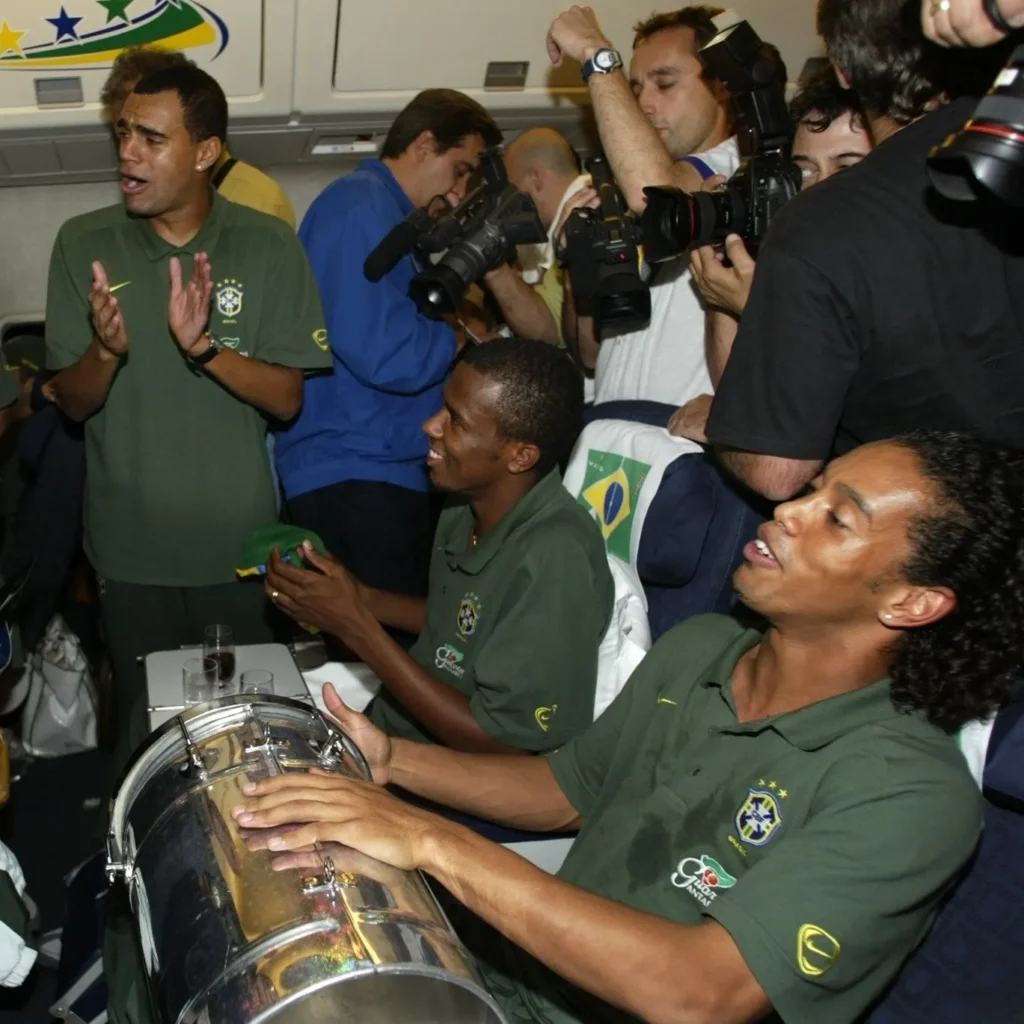
Samba foot: Ronaldinho Gaucho didn’t just incorporate samba dance moves into his dribbling style, he led samba jam sessions between matches during the 2002 World Cup. Today’s players seem to prefer dour gospel pop and syrupy sertanejo
The Rise of Prosperity Churches
As I wrote in 2014 for Vice Brasil, Rio de Janeiro’s drug trafficking gangs were evangelized and began a policy of kicking out any type of manifestation of Afro-Brazilian religion and culture from the favelas in favor of money laundering Funk parties. As a former leader of the Comand Vermelho I interviewed for a my article told me, to evangelical Christians, funk is acceptable because it represents the devil, which is something you can repent.
Samba, Jongo, Capoeira and other traditions represent an alternative religious belief system were things that evangelicals needed to destroy. Whereas it is true that there were a few evangelical Christians on the 1994 and 2002 World Cup teams, most weren’t explicitly connected to prosperity gospel churches. This started with Kaka and Robinho, whose family belonged to the same prosperity gospel Church as Neymar. Neymar followed and has been a huge influence on the current generation of players.
The 2026 squad only has one non-evangelical in the starting lineup. Keeper Alisson regularly baptises other footballers into his prosperity gospel church in the swimming pool behind his Liverpool mansion. Prosperity gospel indoctrinates its followers into believing that all of the success and failure in their lives is the result of an individual relationship with God, as opposed to traditional Catholic and Afro-Brazilian values of the importance of working with others to improve the World. This has resulted in narcissistic players who believe they are famous because they are more special than commoners, more holy than lesser players.
It’s not very good for teamwork and this was exemplified by Neymar’s individualist histrionics when he came onto the pitch after the mandatory corporate advertising break in the second half of the game against Norway.
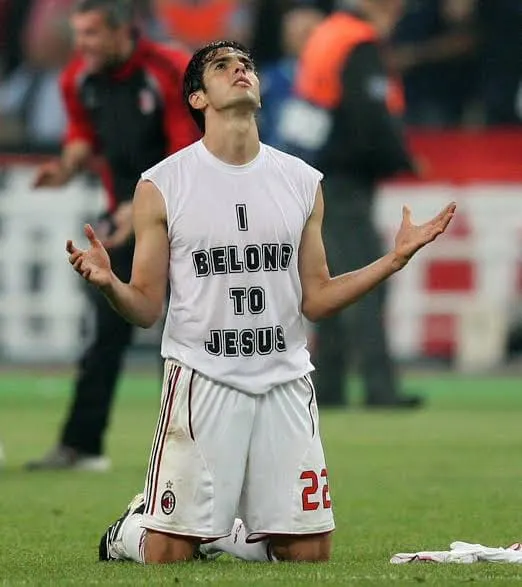
Kaká, a fine club player but huge disappointment for the Seleção, celebrates a goal for Jesus against Brazil’s rich Afro-Brazilian religious and cultural traditions
Child Trafficking
Before the 1990s, it was rare for Brazilians to ever play in Europe. When they did, they were often forgotten about back home and ended up not being selected for the national team. Up to that point, the level of club play in Brazil and Argentina was as good or better than that of the top teams in Europe, as the results of 70 years of confrontations between top South American and European teams proved. This can be exemplified by the fact that nearly all of the players on Brazil’s first 3 World Cup championship teams, including 1970, widely known as the greatest team of all time, played for South American clubs.
This began to change in the 1990s as the inflation crisis caused a series of successive currency collapses in Brazil and more money began pumping into the sport. Now, after 5 or 6 years proving themselves in the still top level Brazilian first division, players would move to Europe for a few years to make money. At this moment, the Dutch first division, which was still capable of competing with other top European divisions, became an incubator for some of Brazil’s best players.
Romario and Ronaldo both played at PSV Eindhoven before moving to higher paying contracts in La Liga. As the years progressed, wealthy European teams started importing younger and younger players. Felipe Coutinho was sold to Inter at age 16 after playing in a handful of first division matches for Vasco da Gama. When he cropped up years later on the Selecao, few people in Brazil, where only the middle class had the money to watch European club leagues on satellite TV, even remembered who he was. Alexandre Pato is another player who was sold to Europe at age 16 after playing one professional game with Internacional de Porto Alegre. For these two high profile examples, there are dozens more of players going straight from Brazil’s 3rd division to top level European teams as teenagers.
For all the success stories, there are many more cases of talented players who were ruined in Europe. Robinho was the most talented right winger in Brazil when he landed his contract with Real Madrid. He was a great passer and his nickname was the King of the Dribble. Some Brazilian sports writers compared him to Garrincha. The problem is that they already had an even better guy in the same position on his team, Cristiano Ronaldo. This prompted the manager to move him to striker. He was a better than average striker but never reached his full potential because he simply had a weak shot.
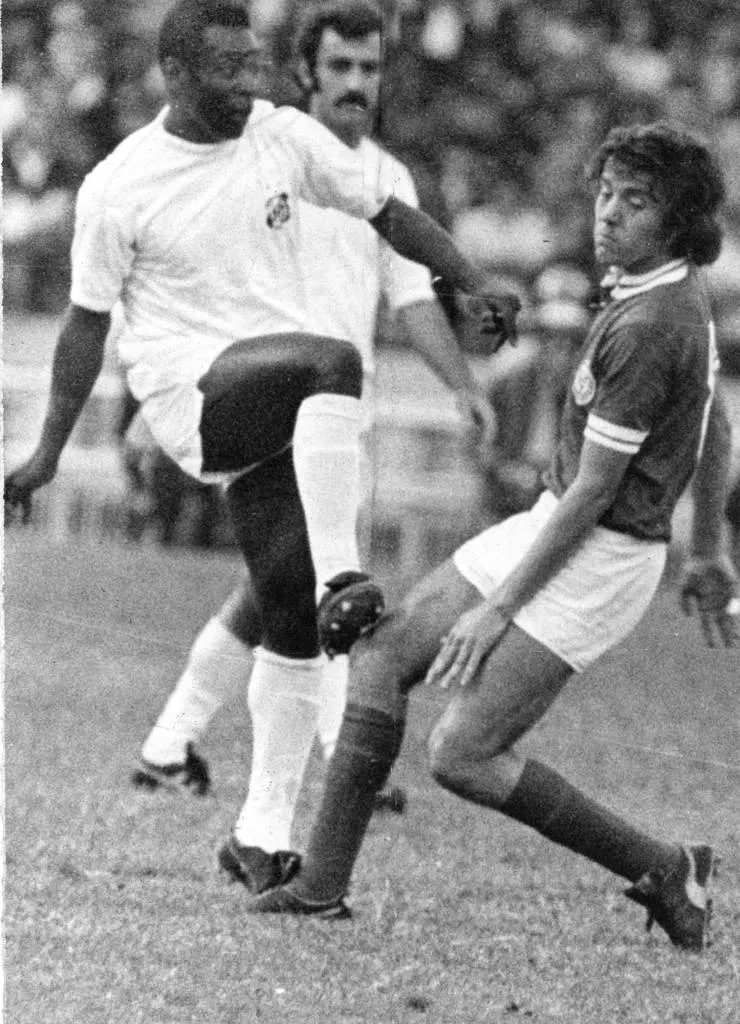
June 26, 1959: Led by Pelé, Brazilian club team Santos beat Inter de Milan 7×1 in one of its many routs of top-ranked club teams during a European tour
There is a long list of Brazilian players who didn’t have the benefit of incubating at a Dutch team, as that league began to collapse in the 2000s, made ill informed decisions to go straight to top level teams, and saw their careers fizzle. When the best players move abroad young, they are forced to unlearn their traditional Brazilian skills and fit into European tactical formations which reward mathematical precision and athleticism more than creativity on the pitch. It also causes them to lose touch with Brazilian fans, especially kids. Contrary to what a lot of people in Europe assume, the vast majority of Brazilian fans do not watch European football. The Libertadores Cup has higher ratings than the Champions League, which is rarely even broadcast on open air TV in Brazil.
For the last 16 years, I’ve watched my Brazilian friends scramble to figure out who the Selecao players even are the day after the managers announce the teams. Very few people in Brazil knew who David Luiz and Roberto Firmino were when they joined the team, for example. I only knew who Felipe Coutinho was because, as a Vasco fan, I remember thinking, ‘why are they putting a 16 year old on the pitch’? The siphoning off of Brazil’s finest talent reached such a crisis point that the federal government had to step in, enacting a new law banning players under the age of 18 from playing professionally in Europe. This meant that, for example, Vini Jr. signed his contract with Barcelona at age 16 but was only able to move there after his 18th birthday. I believe that the age limit should be increased to 21.
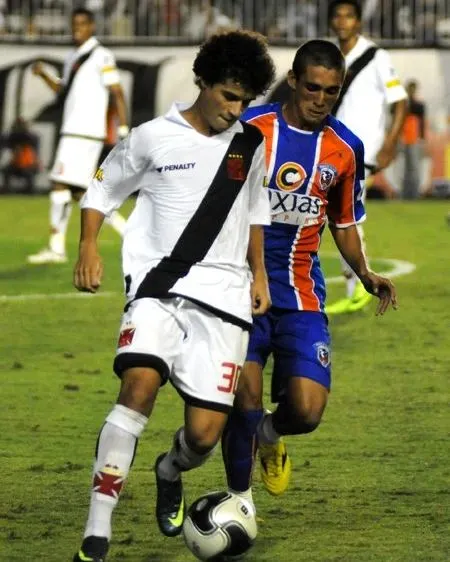
Playing 16-year-old Philippe Coutinho with the big boys and nickaming him, “the Little Prince” certainly helped increase his transfer fee
Brazil’s Inferiority Complex with Europe: the Stray Dog Complex
The morning after Brazil was eliminated in its earliest exit from the World Cup in 36 years, Peruvian football historian Jaime Pulgar Vidal wrote, “Brazil has spent years trying to overcome a supposed inferiority complex with Europe by attempting to Europeanize its football. Managers are obsessed with tactics, players are trained from adolescence forward in Europe, they focus on defensive transition, blocking, intensity, and rational occupation of space. The problem is that when the team does this it can’t compete with European teams precisely at what they know how to do best. Brazil has lost its identity, its essence.”
This inferiority complex is epitomized by the CBF’s decision to hire the first foreign manager in Brazilian history, Carlo Ancelotti. I’ve spent the last 2 years reading in local sports press that the reason Brazil was losing so many friendlies and qualifying matches was because Ancelotti was a genius who was playing 5D chess, allowing the team to lose because he was testing out different lineups and tactics in the lead up to the Cup. When Brazil barely qualified, it was just typical Ancelotti, I was told. He was the best manager in the world and one of his tactics was to always squeak by until his team won a tournament. I also heard this excuse after Brazil’s lackluster tie against Morocco in the opener.
All of my doubts about Ancelotti were put to rest in Brazil’s final match against Norway, when he made two huge errors that contributed to Brazil’s earliest elimination from the World Cup since 1990, when a member of Argentina’s support staff gave Branco water doped with sedativesin the match that caused their early exit. After Brazil was awarded a penalty in the first half, Bruno Guimarães was chosen over Vini Jr. to shoot it. Visibly nervous, his weak shot was easily defended by Norwegian keeper Ørjan Nyland.
After the game, it came out that Ancelotti’s ‘brilliant’ tactical decision to designate Guimarães to shoot the penalty was the result of a mathematical calculation based on the grand total of 3 shots taken in his history with the Seleção. The second huge error was playing Neymar, who hadn’t had a good game in 4 years before he was called in at a moment when the score was 0x0. Gravitating towards the center, an old and slow Neymar pushed Brazil’s two biggest scoring threats, Endrick and Vini Jr., to the sides of the pitch. Soon, Norway was up 2×0.
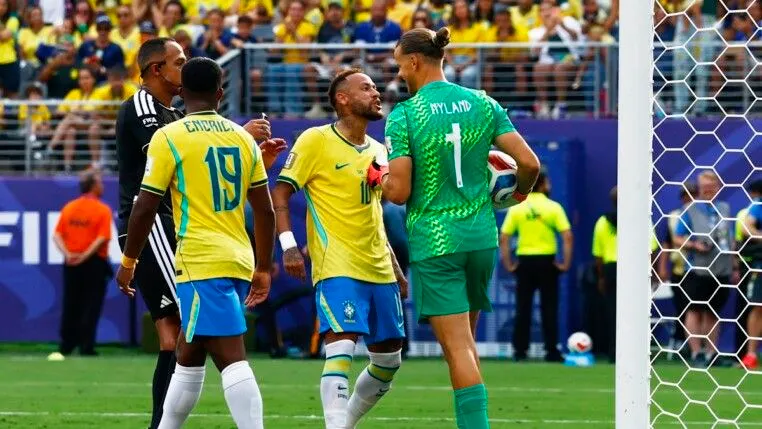
The game was tied 0x0 when Ancelotti made the ‘genius’ move of bringing on an over-the-hill Neymar
When Ancelotti was first announced as the new manager in 2023, President Lula, who was a fine amateur player in his day and had a lifelong friendship with football legend Socrates, said, “If he’s such a great manager, how come he’s never been able to fix Italy? It’s easy to coach a team when you have 11 starters who all play for their national teams. I’d like to see him try to manage a team like Corinthians.”
The fact is that managing a national team, which Ancelotti tried for the first time in this Cup, requires different skills from managing a club team, where one has the benefit of much more time to practice tactical formations and set plays. With the hugely diminished practice time allowed for national teams, leadership becomes one of the most important attributes. It’s hard to imagine how effective leadership can be conducted by someone who has little familiarity with the culture of his players.
In 1994, Carlos Alberto Perreira did interesting things with tactics, but, having a good understanding of his own leadership weaknesses, he brought in the first man to ever play on and manage World Cup champion teams, Mário Zagallo, as advisor and technical coordinator. In 2002, Luiz Scolari may have had a relatively easy task managing the greatest talent pool since the 1970 World Cup, but his leadership strategy of acting like a friendly Dad figure to his player ‘children’, was praised at the time.
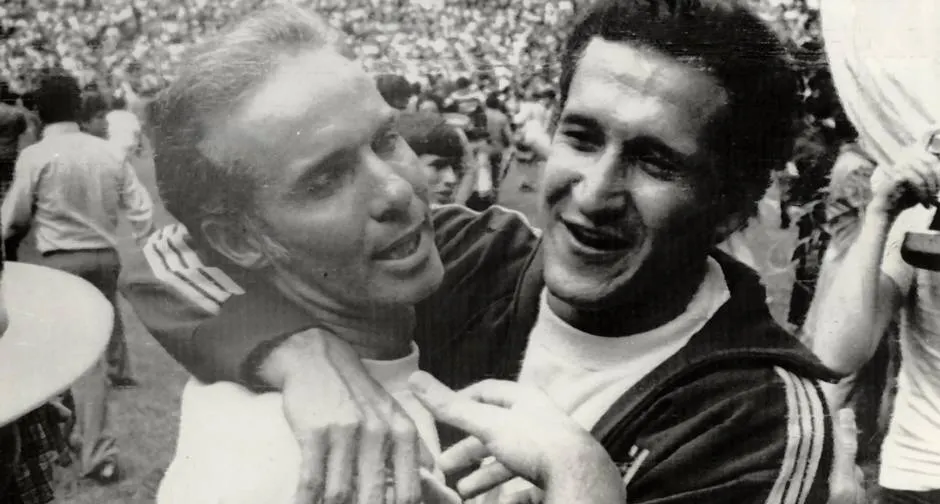
Zagalo (l) and Perreira ® – a decades-long professional relationship and friendship formed during Brazil’s victorious 1970 World Cup run
Ancelotti appears to have ignored the cultural differences between Brazil and Europe. He hired his own son, a clear case of nepotism, and most of his staff were Europeans who didn’t seem to speak Portuguese. I find it hard to believe that he lost all of those friendlies and qualifying matches on purpose as part of a 5D chess strategy, but if that was really the case, how did he counteract the lack of confidence that that must have instilled in his players?
The bottom line is that Brazil has never had a shortage of talented managers. As I have laid out in the preceding text, the problems with Brazilian football today go far deeper than anything that could be fixed with the band aid of paying R$5 million/month for a celebrity manager.
Final Thought: Brazil Needs Craques
Legendary 1970 World Cup star, sports physiologist, and football writer Tostão defined what he viewed as the main problem with Brazilian football after Brazil was eliminated from the World Cup in 2010.
Brazil, he wrote, was no longer producing craques. A craque is a mythological figure in Brazilian football who isn’t just one of the best in the world in his position, he brings an element of creative magic into the game.
A craque is someone who defies logic, like Garrincha, who was diagnosed by doctors as not being physically able to play football because of his partially crippled leg, who went on to perform 4 of the top 5 highest numbers of dribbles per game in World Cup history.
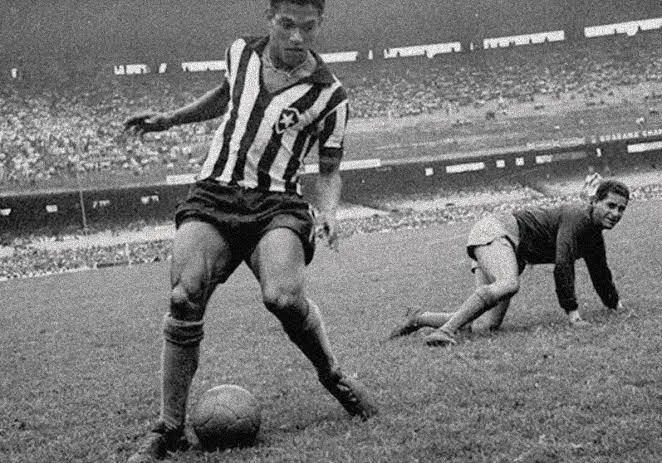
Doctors said he would never play football. The team psychiatrist recommended he stay on the bench. Then, in the first 2 minutes of Brazil’s group stage match against the USSR in 1958, Manuel Garrincha left 4 USSR defenders on the ground, to the laughter of the crowd
According to Tostão, a player could be one of the best in the world in his position and still not be a craque. Cafu, he wrote, was the world’s best right back for years, but was not a craque. The reason? He was unable to make a long pass curving around a defender into the feet of a teammate while running full speed up the pitch.
“Brazil is no longer producing craques,” he wrote in 2011. “Some people say Neymar might develop into one, but the word is still out on that.” Tostão cited lack of investment by clubs in youth development in favor of selling young players off to Europe for a quick buck as reasons it would be a long time before Brazil developed another craque. Unfortunately, his prophecy has come to be. There were no craques on Brazil’s Seleção in 2026. Maybe next time.
From teleSUR English via This RSS Feed.