

It will study billions of galaxies, dark energy, and exoplanets.
On Wednesday, the National Aeronautics and Space Administration (NASA) announced that the Nancy Grace Roman Space Telescope, with a field of view at least 100 times greater than that of the Hubble Space Telescope, will be launched aboard a SpaceX rocket no earlier than Aug. 30.
RELATED:
NASA to Send Four Missions to the Moon
The approximately 8,200-kilogram observatory will be able to study billions of galaxies, investigate dark energy and discover thousands of exoplanets thanks to its wide field of view.
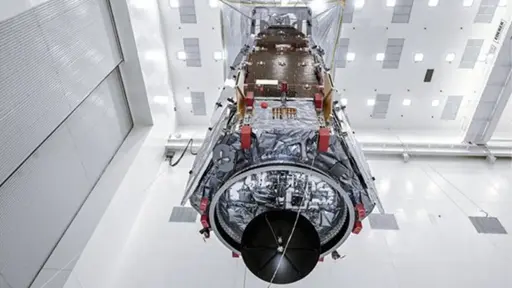
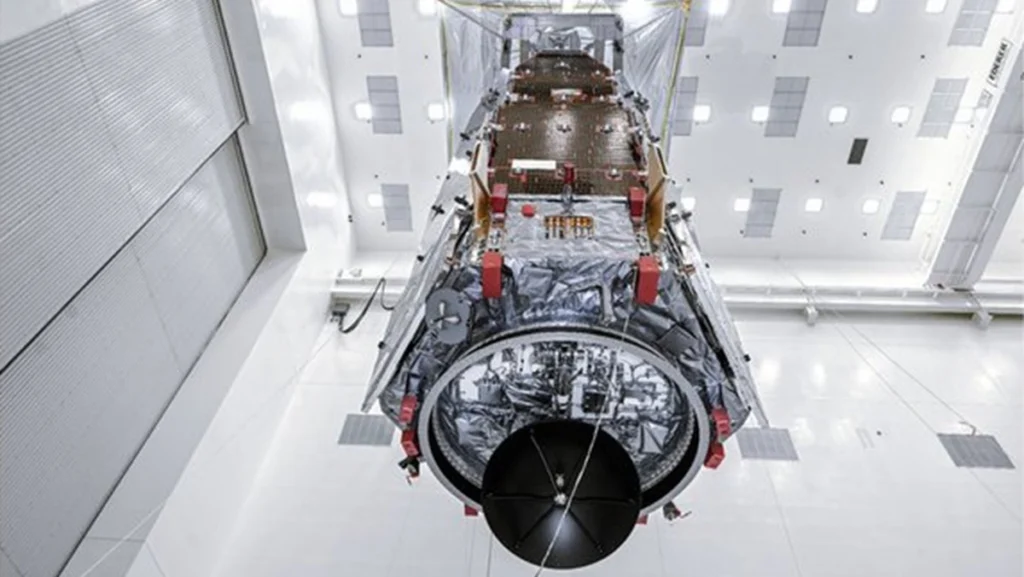
The telescope arrived at the Kennedy Space Center in Florida on June 21 from NASA’s Goddard Space Flight Center in Maryland, where it was assembled and tested.
After being moved to a clean preparation room, technicians placed it in a vertical position on June 25 and began final testing before liftoff.
NASA estimates that over its operational lifetime, the telescope, measuring about 12.7 meters (41.7 feet) long and 4.4 meters (14.4 feet) wide once deployed, could measure the light from 1 billion galaxies.
Today’s Space News Bulletin – NASA’s Swift Telescope rescue mission, the upcoming launch of the Nancy Grace Roman Space Telescope, Euclid’s record-breaking Milky Way image, advances in commercial satellite servicing, and the ongoing search for Earth-like planets.#dss @SIA_Ind pic.twitter.com/4UfKbqsqBh
— MERI Group Of Institutions (@meri_college) July 6, 2026
The mission will investigate dark matter and dark energy, two of the greatest mysteries in cosmology. To accomplish this, it will carry two instruments: a 288-megapixel wide-field camera and a coronagraph capable of capturing direct images of exoplanets, worlds located beyond the solar system.
Its 2.4-meter (7.9-foot) primary mirror is the same size as Hubble’s, but weighs 80% less, an advance NASA presents as an example of new telescope technology.
The Roman telescope will operate for at least five years in orbit around the Sun-Earth L2 Lagrange point, located about 1.5 million kilometers (932,000 miles) from Earth, where the gravitational forces of the Sun and Earth balance to create a highly stable region that allows space telescopes to remain in orbit with minimal fuel consumption.
NASA will make all of its data publicly available for astronomers around the world. The telescope honors Nancy Grace Roman, NASA’s first chief of astronomy, whom the agency describes as “the mother of the Hubble Space Telescope” for her determination to bring that project to fruition.
teleSUR/ JF
Sources: NASA – EFE
From teleSUR English via This RSS Feed.