


By RICHARD WESLEY
Standing on the steps of the U.S. Capitol Building on July 1, 2026, Major Jason Watson, USAF, spoke out in defiance of the Department of Defense and the UCMJ (Uniform Code of Military Justice) calling for the “impeachment, conviction, and removal” from office of the president, vice president, and other administration officials for violating the Constitution.
Major Watson prefaced his criticisms by citing the oath he took to protect and defend the Constitution of the United States from all enemies, both foreign and domestic. He accused President Trump and Vice President Vance of actions that violated the same oath of office they had taken. In particular, he said, he regards their actions taken against the sovereignty of Venezuela and Iran without first seeking a declaration of war from Congress, which is stipulated in the Constitution, as illegal acts, worthy to be considered “high crimes and misdemeanors.”
Major Watson also cited the administration’s policies being carried out by the Department of Homeland Security as violations of the rights accorded citizens in the Bill of Rights. For his protest while in uniform, Maj. Watson could face charges leading to dismissal, just three years before his retirement, or even more seriously, trial by court martial.
This event followed an earlier demonstration in the Capitol rotunda of veterans and family members on April 20. Approximately 60 veterans of the Viet Nam, Iraq, and Afghanistan conflicts were arrested for their protest of the war in Iran.
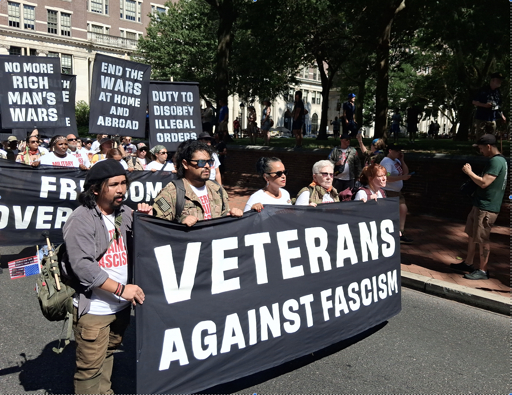
Subsequent to Maj. Watson’s arrest, the Fourth of July observance in Philadelphia was the scene of a rally and march by hundreds of veterans and families under the banner of “Freedom Over Fascism.” Possibly inspired by Major Watson, banners also declared, “Conscience Takes Courage.” The vets’ contingent joined a larger march of about 1200 antiwar and social justice protesters. It started in Washington Square, site of the Tomb of the Unknown Revolutionary War Soldier, and wound through the streets of the city, passing historic landmarks such as Independence Hall.
The veterans came to Philadelphia from around the country. Most of them were mobilized and represented by About Face, Veterans for Peace, the Center on Conscience and War, 50501 Vets, Military Families Speak Out, Common Defense, the Chamberlain Network, and the Fayetteville Resistance Coalition. These organizations work together within a coalition called Veterans Against Fascism. The contingent is said to have been the largest organized resistance of service members since the Vietnam War.
One of the speakers at the rally was Rebecca Roberts, who resigned her commission over the genocide in Gaza. She said, “Military resistance is the only guardrail against fascism.”
Another veteran, from Tacoma, Wash., Aran Myracle, observed, “Veterans in the United States have outsized credibility. It’s important that we use that undeserved privilege to do the crucial work of dismantling the systems that sent us to die for the ruling class’s profits. It’s also the only real tangible way I’ve personally found to cope with moral injury.”
These recent actions prove that, contrary to popular opinion, not all veterans are supportive of military aggression against foreign nations. Those who have seen the wanton killing and destruction of war very often see its pointlessness. Exposure to the death and horrors wrought by war frequently result in trauma from which they may never recover. The thrill of a “noble cause” can quickly turn into a struggle to survive its ugliness.
There is a long history of military resistance in the 20th century, from the “Christmas Truce” of World War I to the resistance documented in “Sir, No Sir,” a film that tells the story of tactics such as “search and hide” and the fragging of officers and senior NCOs. An additional resource is David Cortright’s work, “Soldiers in Revolt: GI Resistance During the Vietnam War,” 2nd ed. (Chicago: Haymarket Books, 2005). The Winter Soldier Investigation of 1971 was a highly publicized event featuring testimony by over 125 military veterans of war crimes they had seen or committed during their deployments to Southeast Asia.
It should be recalled that the draft was a leading cause of unrest among the ranks in Vietnam, as well as the engine for driving resistance among young men, women, and their families at home. With this in mind, we should be aware that, in December, the Selective Service will begin to automatically register young men between 18 and 25, without their consent. Until then, as before, SS registration is required, but individuals have to initiate the process.
There was always the possibility for a registrant to declare their intention to become a conscientious objector. After December, however, that intention can only be expressed if a draft order is activated, and the individual receives a notice to report to duty. It will then be much more difficult to become a CO.
Cortright’s book chronicles the erosion of discipline in the military. By the end of the Vietnam War, the enlisted ranks could no longer be counted on to obey the chain of command. Entire units frequently refused to obey commands. After massive antiwar sentiment had been built at home, the Vietnam debacle ended with over 55,000 U.S. military dead and many more physically and emotionally disabled. We will likely see a repetition of this chapter in the event of an activated draft.
Photo: Veterans and family members march past Independence Square in Philadelphia on July 4. (John Leslie / Workers’ Voice)
The post Military veterans demand: ‘End the wars at home and abroad’ first appeared on Workers’ Voice/La Voz de los Trabajadores.
From Workers’ Voice/La Voz de los Trabajadores via This RSS Feed.