



Wikimedia Commons // Paul Goyette
Erin In The Morning is a reader-supported publication. To receive new posts and support my work, consider becoming a subscriber.
Governor Pritzker rounded out Pride Month by signing a trio of bills that will protect transgender people’s privacy from out-of-state attacks—most notably, by removing testosterone from the list of prescriptions required by law to be added to a government database.
“The work will continue until all Illinoisans are safe, healthy, and free to express their truest selves,” said Governor JB Pritzker in a June 28 press release.
The Illinois Prescription Monitoring Program (ILPMP) is a longstanding interstate database that enables health care providers to track the prescription of certain substances, in order to curb drug abuse. Transgender people are often prescribed testosterone for hormone replacement therapy—it is most notably associated with trans men, but it may also be prescribed to any trans person who receives gender-affirming surgery impacting their hormone production.
The bill, HB 4834, also preemptively banned adding certain drugs to the program in the future—such as estrogen or mifepristone and misoprostol, a pair of medications used for at-home abortions.
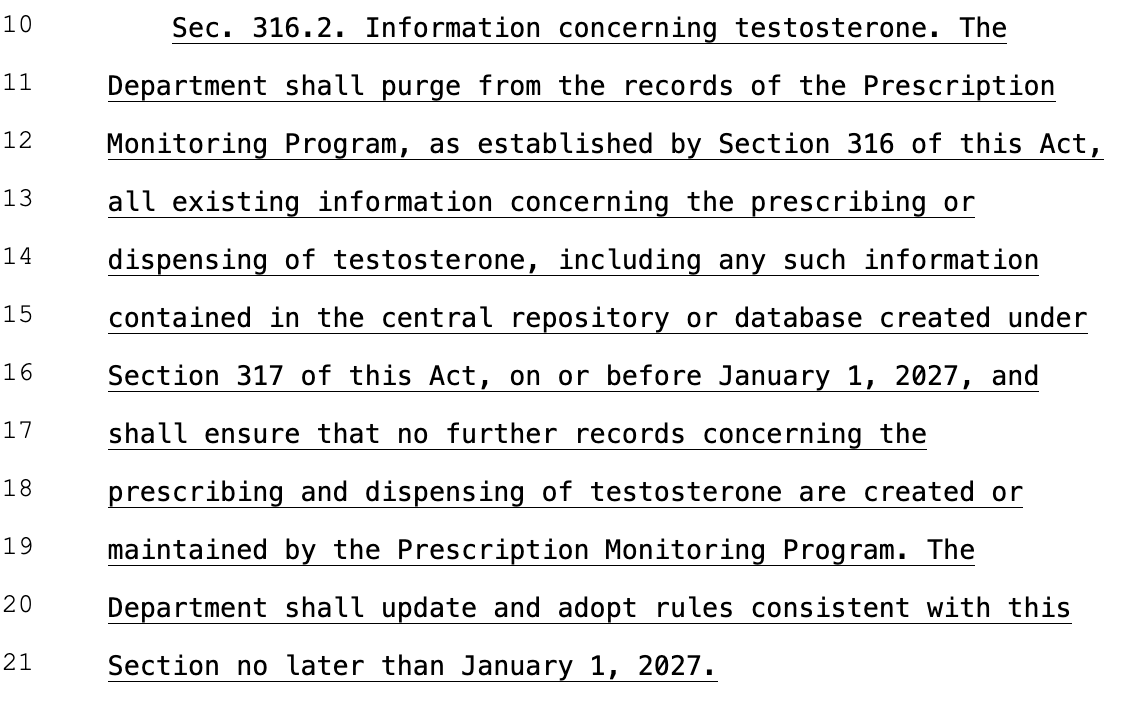
EXCERPT FROM HB 4834
Policies like this “protect trans people from invasive surveillance over their health care,” Alejandra Caraballo, a Harvard law instructor and privacy expert, told Erin in the Morning. In a 2025 report she penned for this newsletter, she explained how similar systems, called Prescription Drug Monitoring Programs (PDMPs), could be exploited to carry out anti-trans attacks.
“The database enabling this crackdown was never billed as a tool for political persecution,” she wrote. “PDMPs were originally established in the 2000s to combat the opioid epidemic and ‘doctor shopping’ for narcotics. Every U.S. state and territory now maintains a PDMP—an electronic registry of controlled substance prescriptions, typically Schedules II through V, that doctors and pharmacies are required to report.”
The ubiquity of this system means it could give bad actors from other states access to someone’s personal medical records, even without a warrant from the state where this care was rendered.
The signing of the law comes as a response to increased efforts by the federal government and red states across the country to reach into trans-friendly jurisdictions to prosecute providers. However, there are currently no public reports of a transgender person or a health care provider being successfully, directly prosecuted with information from a PDMP simply for providing, receiving, or being the parent of someone receiving gender-affirming care.
Hospital systems have comparatively faced more blowback from the Trump Administration, but it’s still important to remember they, too, have managed to avoid any sort of criminal convictions simply for offering gender-affirming care.
But that hasn’t stopped the Trump Administration from antagonizing them anyway, underscoring the importance of laws like this around the country as a protective measure. For example, NYU Langone received a criminal subpoena from the Northern District of Texas, a federal court, demanding information about trans youth care. The move is widely considered to be an act of judge-shopping from the Department of Justice; this district court, though thousands of miles away from New York City, is considered among the most conservative in the country.
It has continued to hang over the heads of trans people and their doctors everywhere.
“No one should fear being monitored or tracked for receiving hormone replacement therapy prescribed by their healthcare provider,” said Illinois State Senator Adriane Johnson, a Democrat. “Protecting medical information is essential to ensuring patients feel safe seeking care, asking questions, and making personal health care decisions.”
Cisgender men and cisgender women may also be prescribed the hormone for anything from cancer treatments to menopause symptom relief. Compared to other hormones associated with gender-affirming care (such as estrogen, progesterone, or spironolactone), testosterone access is especially scrutinized because it’s also heavily associated with drug abuse among cisgender athletes.
It’s also not the only protective law Pritzker signed that day. HB 5492 expands access to hormone therapy by mandating insurance companies cover up to a six-month supply of prescription hormone therapy when a pharmacist or health care provider deems it appropriate.
“In a time when gender affirming care is under constant attack by the federal government, dispensing prescriptions in bulk will give patients from Illinois and others traveling from out of state for care the assurance that they will have access to needed medications,” Pritzker’s press release says.
There was also HB 5095. This takes existing policy by Illinois’ Secretary of State, which makes it easier for people to choose their preferred gender marker on state IDs, and codifies it into law—making it a more permanent fixture, rather than a rule that can be changed on a whim by the next gubernatorial administration.
“Across the country, lawmakers are attempting to strip rights, erase identities, and target our most vulnerable community members,” said Channyn Lynne Parker, CEO of Equality Illinois.
“But here in Illinois, we are fighting back and winning,” Parker continued. “HB5095 preserves gender markers on state IDs; HB5492 expands access to hormone therapy; and HB4834 shields our most private medical information from surveillance. These are not small victories. They are a declaration that in this state, LGBTQ+ lives matter.”
HB 4834 went into effect upon Pritzker’s signing, and agencies have until the new year to transition to compliance. The other two laws will take effect on January 1, 2027.
Erin In The Morning is a reader-supported publication. To receive new posts and support my work, consider becoming a subscriber.
From Erin In The Morning via This RSS Feed.