

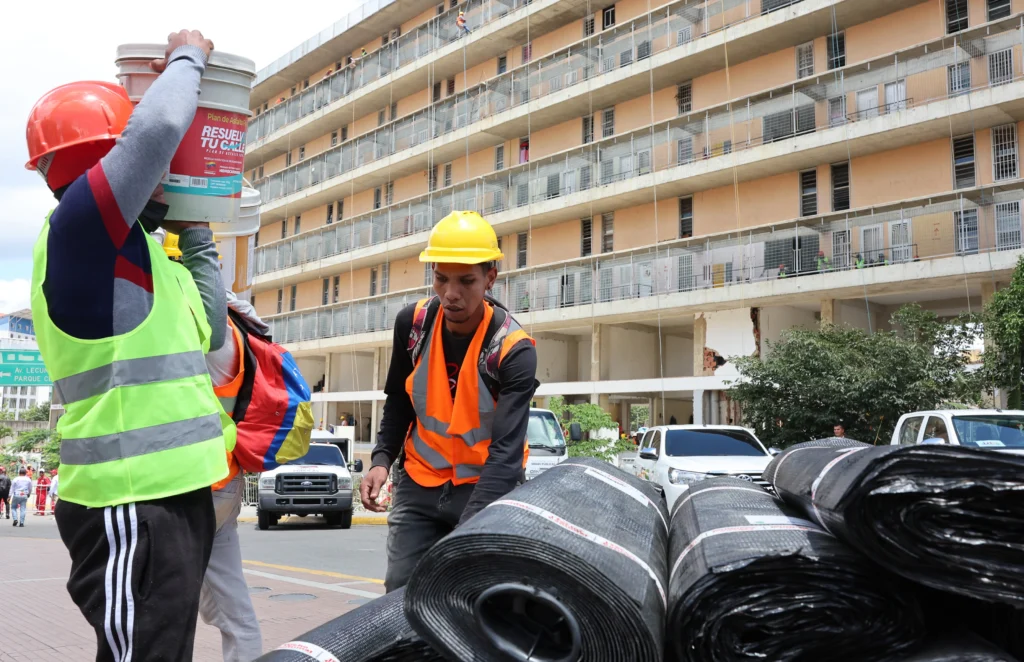
Venezuela’s Acting President Delcy Rodriguez officially activated the Venezuela is Reborn plan on Tuesday, launching the recovery of residential and communal infrastructure affected by the double earthquake that struck the nation on June 24.
Venezuelan Acting President Delcy Rodríguez stated this Tuesday that state technical teams are simultaneously intervening in 20 buildings in the Capital District, marking the largest post-disaster infrastructure recovery effort in Venezuela’s recent history.
Construction materials are being deployed in support of brigades composed of workers, students, engineers and architects who voluntarily joined specialized repair tasks using rappelling techniques.
RELATED: Venezuela Sets 82 Temporary Camps for Earthquake Survivors
Rodríguez emphasized that all reconstruction, refitting and building works strictly follow a technical plan focused on structural viability. The plan is complemented by a centralized information technology platform, deemed essential to safeguard the lives of families in a country recognized as seismically active.
The Acting President explained that the Presidential Commission for Technical Enablement and the General Staff for Transitional Camps and Housing established a traffic light evaluation system to classify damages. Under this system, buildings are categorized as green (safe for immediate occupation), yellow (requiring repairs before habitation) or red (uninhabitable and requiring deeper structural assessment).
In a significant move toward international cooperation, Rodríguez announced that formal contacts have been initiated with governments of nations with extensive seismic expertise, including Japan, Peru and Chile, with the aim of incorporating international specialists for precise diagnosis of affected properties.
Ver esta publicación en Instagram
Una publicación compartida de Prensa Presidencial (@presidencialve)
La Guaira Shows Encouraging Data
During the official broadcast, the Acting President conducted two satellite connections. One linked to La Guaira state, where coordinated intervention was activated for another 20 buildings. Rodríguez also conveyed her condolences to Governor José Alejandro Terán over the loss of nearly his entire executive team during the seismic event, praising the regional leader’s fortitude in transforming grief into work alongside Major General Sulbarán, commander of the Bolivarian National Guard and the sole authority designated for emergency response.
Governor Terán reported that just 13 days after the double earthquake, the coastal entity formally began the recovery and reconstruction phase through the Great Mission Venezuela is Reborn. He detailed that the Presidential Commission of structural engineers, led by Minister Garcés, inspected a total of 1,093 buildings across the state, determining scientifically that 67% of properties are structurally sound, with 426 classified as green-light and 303 as yellow-light.
Terán specified that in the Brisas del Aeropuerto urban development, immediate intervention was activated for 20 green-light buildings, an action that includes the adaptation of 600 apartments to guarantee a dignified and safe housing solution for 3,041 people currently sheltered in transitional camps. These camps, established in the immediate aftermath of the earthquake, provide temporary accommodation, food, water and medical care to displaced families while permanent solutions are developed.
The double earthquake of June 24 -with magnitudes of 7.2 and 7.5 respectively- stands as the most powerful seismic event to hit Venezuela since the San Narciso earthquake of 1900. Official reports indicate more than 3,500 fatalities and over 16,700 injuries, with the heaviest damage concentrated in La Guaira and Caracas. The disaster prompted the Venezuelan Government to declare a national state of emergency, mobilizing all state resources for rescue, relief and subsequent reconstruction.
Community participation has been a cornerstone of the recovery strategy. Volunteer brigades, including students from engineering and architecture programs across the country, have joined professional workers in the field, receiving on-site training in specialized repair techniques. This approach not only accelerates the reconstruction timeline but also builds local technical capacity for future emergency responses.
As the plan moves forward, the traffic light evaluation system continues to expand across all seven states included in the national emergency decree. Authorities have pledged transparency in the assessment process, with results made publicly available to ensure affected families can make informed decisions about their living arrangements. The Venezuelan government has also committed to ensuring that no family returns to an unsafe building, with all green-light certifications subject to verification by international experts in the coming weeks.
From teleSUR English via This RSS Feed.