

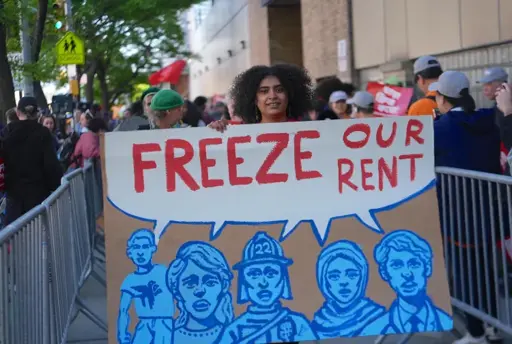
You may have seen the headlines: the rent in New York City is frozen! Mayor Zohran Mamdani has achieved one of his major campaign proposals. But the text underneath the headlines reveals the limits and complications, well known to those familiar with New York’s rent stabilization system, yet opaque to others.
The rent freeze will bring welcome relief to many tenants, and was only made possible through the organizing of thousands of New Yorkers who are fighting for a more affordable city for themselves and their neighbors. Yet the rent freeze alone will not fix New York’s crisis of affordable housing. We need a socialist approach that goes beyond what is achievable within the current system during one mayor’s term.
How New York’s Rent Stabilization System Works
New York has two types of regulated housing: rent controlled and rent stabilized. Rent-controlled apartments are few and far between, and are limited to tenants who have been in continuous occupancy since 1971 or their cohabiting descendants. Rent-stabilized apartments, however, make up about 43 percent of the total housing stock in New York City.
The mayor appoints all nine members of the Rent Guidelines Board (RGB), who serve on rotating terms. Mamdani has appointed six of the current board members. Every year, the RGB reviews economic data and holds a series of hearings before voting on rent increases for rent-stabilized apartments. There is one increase rate for 1-year leases/renewals, and one increase rate for 2-year leases/renewals. Tenants renewing a lease choose between the 1-year and the 2-year options. Often (but not always), a 2-year rate is a higher rent that applies to both years, allowing tenants to effectively guarantee themselves no increase in the following year at the cost of a higher rate in the meantime.
This is not the first time the Board has voted for a rent freeze. Under Mayor Bill DeBlasio, the Board froze the rent for 1-year leases three times, and overall kept increases consistently lower than boards appointed by every other mayor until Zohran Mamdani.
While rent-stabilized apartments tend to be cheaper than unregulated apartments, that doesn’t mean they are affordable for most individuals, couples, or families. For example, Mamdani’s own rent-stabilized apartment in Astoria, where he lived with his wife until becoming mayor, had a rent of $2,300 per month, which would require an annual income of $92,000 to be considered affordable — $7,000 higher than the median household income for the city.
Who Actually Benefits from the Rent Freeze?
Although 40 percent of New Yorkers live in rent-stabilized apartments, the freeze passed by the Rent Guidelines Board in June will only apply to all rent-stabilized tenants signing renewal leases with terms beginning October 2026 through September 2027. This means it only applies to tenants who signed 1-year leases within the last year. Tenants who signed 2-year renewals during that time will not be eligible for the rent freeze, and will have to cross their fingers that the board will freeze the rent again next year. So, less than 40 percent of the city will benefit from this rent freeze.
Some neighborhoods, such as in Upper Manhattan and southwest Bronx, have very high rates of rent stabilization, above 80 percent as of 2011. The rent freeze will disproportionately benefit people in these neighborhoods, although rent-stabilized apartments exist all over the city. Rent-stabilized tenants are more likely than tenants in unregulated buildings to be low income, seniors, and/or long-time city residents.
How much will a rent freeze benefit tenants? Let’s use Mamdani’s pre-mayoral rent of $2,300, which is a few bucks cheaper than the 2024 median rent-stabilized rent in buildings built after 1974. If someone in a similar apartment signed a 1-year lease earlier this year in anticipation of a rent freeze, they would see their rent raised to $2,369. Tenants who signed a 2-year lease would be paying $2,403 now, $414 higher per year. Those who chose a 1-year renewal this year will then get a 2-year rent freeze, locking in that lower rate for a total of three years. Let’s assume those with a 2-year renewal now get a freeze in the third year as well, but will be frozen at the higher rate. Those who are getting the 2-year rent freeze this year will save $1,242 over three years compared to those with the same starting rent who missed out. That’s enough to pay out of pocket for two community college courses. For tenants with higher-than-median rents, the savings will be even greater.
Will a Rent Freeze Hurt New York City Housing in the Long Run?
Many people are claiming that a rent freeze will send landlords into financial distress, rendering them unable to pay for operating costs. They also argue that landlords will refrain from building maintenance, allowing buildings to fall into greater disrepair over time, and perhaps increasing the rates of warehousing (the practice of intentionally allowing apartments to remain vacant in order to avoid the cost of preparing the apartments for re-rental).
However, a 2026 report from the New York City Independent Budget Office found that conditions in most rent-stabilized buildings are comparable to or better than housing conditions in non-regulated buildings, even within rent-stabilized housing stock that have higher rates of poor conditions and financial distress (buildings built prior to 1974 and buildings with high numbers of rent-stabilized apartments). Additionally, a decrease in landlord profits is not the same as landlords not being able to afford actual operating costs, such as maintenance, water bills, and property taxes.
Furthermore, JW Mason, professor of economics at John Jay College of Criminal Justice (part of the City University of New York), argued earlier this year that “the great majority” of rent-stabilized buildings bring in more money than their operating costs and could continue to turn a profit even with lower rents, not just frozen rents. The problem, he says, is not operating costs, but mortgages and other debts taken on by landlords looking to expand their portfolios with the assumption of a certain rate of rent increases per year. Mason points out that the “Abundance” method — easing regulations to make new housing easier and cheaper to build, theoretically lowering citywide rents — would result in the same problem for these landlords: lower-than-anticipated future rent increases to pay off the mortgage, rather than an actual lack of operating funds.
The RGB’s own study, published in early 2026, found that the number of distressed buildings (those unable to pay their actual operating costs with rental income) was only 9.2 percent of all rent-stabilized buildings, and that this portion was declining over time, not increasing. Furthermore, net operating income (revenues after all operating expenses are paid) per unit for rent stabilized buildings has increased by 56.6 percent since 1990 after adjusting for inflation. This report is the key data summary and analysis that the board uses when determining rent increases for the coming year. Not only are landlords profiting off of housing (of course they are, that’s why people become landlords), but their average rate of profit is growing over time.
Mason argues for public ownership of the genuinely distressed buildings, the ones that really don’t generate enough rental income to cover operating costs, and for the city to intervene to negotiate debt relief for landlords facing foreclosures in exchange for hard commitments to better maintenance, to ensure that tenants don’t bear the cost of the landlords’ mortgage decisions.
But what about a socialist approach to housing?
A Socialist Approach to Housing
There are many ways to go beyond freezing the rent within the bounds of New York’s existing rent stabilization system, even within the limits of capitalist economies.
Last year, shortly before the mayoral election, my comrade Nathaniel Flakin argued that New York “does not actually have a housing crisis — it only has an affordable housing crisis.” Many luxury condos don’t have owners, and even more are pied-a-terres, apartments that are owned by wealthy people who do not live in them. As readers might remember from lockdown, “return to office” mandates were based in part on companies wanting to make use of office space they either owned or rented. However, recent data suggests that while only 20 percent of workers worked remotely at least some of the time in 2023, a far greater number of workers are interested in working remotely some or all of the time, particularly through hybrid arrangements. If office space was reduced to fit the actual needs of workers who want to (or must, depending on their job) work in-person, the remaining office space plus empty luxury apartments could be converted into publicly owned, affordable housing units.
Flakin also wrote:
In 2021 in Berlin, 59 percent voted for the expropriation of big corporate landlords. Under the proposal that activists got onto the ballot with an enormous signature campaign, any for-profit company with more than 3,000 units would be put into public ownership, with control being exercised by elected representatives of renters. Over a million voters back this idea — yet Berlin’s subsequent governments simply ignored the decision. This shows that radical proposals can generate mass enthusiasm — and also that the capitalist state cannot accept them.
Another example —- that did get implemented — is Vienna. Nearly a quarter of the Austrian capital’s residents live in publicly owned apartments, and more than half the population lives in either publicly-owned apartments or buildings owned by non-profits that were built with public subsidies. Most apartments are rent regulated, with the city establishing a complex system of determining the maximum allowable rent for each unit and allowable annual increases linked to inflation.
The Viennese system was built over the course of several decades, much longer than any one mayor’s tenure. And even if Mamdani-appointed board members continue voting for rent freezes for the duration of their terms, there’s nothing to stop future boards from reversing these savings by imposing higher rent increases in future years, displacing some tenants. The rent freeze was so easily possible precisely because it relies on a pre-existing, top-down mechanism over which the mayor has substantial influence. It did not require a strong, class-independent tenant movement, which, while some tenant organizations do exist, New York City is sorely lacking.
Furthermore, even though the rent freeze will benefit rent-stabilized tenants, Mamdani has also expressed support for the supply-side approach to housing advocated for by the “abundance” school of thought. Incentivizing developers to build more apartment buildings — even with a portion of the apartments set aside for “affordable” housing — which, through the housing lottery, can rent for over $4,000, unaffordable even for many middle class people — does nothing to disrupt a housing system fundamentally built on profit and tenant exploitation.
As Flakin said, quoting Bertolt Brecht, creating a housing system that serves tenants rather than landlords is a “simple thing that’s hard to do” and will require significant organizing to achieve, through the vehicle of a working class party supported by a mass movement, rather than isolated leftists attempting to work within a hostile Democratic Party. While we celebrate the relief the rent freeze will bring to our neighbors (or, for the lucky ones, ourselves), we must keep our eyes on the horizon of the much bigger reforms needed to make a more meaningful impact on New York’s housing crisis and organize to achieve them; it might take decades, but we must begin now.
The post New York City’s Rent Freeze: Who Benefits, and What’s Next? appeared first on Left Voice.
From Left Voice via This RSS Feed.