

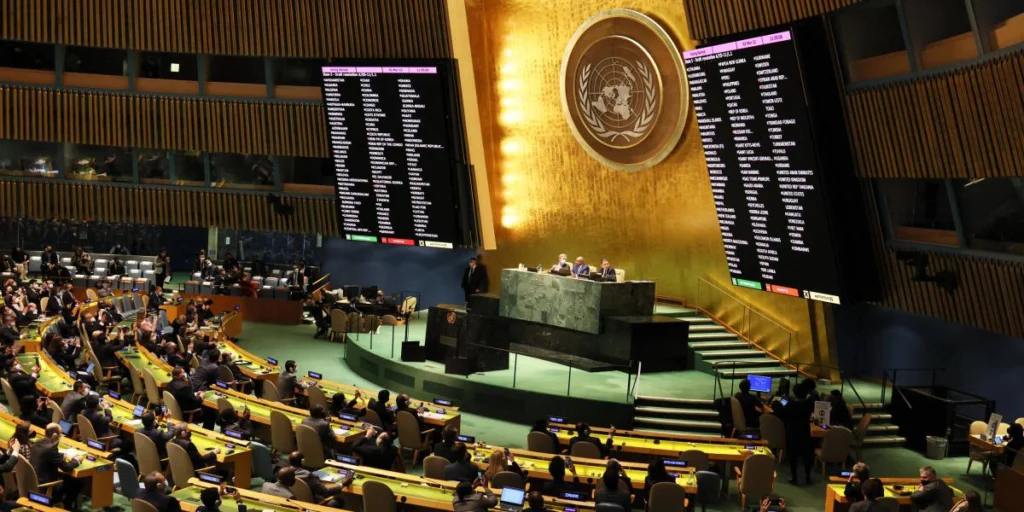
On Tuesday, July 7, the United Nations General Assembly held a debate requested by Cuba in which various countries, organizations, and international blocs demanded the lifting of the economic, commercial, financial, and energy blockade imposed by the United States against Cuba.
RELATED:
Cuba Prioritizes the National Electric System Recovery and Vital Services
Speakers warned of the intensification of these policies in recent months and detailed the serious humanitarian consequences suffered by the Cuban population. They denounced the disruption of daily life caused by prolonged blackouts, the paralysis of public transportation, failures in the distribution of drinking water, and difficulties in preserving food.
The European Union’s Permanent Observer to the UN, Stavros Lambrinidis, formally recognized the extraterritorial effect of the blockade imposed by Washington. In his remarks, the European ambassador stated that the unilateral sanctions applied for almost seven decades directly disrupt the economic interests of the European Union.
“The United States’ extraterritorial measures against Cuba negatively affect the EU’s economic interests and violate generally accepted international trade norms designed to protect legal entities and individuals residing in member states from the application of the Helms-Burton Act,” the diplomat stated.
Various groups of nations expressed their concern about the extraterritorial nature of the US sanctions, which violate sovereign rights and hinder trade relations between foreign companies and banks and the island.
#ENVIDEO |
Cuba exige en sesión extraordinaria de la #ONU el fin del bloqueo inhumano de EE.UU. Las sanciones se han endurecido y golpean cada vez más a la población. La isla urgió su cese inmediato. #Cuba #Bloqueo #teleSUR
@hcamelot pic.twitter.com/3S0SgF1GXu
— teleSUR TV (@teleSURtv) July 7, 2026
The text reads, “Cuba Demands in Extraordinary #UN Session an End to the Inhumane U.S. Blockade. Sanctions Have Hardened and Are Increasingly Hitting the Population. The Island Urged Its Immediate Cessation. #Cuba #Blockade #teleSUR“
Representatives of the Non-Aligned Movement (NAM), the Group of 77 and China, the Organization of Islamic Cooperation (OIC), the Association of Southeast Asian Nations (ASEAN), and the Group of Friends in Defense of the UN Charter indicated that the US coercive policies openly contradict the principles of sovereign equality, non-intervention, and the peaceful settlement of disputes. China denounced the unilateral measures imposed over six decades, stating they have generated an “immense catastrophe” for the Cuban people.
For its part, the Russian delegation described the situation as a policy of illegal pressure against a sovereign nation through a financial, logistical, and technological blockade. The Russian diplomat contrasted the severe damage suffered by the civilian population with the resilience demonstrated by the Cuban economy and reaffirmed his government’s solidarity and assistance in mitigating food insecurity.
The Caribbean Community (CARICOM) defended multilateralism and asserted that bilateral differences should be overcome through effective diplomatic channels. The bloc welcomed the recent contacts between Cuba and the United States, urging both governments to continue exploring these avenues of rapprochement with urgency and good faith.
The Caribbean countries urged the international community to adopt a clear position in favor of peace and to prevent any kind of direct military aggression against Cuba. They warned that an armed intervention would have devastating humanitarian consequences and would seriously endanger the political stability and security of all of Latin America and the Caribbean.
On the same day, the delegations rejected international campaigns aimed at discrediting Cuban medical cooperation abroad and recognized the historic work of the island’s healthcare professionals.
Economic and Social Damage
The call for this debate was supported by 136 votes in favor at the UN General Assembly. According to figures presented by Cuban Foreign Minister Bruno Rodríguez Parrilla, the economic damage caused by the blockade between March 2025 and February 2026 amounted to $8.103 billion at current prices, a seven percent increase compared to the previous period. The cumulative impact of this policy reaches $178.7 billion.
He also denounced the addition of the energy blockade, equivalent to a naval blockade and an act of war. “Access to fuel supplies to Cuba, both commercial and humanitarian, is being blocked through direct threats, unilateral coercive actions, and even the harassment or intimidation of tankers by the United States,” Rodríguez added.
The island’s Foreign Minister reiterated the frequent threats of military aggression from the highest levels of the U.S. government and the descriptions, by public sources, of war options and preparations.
The Cuban representative added that the blockade is compounded by unprecedented actions of an extreme extraterritorial nature and the use of secondary sanctions, which follow the macabre plan to provoke destabilization in Cuba, a humanitarian crisis and support for an imperialist military intervention that would cause a bloodbath and large losses of Cuban and American lives.
#Cuba | Foreign Minister Bruno Rodríguez denounces the intensification of U.S. sanctions, describing the current “energy siege” as an act of war equivalent to a naval blockade that cuts off vital commercial and humanitarian fuel supplies.#UnitedNations #UnitedStates… pic.twitter.com/yXi29XOu1z
— teleSUR English (@telesurenglish) July 7, 2026
From teleSUR English via This RSS Feed.
Embargo the US then
