

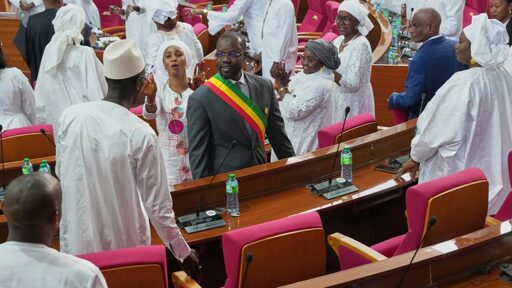
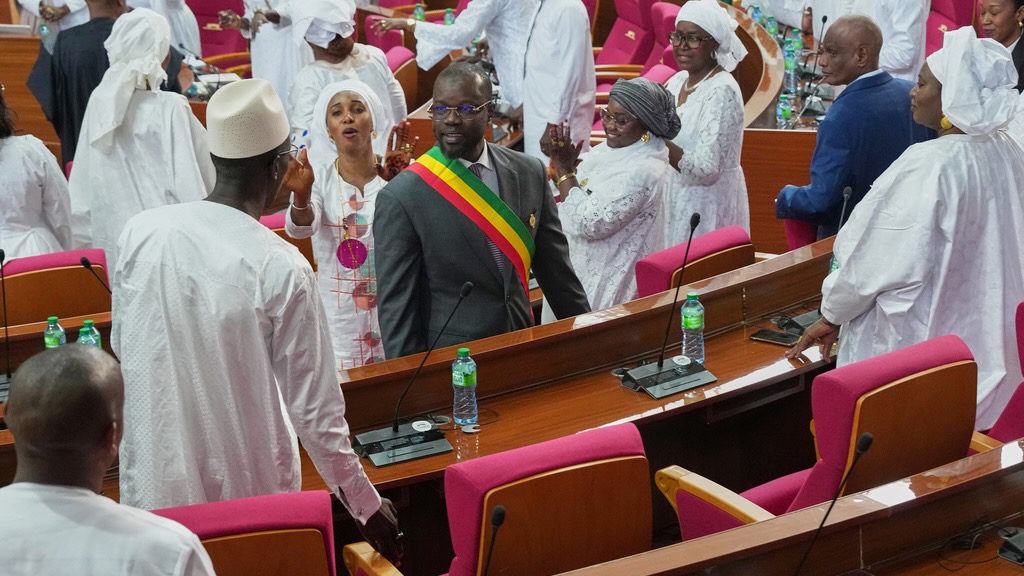
The political alliance between President Bassirou Diomaye Faye and his former Prime Minister Ousmane Sonko continues to deteriorate, raising concerns about the future of governance in Senegal. Sonko’s dismissal from being a prime minister and his subsequent return to the National Assembly, where he now leads the parliamentary majority, indicate that the country is entering a phase of institutional rivalry, with the executive and legislature increasingly positioned on opposing sides of the political divide.
With 130 of the National Assembly’s 165 seats held by Patriots of Senegal (PASTEF) and now led by Ousmane Sonko, the parliamentary majority has proposed constitutional amendments that would expand the powers of the legislature while reducing those of the presidency. If adopted, the reforms could significantly strengthen parliament’s influence and pose a major political challenge to President Bassirou Diomaye Faye.
The developments come barely two years after the two leaders rode an unprecedented wave of popular mobilization to power under the banner of PASTEF. Their campaign promised a decisive break with decades of economic dependency, foreign influence, and governance associated with Senegal’s traditional political establishment.
From “Diomaye is Sonko” to political separation
Throughout the 2024 election campaign, supporters rallied behind the slogan “Diomaye mooy Sonko” (“Diomaye is Sonko”), insisting that the two leaders represented a unified political vision after Sonko was barred from contesting the presidency. That image of unity now appears to have fractured.
In dialogue with BreakThrough News, Aliou Gérard Koita, delegate for the Front for a Popular, Anti-Imperialist and Pan-African Revolution (FRAPP), says that the disagreement should not be reduced to personal differences.
“We must acknowledge that there is a political disagreement. They sold us the slogan ‘Diomaye mooy Sonko,’ but that is no longer the reality. We are not here to analyze moods or friendships within a party. This is a political rupture, and each camp must clearly define its position so that the people understand what is happening.”
According to Koita, the central question is whether President Faye continues to govern according to the anti-imperialist and sovereignty-oriented program that inspired millions of Senegalese voters.
Sovereignty promises yet to materialize
The election of the PASTEF government generated enormous expectations both inside Senegal and across Africa.
Its program promised greater control over national resources, institutional reforms, economic sovereignty, and a reassessment of Senegal’s relationship with external financial institutions and foreign powers.
Koita believes progress has fallen short of what many supporters anticipated.
“In two years, with or without Sonko, PASTEF has not undertaken concrete actions along the expected line of rupture. Beyond a few measures concerning military bases and street names, serious changes regarding the currency, public debt and the justice system are still awaited.”
This is a debate within sections of Senegal’s social movements over whether the government has been constrained by existing institutions or has moderated its original program after assuming office.
Debt at the center of the political contest
For activists within Senegal’s anti-imperialist movement, the current political tensions are inseparable from larger questions surrounding economic sovereignty.
Koita argues that public debt remains the defining issue shaping policy choices.
“The principal issue is the debt and its consequences for economic and social policies. The tensions within the government also reflect a balance of forces between revolutionaries and reactionaries. Unfortunately, for now, it is the reactionary forces that are steering the ship.”
Across Africa, debates over sovereign debt have intensified as governments confront rising repayment obligations, fiscal pressures and negotiations with international financial institutions. Many movements advocating economic sovereignty view debt restructuring, monetary reform, and greater domestic control over development planning as essential components of political independence.
Parliament seeks greater powers
The political tensions coincide with major constitutional developments.
With Senegal’s National Assembly approving constitutional amendments aimed at expanding parliamentary powers while reducing some presidential authority. Supporters argue that the reforms would reduce the concentration of executive power that has characterized Senegal’s political system for decades. While those against see it as a get back mission by Sonko.
Koita welcomed the direction of the reforms but argued they do not go far enough.
“This is primarily a measure intended to rebalance institutional powers. It is the product of years of consensus and moves toward reducing hyper-presidentialism. However, it remains insufficient because it overlooks the power of citizens. This was an opportunity to strengthen popular power through mechanisms of citizen oversight and citizen-led initiatives.”
What is needed is more constitutional reforms that would strengthen democratic accountability beyond periodic elections.
Koita also cautioned against placing excessive faith in political personalities rather than organized citizens.
“Many people were moved by individuals rather than ideas. Citizens often fail to recognize their own power. They delegate it to leaders and later become disappointed.”
Despite the growing tensions, Koita says it remains too early to predict Senegal’s political trajectory.
“Senegal is a country where it is very imprudent to make political forecasts,” he said. “The future depends on citizens and on their ability to organize themselves into a critical mass capable of shifting the balance of power.”
While Senegal enters a new phase of political uncertainty, Ousmane Sonko remains one of the country’s most influential and popular political figures, commanding a loyal grassroots base and retaining significant influence within the parliamentary majority. His continued prominence means that President Bassirou Diomaye Faye is likely to face sustained political pressure, from him and within the movement that brought both leaders to power.
Zoe. , July 7, 2026
From BT News via This RSS Feed.