

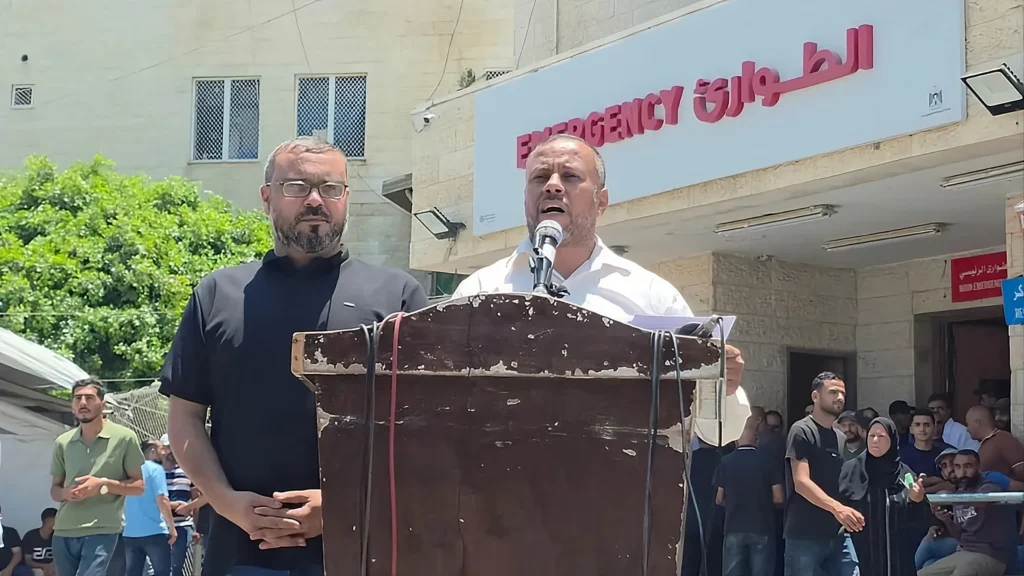
Hamas steps back from governing, but disarmament and Israeli withdrawal remain unresolved obstacles to Gaza’s reconstruction.
For two decades, the administrative framework of the Gaza Strip has been inextricably linked to Hamas, a movement that operated as a militant national liberation group and a state authority.
RELATED:
Hamas Dissolves its Government in Gaza
On July 6, 2026, the Hamas-led administration announced the formal dissolution of its internal government, signaling a readiness to hand over administrative responsibilities to an independent, non-political framework.
This transition occurs within a context of a fragile 20-point peace plan brokered following the devastating genocide and a subsequent ceasefire agreement.
Examining how this government was initially formed and detailing its administrative scope provides critical context for understanding why its structures are being dismantled today.
Hamas announced on Monday the dissolution of the body that has governed the Gaza Strip for nearly two decades, clearing the way for a technocratic committee to implement civilian rule.
The move marks a significant political shift by Hamas, which has run Gaza since 2007 after… pic.twitter.com/RieQ4Sfcee
— Middle East Eye (@MiddleEastEye) July 6, 2026
How the Hamas Government Was Formed
The origins of the Hamas government trace back to January 2006, when the Palestinian Legislative Council elections were held across the West Bank and the Gaza Strip.
Running on the platform of the Change and Reform list, Hamas secured a parliamentary majority, winning 74 out of 132 available seats. International monitors, including former United States President Jimmy Carter, verified the election as free, fair, and transparently democratic.
The electoral outcome reflected widespread dissatisfaction with the ruling Fatah party, which many voters associated with corruption and the perceived failure of the Oslo Accords to deliver a sovereign Palestinian state.
Following the legislative victory, Hamas formed a national unity government in early 2007 alongside Fatah and other political factions. However, this democratic transition faced immediate resistance from external actors.
Fearing the rise of an Islamist administration, the United States, Israel, and the European Union imposed stringent political and economic sanctions on the newly formed government. Investigative reports subsequently revealed that these external governments funneled weapons and financial support, aiming to subvert the election results and orchestrate a political shift in the West Bank.
This escalating pressure culminated in a brief conflict in June 2007. In a preemptive move to prevent an external coup, Hamas security forces seized full control of the administrative infrastructure within the Gaza Strip, expelling Fatah-loyal security forces to the West Bank.
Palestinian Authority President Mahmoud Abbas responded by dismissing the unity government and declaring a state of emergency. This critical rupture resulted in a political and geographical split: the Fatah-led Palestinian Authority retained administrative control over portions of the West Bank, while Hamas established a distinct, standalone administrative government in the Gaza Strip.
The Scope of Hamas Governance
In 2007, the Hamas administration established a comprehensive civil bureaucracy tasked with managing the daily life of Gaza’s population. The civilian government operated distinctly through the Government Follow-up Committee. This body functioned essentially as a council of ministries, overseeing a vast network of public services.
The Hamas administration managed municipal sanitation, the judicial and court systems, local police forces, public schools, agricultural distribution, and the internal healthcare sector, employing tens of thousands of local Palestinian civil servants.
The central challenge of this government was the necessity of operating under a permanent state of siege. Following the 2007 administrative split, Israel, with cooperation from Egypt, implemented a comprehensive land, air, and sea blockade on the Gaza Strip.
This blockade on the Gaza Strip restricted the movement of people, commercial goods, medical supplies, and construction materials. As a result, the Hamas government was forced to operate within a severely restricted economy.
The economy was heavily dependent on international humanitarian aid from organizations like the United Nations Relief and Works Agency (UNRWA), alongside financial subsidies from foreign donors like Qatar, which frequently paid the salaries of civilian public sector workers.
#ICYMI Hamas on Monday announced the dissolution of the Government Emergency Committee in Gaza and the transfer of the administration of the Gaza Strip to a Palestinian technocratic committee.#AWANInews #AWANIinternationalhttps://t.co/doIMwhDnbM
— Astro AWANI (@501Awani) July 7, 2026
Popular Acceptance and Internal Contradictions Among Palestinians
A complex dynamic of ideological support, practical reliance, and internal tension has historically characterized the domestic relationship between the population of Gaza and the Hamas administration.
As both a political party and a militant national liberation movement, Hamas’s domestic standing has often fluctuated; in periods of direct escalation or intense blockade, its popularity and upward trajectory among Palestinians who viewed the group as the primary entity actively resisting Israeli occupation contrasted sharply with the administrative compliance of the West Bank-based Palestinian Authority (PA).
However, managing the civilian affairs of an isolated territory exposed the Hamas administration to domestic scrutiny. Running a blockaded enclave meant balancing structural deficits with public needs.
Over the years, the Hamas government faced localized protests over economic stagnation, high unemployment rates, and internal tax burdens levied on small businesses to sustain the public sector.
Despite these civil frictions, the extraordinary scale of destruction and humanitarian hardship during periods of prolonged conflict fundamentally reordered Hamas political priorities.
While public opinion remained diverse and politically fragmented, the administrative structures of the Hamas government were widely accepted by residents as the only functional state apparatus capable of maintaining local civil stability, distributing emergency resources, and preventing total social collapse under blockade conditions.
Why and How the Government is Being Dissolved
On July 6, 2026, the administrative organization of the Gaza Strip underwent a structural shift. Following the milestone of 1,000 days of intense warfare, the Hamas leadership officially announced the dissolution of its Government Emergency Committee.
This decision marked an intentional step toward ceding its two-decade civilian rule to an interim, non-partisan authority known as the National Committee for the Administration of Gaza (NCAG).
The NCAG, a 15-member transitional body composed entirely of independent Palestinian technocrats, was established under a UN Security Council framework and a 20-point peace plan mediated by international actors, including the United States.
Chaired by Chief Commissioner Ali Shaath, a Gaza-born engineer and former Palestinian Authority official, the committee’s core mandate is to restore basic municipal services, manage incoming humanitarian aid, and oversee the massive economic reconstruction of the devastated territory.
During a press conference detailing the structural step-down, Dr. Ismail al-Thawabta, the director general of the Government Media Office in Gaza, explicitly called upon all international stakeholders to expedite the immediate transition of local civilian responsibilities to the NCAG. He announced that technical and professional staff would remain in positions to prevent an administrative and technical vacuum.
Al-Thawabta assured observers that the extensive existing Gaza civil service would present no bureaucratic obstacles to the new technocratic ministers. Hamas spokesperson Hazem Qassem further clarified that the self-dissolution was a practical implementation of the group’s long-standing diplomatic position that it would not seek a role in post-war governance arrangements.
According to official statements, Hamas deliberately dismantled its formal governance apparatus to “remove any pretexts” utilized by the Israeli military to impede the entry of reconstruction materials, block the flow of international medical relief, and deny the NCAG physical access to the enclave.
Hamas has announced the dissolution of its governing committee. After running the Gaza Strip for nearly two decades, it will allow a transitional, technocratic committee to assume responsibility.
Al Jazeera’s Hani Mahmoud and Nour Odeh reports. pic.twitter.com/j4Q50CZlap
— Al Jazeera English (@AJEnglish) July 6, 2026
The Realities of Power and the Disarmament Impasse
While the dissolution of the Government Emergency Committee opens a legitimate avenue for technocratic management under Ali Shaath, it does not represent a complete erasure of the Hamas movement from Gaza’s landscape.
Independent regional analysts note that while the NCAG may now hold the administrative mandate to govern municipal water, finance, and education, the actual enforcement of internal security remains inextricably linked to the native security structures already established on the ground.
Mainstream Israeli officials, including Foreign Minister Gideon Saar, have swiftly dismissed the administrative dissolution as a tactical maneuver or a “spin,” asserting that the move is designed merely to preserve the movement’s armed capabilities while shifting the financial burden of civilian survival to external entities.
The international peace framework, supervised by a newly minted Board of Peace, explicitly calls for the gradual disarmament of all political factions in Gaza.
However, Hamas has consistently refused to agree to unilateral disarmament, asserting that its weapons represent a core element of national resistance that cannot be surrendered before a comprehensive, permanent political settlement and a total military withdrawal from Palestinian territories.
By stepping back from ministries and municipalities, Hamas has adjusted its strategy to prioritize the immediate physical survival of the local population and facilitate international reconstruction efforts.
Yet, as the transition unfolds, the underlying geopolitical reality remains unchanged: a top-down administrative transition cannot easily bypass the core issues of territorial sovereignty, occupation, and national resistance.
#FromTheSouth News Bits | The Israeli Army carried out a new raid against Gaza, resulting in the murder of football player Saleem Al-Ashgar. pic.twitter.com/zHFSdNe2ov
— teleSUR English (@telesurenglish) July 6, 2026
Sources: Al Jazeera – Vijay Prashad – Trincontinental – People’s Dispatch – The Intercept – BBC – Xinhua – CGTN – teleSUR
From teleSUR English via This RSS Feed.