

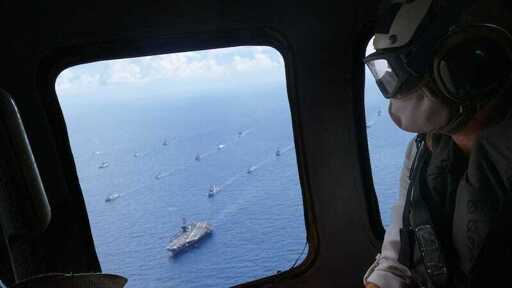
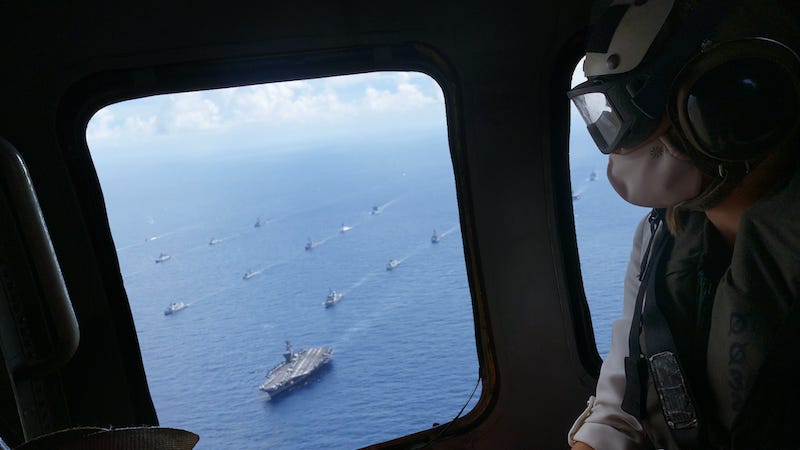
Some of the most peaceful moments of my life were spent standing on the deck of a U.S. Navy aircraft carrier just before dawn. It feels like looking over the entire ocean, into endless blue water. An aircraft carrier is massive — like a floating city on the sea — and yet you can still feel the gentle rocking from the ocean’s waves through the soles of your feet. When you breathe into this moment — the salty air filling your lungs — you’re reminded of how incredibly small you are in the grand scheme of things. The realization causes a sort of lightness and fluttering within the chest, an overwhelming sense of gratitude for all that you cannot understand.
Then the day begins. The launch of the first F/A-18 fighter jet tears a sonic hole through the silent morning. Naval airmen run around the deck, bracing themselves and clutching their headsets to evade the thundering sound. The whole ship shakes as it launches jet after jet, white and gray trails marking their courses across the serene blue sky. Fuel and oil cover the hands and faces of mechanics working throughout the day and into the night to make sure the jets keep coming and going, launch after launch. There is not enough ocean breeze to prevent the sweat that stains our coveralls. The mixture of stenches — salt, oil, sweat — sticks to the hair inside your nostrils. It is the same the next day and the next. Preparation for war — for terror — is a never-ending, completely mundane affair. We eat our oatmeal, we don our coveralls, we load the jets, we drop the bombs, we do it all again.
I currently work for the antiwar organization CODEPINK, but long before that, I was an enlisted member of the U.S. Navy. My last job in the Navy was easy compared to others. I was the Operations Specialist for a squadron of fighter pilots. I worked with the commissioned officers, pilots whom I affectionately called “the frat boys of the Navy.” They were young, zealous, mostly white men hyped about their jobs. I mean, they got to fly ultrafast planes and practice dropping bombs all day. Isn’t this the American boy’s dream? I sat in their lounge every day, making sure everything was documented and accounted for to get them launching and landing their jets with enough fuel, with the right parachutes, and at the right times.
I joined the military for the same reasons many young people do. My parents couldn’t afford to send me to college. I was desperate to get out of the house, stuck in a place whose only immediate opportunities were casinos and hospitality work, and burdened with a brain and heart that were very eager to prove something. Along came Polly — or, in my case, a Navy recruiter. Travel? Free college? Free basic housing? A mission bigger than myself?! I thought about it for half a second before I signed up.
American warmaking is in the mundane. I’ll say it again and again. Most of us are mere assembly workers in a war-making factory, so disconnected are we in this 21st-century age of war. Most of us are kept far away from the bloody realities of our jobs. At the end of the day, my job was to push paper. I saw a copy machine more than I did a gun. I don’t have valiant stories of combating ISIS. I never leapt onto a grenade to save my comrades. And yet, my spirit and conscience would not let me get away with this blissful ignorance, this American-made delusion, for long.
My saving grace — and the start of my awakening — was the fact that I was a loner. I had a unique job; no one else did what I did. I was kept away from my peers and didn’t care to belong. On the weekends, when many Naval airmen would go out partying, drinking, and building all that collective trauma and camaraderie together, I’d drive four hours from the coast of Virginia to its forest interior. I was always looking for a good hike, a mountain to climb, a waterfall to swim in. In my solitude, I felt an ancestral sense of connection to the land and stars. I could feel love in the light glow of the sun that somehow still reached me between the dense forest trees. Swimming at the base of a waterfall felt like a gentle cleansing — a return to the womb of the Earth herself. There was an innate sense of safety that would wash over me as I lay under the night sky, waiting for asteroids to streak across the stars and rain down on me.
I fell deeply in love. I started going to school while still on active duty. I decided to study Environmental Science. When I told the pilots about my studies and my evolving love of the sea, they laughed, saying, “Well, don’t pay attention to how much fuel we dump in the ocean.”
That statement stayed with me. It followed me onto that deck of the aircraft carrier, lingering with me on those quiet mornings when I looked over the sea. What kind of world was I actually building? What kind of destruction could I possibly be contributing to?
They say that if you’re lucky, you can see dolphins swimming, leaping in the waves close to the ships. I was never blessed with such a sight. But I began to think about that fuel, clogging their blowholes, poisoning their lungs. I began to think about the places where we dropped boots and bullets and bombs. I thought of the people that I deemed enemies and yet knew nothing about. Do they not deserve to enjoy the refreshing peace of a waterfall too? Do their lungs know the crisp, clean air of a mountain walk, away from bullets and the exhaust of aircraft engines? Something broke within me then — something irreparable. And I could no longer pretend to belong.
I don’t think I am the only person feeling this way. And those who do, I invite you to sit with me in this feeling of brokenness, and to step outside of the American delusion of warmaking and “peace through strength” — the normalization of coercion and dominance. This is an invitation to see what you see, to let it wash over your conscience and compel you to change course. Yes, it is frightening to grapple with the truth, but to ignore it guarantees our collective death, both in spirit and in the material world.
I have seen nothing that so succinctly explains and connects the U.S. military’s active demolition of people with the destruction of the environment until I watched Abby Martin’s 2025 documentary film, Earth’s Greatest Enemy. It offers thorough, undeniable evidence that our country’s ongoing military campaigns and occupations are destroying entire communities and ecosystems. To me, this film encapsulates both a sense of grief and of hope: grief over the horror that U.S. militarism has inflicted upon us and the planet, and hope, embodied in the people who continue defending their homelands, waterways, and communities against the seemingly insurmountable force that is the U.S. military. Earth’s Greatest Enemy is available now on major streaming platforms. I invite you to watch the film, to invite friends to watch the film, and then tell me what you saw, tell me what you felt.
In every person, there is a soldier or warrior spirit, long waiting for a direction worth fighting for. This Earth is a place worth protecting, and in its people is a common humanity worth putting your body on the line for.
Watch Earth’s Greatest Enemy at home NOW or organize a screening near you!
Mercedez is CODEPINK’s Campaigns Assistant.
Mercedez is a community organizer and storyteller devoted to building culture, connection, and collective action through narrative. Her work spans environmental justice, political organizing, media, and the arts, with experience in grassroots organizing, advocacy, outreach, and community storytelling.
CODEPINK Substack is a reader-supported publication. To receive new posts and support our work, consider becoming a free or paid subscriber.
From CODEPINK Substack via This RSS Feed.