

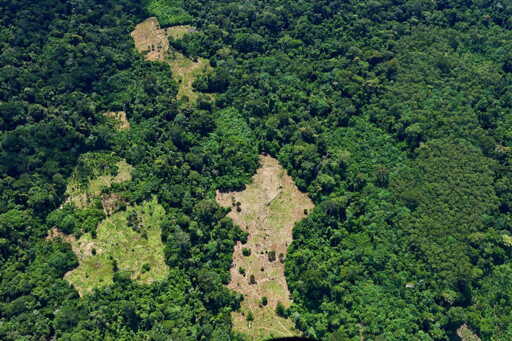
An unprotected area in Peru’s Amazon, where Indigenous people live in voluntary isolation, sits in a growing sea of forestry concessions, illegal roads, illegal loggers and drug traffickers, according to maps and confidential reports seen by Mongabay. Indigenous leaders and national organizations are calling the area Kakataibo Extremo Norte, or Kakataibo Extreme North. Julio Cusurichi, a Shipibo-Conibo leader and president of the Indigenous Federation of the Madre de Dios River and Tributaries (FENAMAD), told Mongabay that the forests and isolated people in this area face serious threats. “There are loggers there, there are illicit activities,” he said in an interview. “It is a very worrying issue. The fact that these illegal activities are linked to roads is particularly concerning.” Indigenous leaders and organizations have sought formal recognition of Kakataibo Extremo Norte from the Peruvian state since 2021. In 2023, however, the Ministry of Culture rejected the application, according to a confidential technical report seen by Mongabay, because it relates to the isolated Kakataibo people. The report said the Kakataibo people are already recognized by the Peruvian state and therefore measures and mechanisms for the protection of their rights have already been established. Kakataibo Extremo Norte sits above the Kakataibo North and South Indigenous Reserve (RIKNS), established in 2021 to protect groups of Kakataibo people who live in voluntary isolation. This latter reserve covers 148,997 hectares (368,180 acres) — an area roughly twice the size of New York City — straddling the departments of Loreto, Ucayali and Huánuco. For the safety…This article was originally published on Mongabay
From Conservation news via This RSS Feed.