

As this essay continues an examination of the limits of Noam Chomsky’s anti-imperialism, readers are encouraged to consult the earlier installments in the series:
- Introduction: Colorless Green Ideas Sleep Furiously
- Chomsky’s Linguistics Theories of Nothing
- Chomsky: The Acceptable Dissident
- Chomsky: The Moderate Rebel
- Chomsky: The Incomplete Anti-Imperialist
Noam Chomsky’s critique follows a consistent pattern. While interventions are still in the planning or early execution phase—when public opposition might still disrupt the machinery of consent—his commentary often accepts the core imperial premises and limits itself to narrow legalistic or procedural objections about method, mandate, or multilateral cover. As we saw with Vietnam and Iraq, only after the body counts mount and the predictable failures unfold does he arrive to pronounce the verdict: “What an atrocity.” “An imperial crime.” “If the Nuremberg laws were applied, then every post-war American president would have been hanged.”
Chomsky follows the same familiar pattern we’ve seen in Iraq and Vietnam. He readily accepts many of the empire’s premises, but condemns US intervention on either some legalese or moral grounds of non-intervention. He never challenges the premises that leads to the war. For example, in Iraq, he failed to challenge the propaganda about Saddam Hussein being a monster, and the world would be better off without him. Thereby giving a weak, uninspiring reason to fight against the war in the first place. In Afghanistan, the pattern repeats itself. He accepts the Empire’s premise about the Taliban. But, once again, claims that the US’s aim is wrong and bad and therefore the war is wrong. In other words, he never leaves the sandbox constructed by the empire.
After 9/11, then President George W. Bush immediately declared a war on terror, and quickly passed through a bill called the AUMF. It said:
That the President is authorized to use all necessary and appropriate force against those nations, organizations, or persons he determines planned, authorized, committed, or aided the terrorist attacks that occurred on September 11, 2001, or harbored such organizations or persons, in order to prevent any future acts of international terrorism against the United States by such nations, organizations or persons.
In other words, this law allowed the president to wage unending war against anyone anywhere as long as they are deemed to be “terrorists” by the United States. Shortly afterwards, the US began its bombing campaign against Afghanistan as part of a “war on terror.” Shortly afterward, Noam Chomsky gave an interview, Chomsky rightfully mentions how the Taliban offered to hand over Osama Bin Laden and George W. Bush refused. He said:
[O]ne thing they could do is what you said: turn him over to a third party. The problem with that is, the U.S. has refused to allow it. Now, are they serious in that offer that’s been going on for a couple of weeks? Well, we don’t know — because every time the offer is made, George Bush stands up and says “We’re not gonna talk to you. We’re not gonna negotiate with you. We don’t want him turned over.”
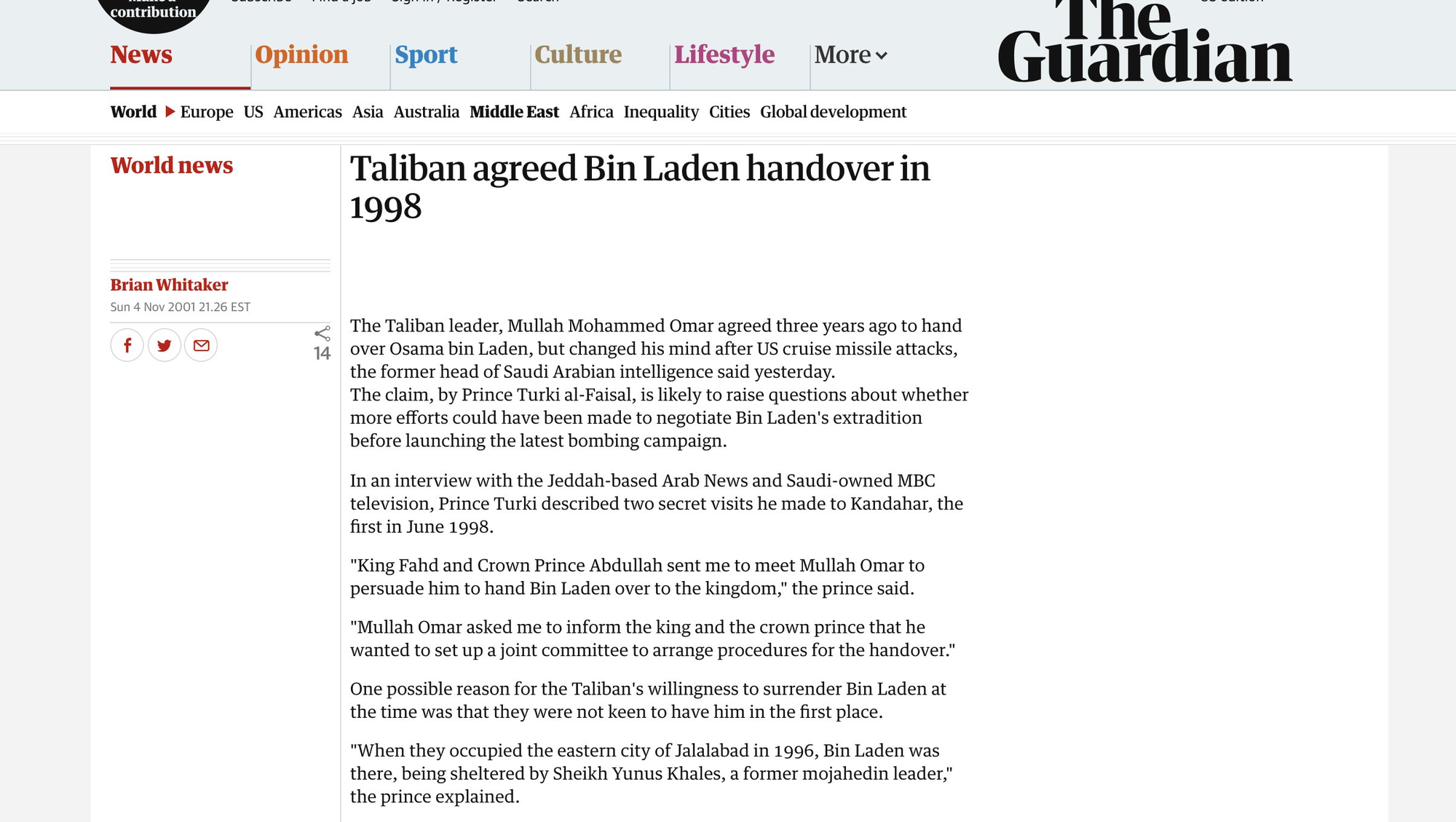
They had agreed to hand over Bin Laden well before 9/11
However, in a 2002 interview, Chomsky claimed: “That’s why everyone was in favor of the overthrow of the Taliban, except the U.S. government. Let’s keep in mind that the overthrow of the Taliban regime was not a war aim.” He added that the U.S. only joined the effort later, rejecting calls from Afghans for funding and political support to overthrow the regime from within, and instead insisted on demonstrating its own military power through bombing.
This is hard to square with the facts. If overthrowing the Taliban was never a goal, why did the Bush administration reject the Taliban’s repeated offers to hand over Osama bin Laden (often conditional on the U.S. providing evidence or stopping the bombing) Accepting such an offer would have avoided major military action. Moreover, planning to pressure or remove the Taliban was already underway before 9/11, and accelerated dramatically afterward.
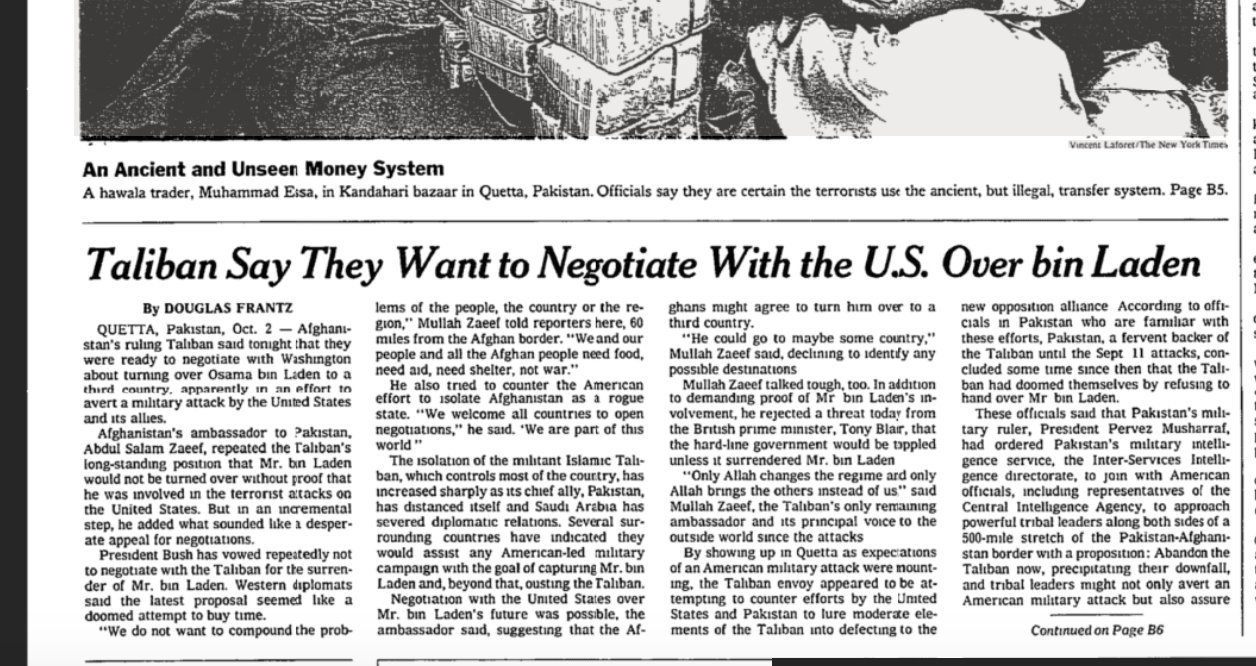
Taliban were ready to hand over Bin Laden
Even more problematic is Chomsky’s reference to “Afghans” who supposedly wanted American help to overthrow the Taliban. The main organized anti-Taliban force on the ground was the Northern Alliance — a coalition of warlords with a long record of atrocities, including mass rape, indiscriminate shelling of civilians, and ethnic massacres during the 1992–1996 civil war. Alongside them were exile groups (particularly the Rome Group, loyal to the deposed King Zahir Shah). Hamid Karzai, who would become the interim leader chosen at Bonn, emerged from these exile networks. Karzai had previously worked as a consultant and political lobbyist with connections to the U.S. oil company Unocal during the 1990s, when the firm was pursuing a major gas pipeline project through Afghanistan.
These were not ordinary Afghans begging for bombs and destroyed infrastructure — they were factional leaders and exiles with their own agendas, bloody histories, and, in Karzai’s case, prior business ties to American energy interests.
These groups of people, without any democratic mandate or broad popular support, were invited to form the new “transition” government in Bonn in 2001. The Northern Alliance warlords, who had committed widespread atrocities during the 1990s civil war, sat alongside moderate royalist exiles (the Rome Group) and other factional representatives with ties to Iran and Pakistan. They were chosen not because they represented the Afghan people, but because they were the main anti-Taliban factions that controlled guns, territory, or exile networks after the Taliban’s rapid collapse.
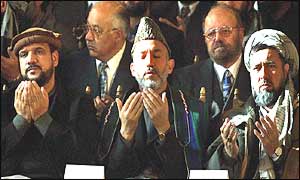
Hamid Karzai at the Bonn 2001 Conference
With no functioning central government and the country at risk of descending back into full civil war, the United Nations (with strong U.S. backing) facilitated the conference as a pragmatic way to fill the power vacuum. The resulting Bonn Agreement created an Interim Administration led by Hamid Karzai — but its legitimacy rested more on international recognition and a temporary balance of power among warlords and exiles than on any genuine mandate from ordinary Afghans.
More importantly, the Bonn Agreement promised a clear transition to a democratic government through “free and fair elections.” The roadmap was explicit: an Interim Administration (six months), followed by an Emergency Loya Jirga to select a Transitional Authority, a Constitutional Loya Jirga to draft a new constitution, and then national elections. Presidential elections were held in 2004 and parliamentary elections in 2005, which were presented as major milestones.
In reality, the democratic transition was deeply flawed from the start. While the national elections received international attention, real power at the provincial level remained firmly in the hands of the central government. Provincial governors were never elected — they were appointed (and frequently rotated) directly by the president. This allowed figures from the Northern Alliance and other warlord networks to continue dominating large parts of the country through patronage, militias, and informal control, even after the formal “democratic” institutions were in place.
The result was a highly centralized presidential system that looked democratic on paper but often functioned as a vehicle for elite power-sharing among the same factions that had gathered in Bonn. A clear example of this centralized, undemocratic reality was the frequent rotation of provincial governorships. Warlords and former militia commanders were repeatedly appointed, dismissed, and shifted between provinces by the president as a tool of political management. Ismael Khan, a powerful Tajik commander from the Northern Alliance, served as governor of Herat from 2001 to 2004 before being moved into a national ministerial position. Gul Agha Sherzai, a Kandahari strongman, was governor of Kandahar (2001–2003) before being rotated to Nangarhar province (2005 onward). Similar musical-chairs appointments occurred across the country, allowing these figures to maintain influence while preventing any single warlord from building too strong a regional power base. This system kept real provincial power in the hands of presidential appointees rather than elected representatives.
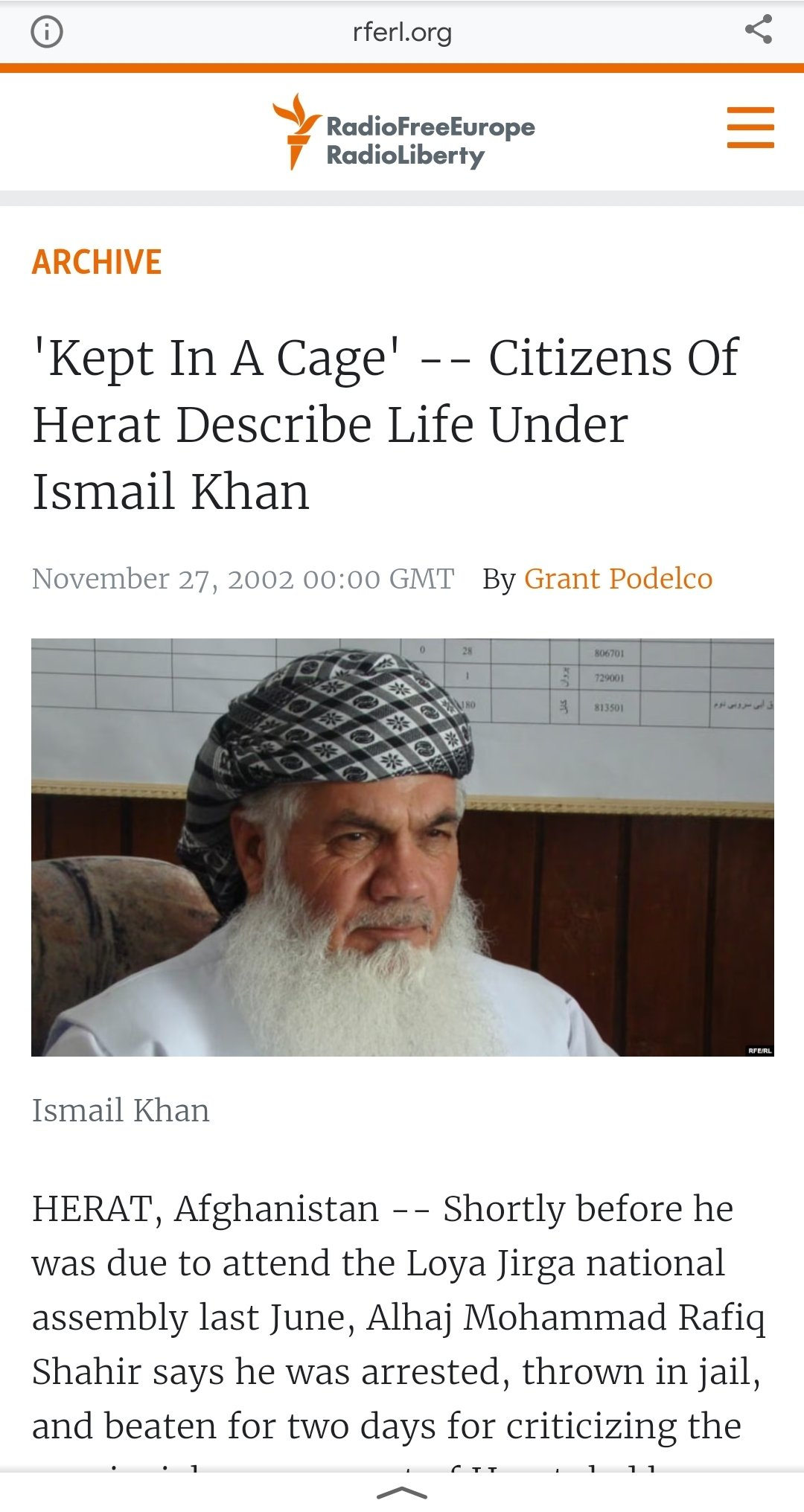
One of the key figures and later a member of the Afghan Government
In the same interview, the interviewer, David Barsamian made some extraordinary claims. He said, “CNN’s Christiane Amanpour said, “There is no doubt that U.S. intervention in Afghanistan has had a net positive effect for the Afghan people.” Then Ahmed Rashid, the Pakistani journalist and author of Taliban, told me in an interview, that there’s been “an enormous improvement in the status of women in Afghanistan with the advent of the new government. Several million children are back in school and 50,000 women teachers are back on the job.”
Chomsky didn’t push back against claims that the overthrow of the Taliban was a net positive for the Afghanistani people. In fact, he agreed to this premise. He said, “There certainly were improvements that resulted from the overthrow of the Taliban. That’s why everyone was in favor of the overthrow of the Taliban, except the U.S. government” and went on to add, “However, it’s a good thing that the U.S. finally came around to joining others in opposing the Taliban regime toward the end of the war.”
Unfortunately, Chomsky was wrong on this fact too. Despite how terrible the Taliban were, despite the public executions, the banning of women’s education, despite their extremely draconian interpretation of the Taliban, despite them destroying the Buddha’s of the Bahimiyan, they were better than the warlords that came after.
The origin story of the Taliban dates back to 1994, when a local mujahadeen warlord kidnapped and raped two girls. Mullah Omar, a figure in the Taliban, was allegedly so disgusted by this, that according to the New York Times, Mullah Omar gathered a small group of fighters, attacked the checkpoint, freed the girls, and publicly executed the commander by hanging his body from the barrel of an old Soviet tank. As the article noted, this grisly act helped turn Omar into a folk hero in the eyes of many Afghans who had suffered under the warlords. Stories like this explain why the Taliban were initially welcomed in many areas — they positioned themselves as restorers of order against the far worse abuses of the Northern Alliance-aligned commanders.
Meanwhile, after the Soviets left, Afghanistan delved into a gangster’s paradise. Many of these mujahideen began fighting amongst themselves, for control and turf wars. They literally had shoot-outs over who could sell eggs in which region. The Taliban, promised, and brought some kind of order into this unlivable chaos.
Soon after the Taliban were replaced, the old warlords came back into power, such as Abdul Rasul Sayyaf, who was part of the Bonn Conference, and a northern alliance warlord. He insisted that Afghanistan must continue with the draconian version of Sharia law that included stoning and amputation.
In February 2002, one of the warlords Bush left in charge supported stoning and amputations.
In case, westerners think women’s rights were protected by US occupation pic.twitter.com/Aq7bV8bN3l
— Historic.ly (@historic_ly) August 24, 2021
One of the worst examples was General Abdul Rashid Dostum, a powerful Uzbek warlord and Northern Alliance commander. Dostum had a long record of atrocities, including the infamous 2001 Dasht-i-Leili massacre, where hundreds of Taliban prisoners were suffocated in shipping containers or shot and dumped in mass graves. He was also credibly accused of maintaining private torture dungeons at his residence, where opponents were beaten, electrocuted, and subjected to extreme abuse. In one notorious case, he was alleged to have ordered the rape of a political rival as a form of humiliation. Despite this history, Dostum was rewarded with senior positions in the new Afghanistan
In the Tashkar province, many people were driven from their lands and made homeless by the warlords put in charge.
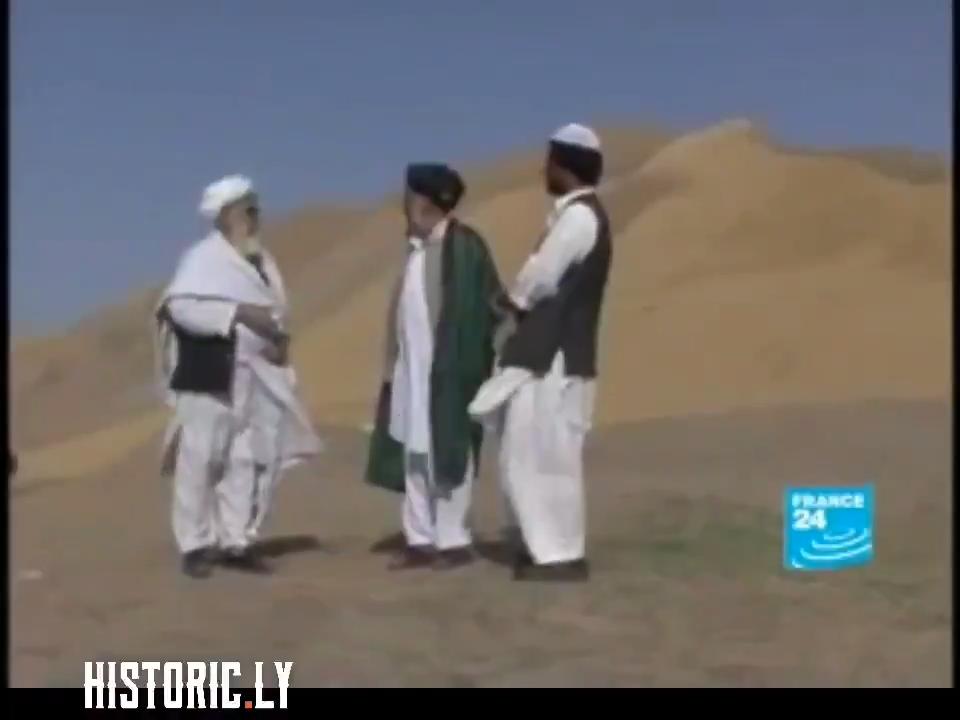
Including General Dostum
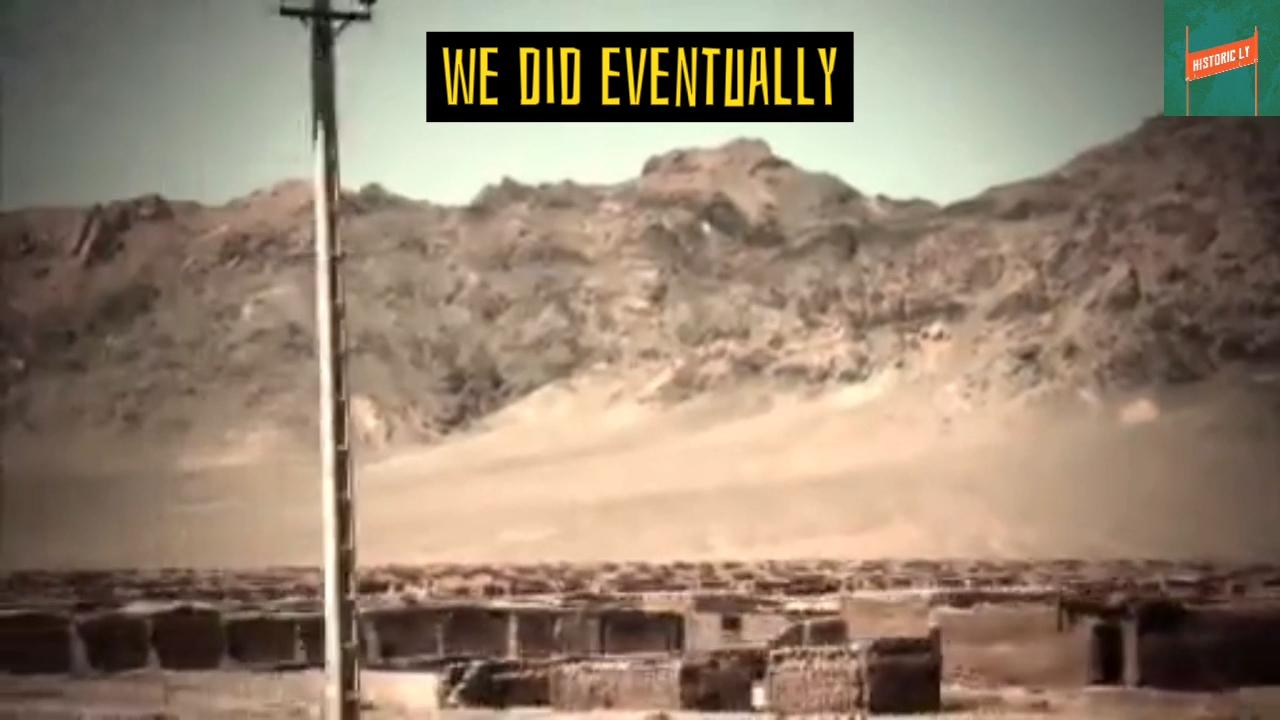
In fact, things were so bad with the warlords in power, some people actually felt nostalgia for Taliban. A baker said, “ from the point of view of security, the Taliban were good” because he didn’t get robbed by a different warlord on a different street corner everytime he went home.
Pacha Khan Zardar set up road blocks and started extorting tolls. The central government tried to get him but they couldn’t…so they compromised and gave him a government post. Nato met with him as well as Gehrardt shroder. pic.twitter.com/L55OVjiFCM
— Esha K (@eshaLegal) August 27, 2021
The Old Warlords Returned to their way of Extorting Afghans
Even women’s group like RAWA expressed similar sentiments. In 2004, Miriam Rawi, a member of an Afghanistani women’s liberation organization wrote a scathing article about the post-Taliban regime in Afghanistan, entitled, “Rule of the Rapists.” She quoted one NGO worker who said "During the Taliban era, if a woman went to market and showed an inch of flesh she would have been flogged; now she’s raped.”
Another horrific practice was also resurrected in Afghanistan. The Baazi Baccha, where rich warlords would take young preteen boys and sexually assaulted them. The practice was so common that the Taliban could honey pot the Afghan police with young preteen boys. This happened under the watchful eyes of the US military who were given orders to ignore this practice, if they happened to see it.
Warlord Extortion in Afghanistan During the US-Backed Occupation (2001–2021)
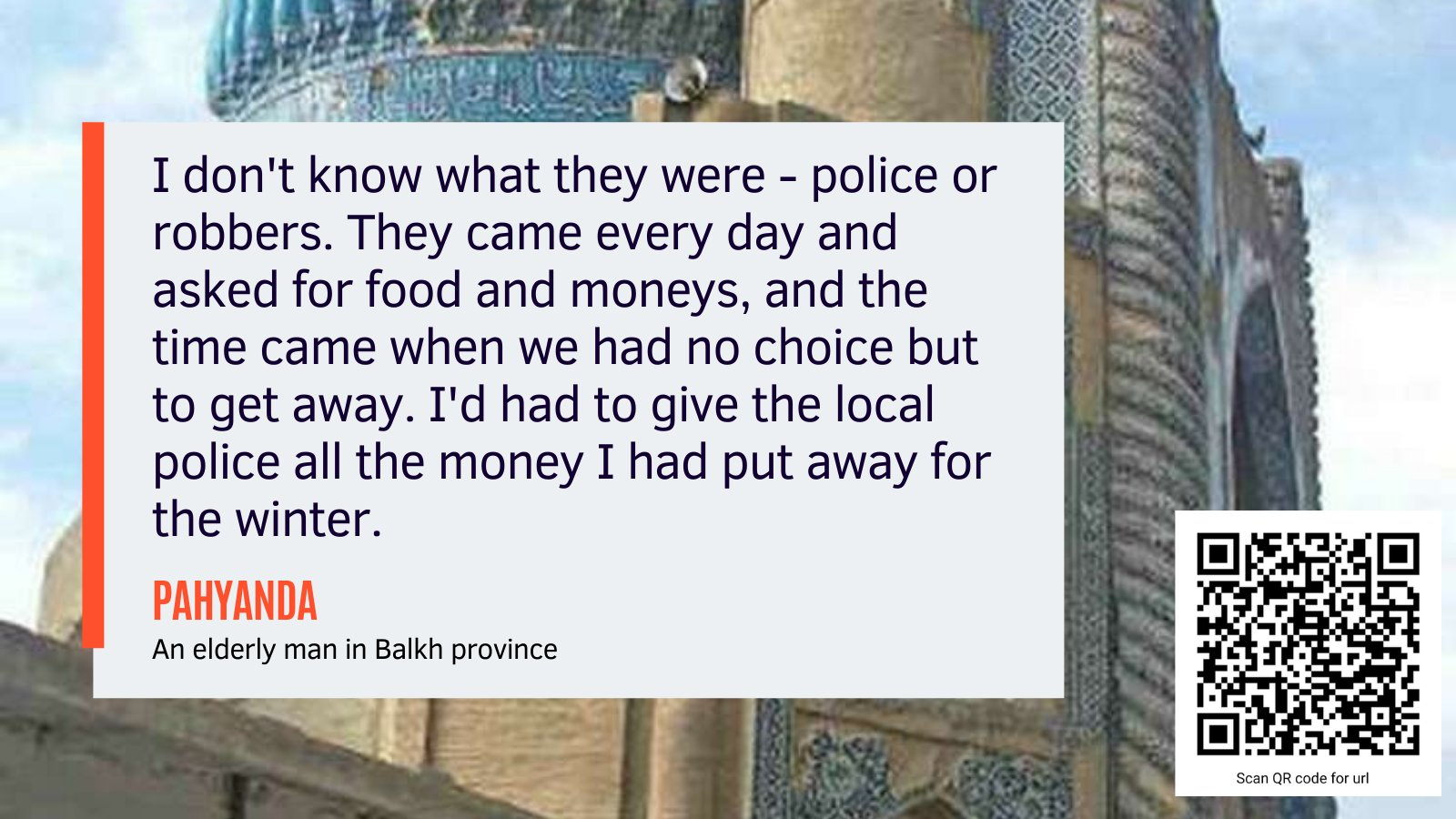
Under the US-supported Afghan Republic, many provincial governors — often former mujahideen commanders turned “warlords” — exercised near-feudal control over their regions. Backed by personal militias and the central government’s patronage system, they routinely extorted ordinary Afghans for “taxes,” protection money, food supplies, bribes, and resources. Farmers and merchants were forced to hand over portions of their harvests or earnings; families paid informal levies to avoid harassment or violence; and local businesses faced demands for everything from fuel to vehicles. In provinces like Balkh, Nangarhar, and Kandahar, testimonies like that of Pahyanda illustrate how these networks blurred the line between official police/government forces and outright robbery. Rotating appointees often exacerbated the problem by extracting what they could before being shifted elsewhere, while long-serving strongmen like some of the more entrenched governors built patronage machines that treated provinces as personal fiefdoms. This systemic predation, fueled by massive inflows of foreign aid and weak oversight, eroded public trust, deepened grievances, and ultimately undermined the state’s legitimacy — contributing to the swift collapse in 2021 as many communities saw little reason to defend a predatory order…
The former warlords reinstated the massive growth of opium and poppy in their country. On top of that, USAID came with a condition that the farmers use Monsanto’s patented seeds. In 2009, Afghanistan changed its seed laws to align with these policies, making it much harder for farmers to save, replant, or share traditional seeds. The new regulations favored commercial, patented varieties that farmers had to purchase anew each season. Afghan farmers could not afford to grow wheat under these conditions — the costs of the required seeds, fertilizers, and inputs were prohibitive compared to their traditional methods. As a result, many turned to poppy cultivation instead, which was more immediately profitable. During the 20-year occupation, half of Afghan children were malnourished, while the warlords became unbelievably rich.
As for girls education, while much funding was allocated by USAID, schools were never built, or partially built, then blown up, then they got more US funding to build schools. This was obvious since the main beneficiaries fof US supply chain and contractors were warlords, who saw USAID as a way of lining their pockets instead of building much needed infrastructure.
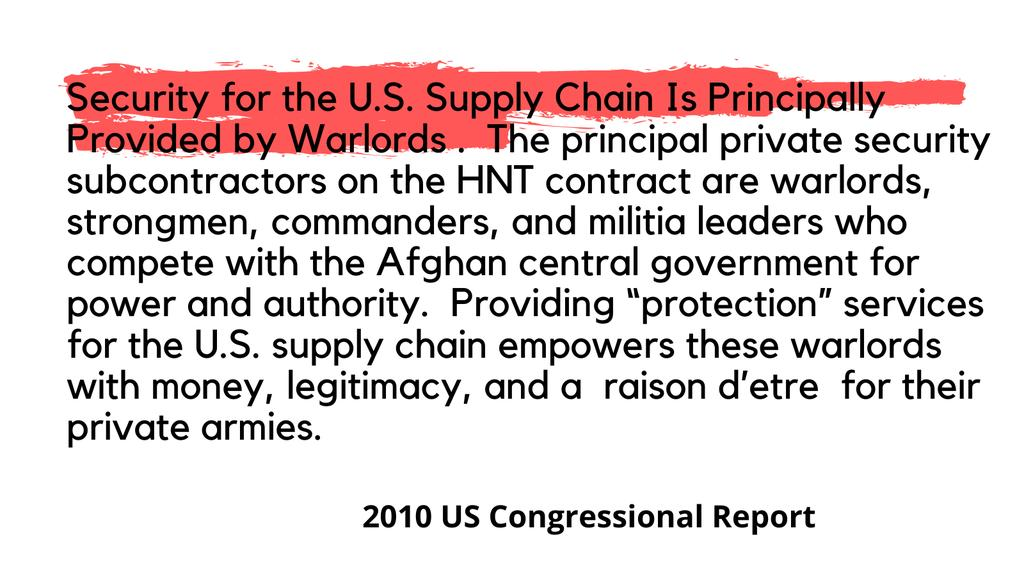
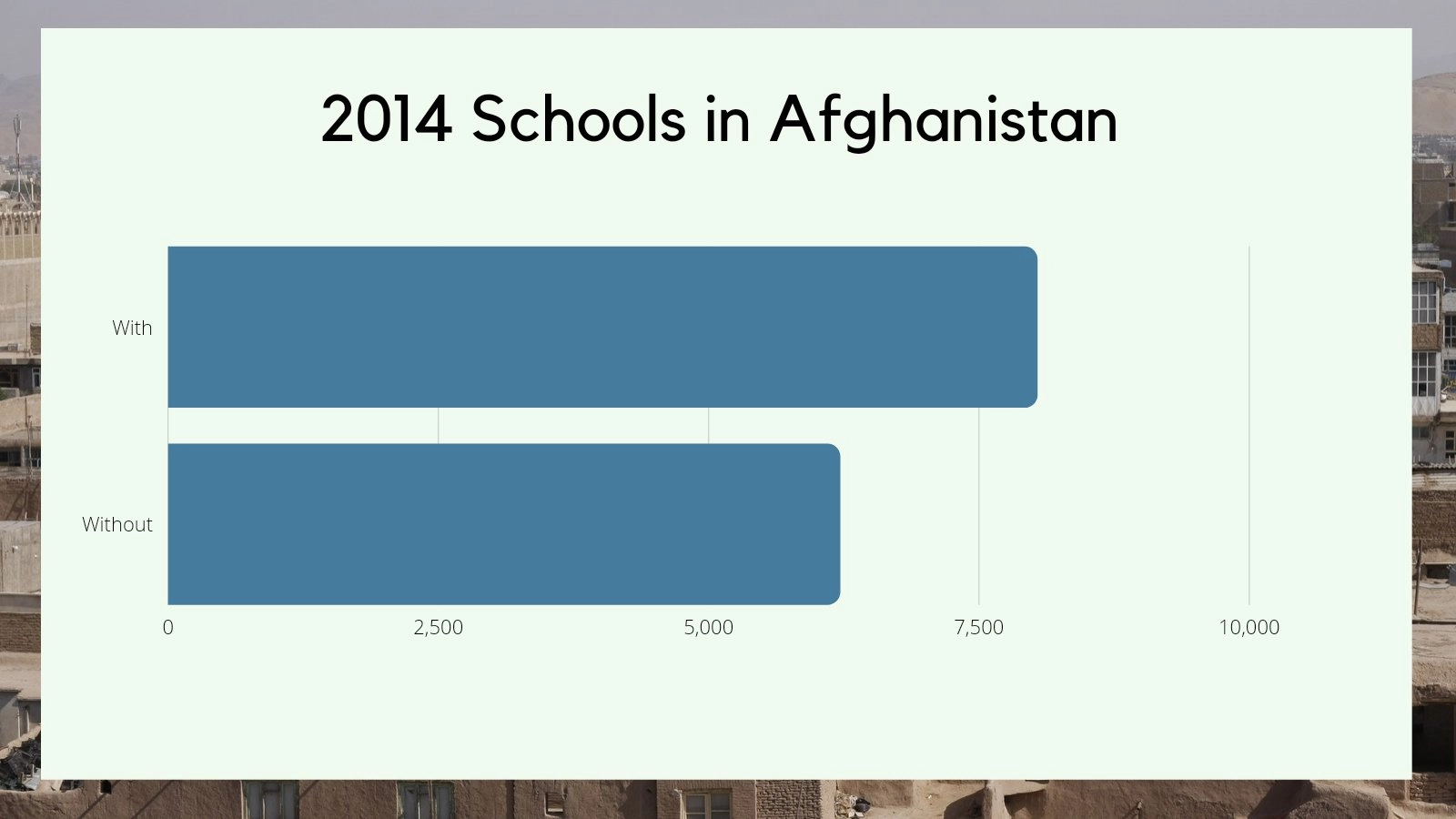
This became obvious, since in 2014, according to a congressional report, there were 5000 schools “without buildings” or in other words, “no school." Illiteracy remained common.
None as bad as Helmand province where in 2021 99% of the women remained illiterate.
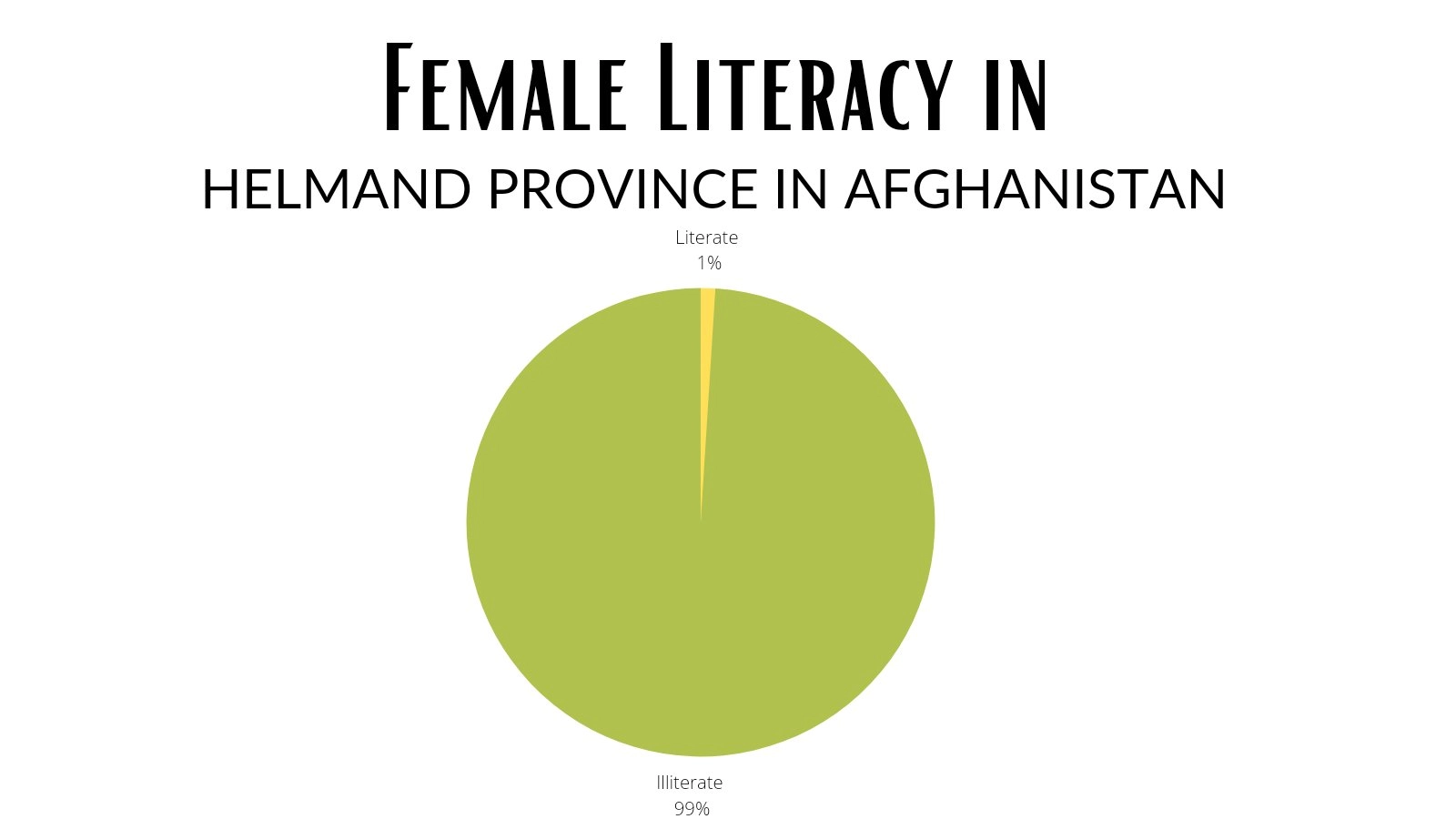
Helmand Province in 2021
Meanwhile, Michael Parenti, never accepted the premise that the removal of the Taliban would be good for Afghanistan. He said, “If anything positive can be said about the Taliban, it is that they did put a stop to much of the looting, raping, and random killings that the mujahideen had practiced on a regular basis. In 2000 Taliban authorities also eradicated the cultivation of opium poppy throughout the areas under their control, an effort judged by the United Nations International Drug Control Program to have been nearly totally successful. With the Taliban overthrown and a Western-selected mujahideen government reinstalled in Kabul by December 2001, opium poppy production in Afghanistan increased dramatically.”
Throughout his commentary on Afghanistan, Chomsky provided valuable legal and procedural criticism. He was right about the bad-faith rejection of Taliban offers, the corruption of the occupation, and the ultimate failure of nation-building. However, by accepting the foundational premise that the Taliban’s removal was desirable — and by framing the debate largely around U.S. methods rather than the wisdom of intervention itself — he remained firmly inside the empire’s sandbox. This is what makes his anti-imperialism incomplete. He serves as a sharp diagnostician of imperial failure after the fact, but he does not consistently challenge the assumptions and narratives that make such interventions possible in the first place. For a more thoroughgoing critique, one must step outside that sandbox entirely — something voices like Michael Parenti were more willing to do.
Listen to our classic podcast episode to learn more about Afghanistan’s history
If you’ve made it this far, and found our article illuminating, please remember we are 100% reader supported. If you think this work matters, throw us a few dollars so we can keep going. The empire certainly isn’t funding us.
From Historic.ly via This RSS Feed.