

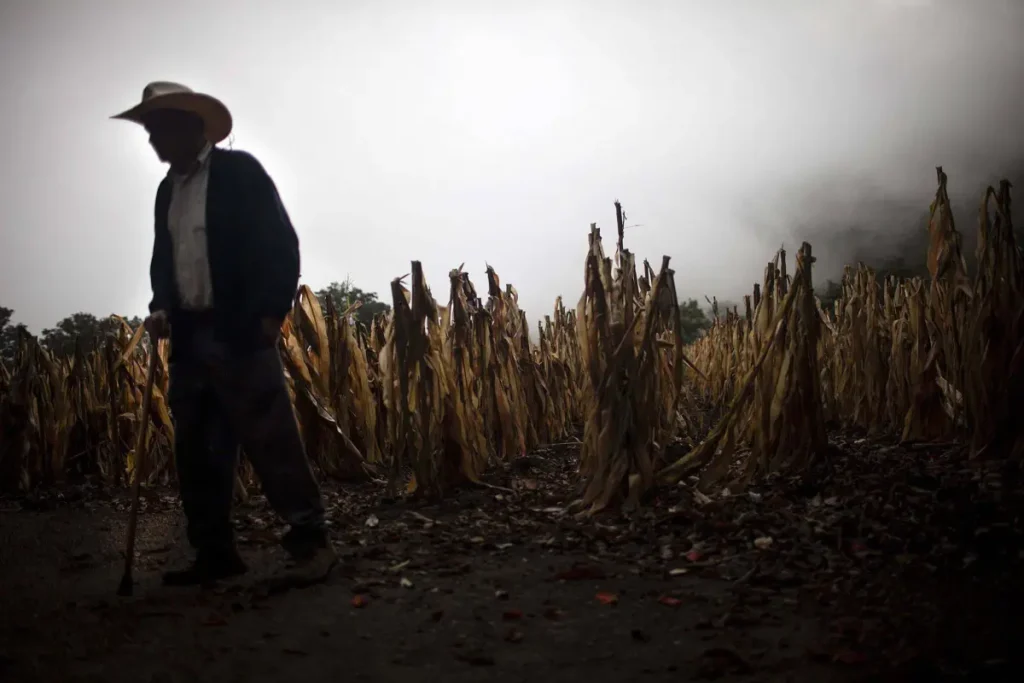
On Tuesday, agricultural authorities in the country indicated Guatemala is on the verge of a water shortage and extreme temperatures that threaten the production of staple grains, due to an unusually prolonged heat wave and the El Niño impact in Central America.
RELATED:
Brazil Floods Minas Gerais: Devastating Rains Claim 69 Lives in Tragic Crisis
The heat wave is the year season with the highest temperatures, characterized by extreme heat, decreased rainfall, and clear skies. Rafael López, Geographic, Strategic, and Risk Management Information (Digegr), director, at the Ministry of Agriculture, Livestock, and Food (MAGA), told EFE that the lack of rain since May has left the soil in critical condition.
López noted that the country is at the beginning of the heat wave, which paints an alarming picture for food security. “The most worrying aspect this year is its prolonged heat wave. We’re talking about a heat wave lasting more than 40 to 42 days, or even longer,” the official explained.
This thermal anomaly is compounded by the strengthening of the El Niño phenomenon, whose probability of impact now exceeds 98%, pushing temperatures above 35 degrees Celsius. López warned that the combination of water scarcity and extreme heat will generate severe “plant stress” in the Central American country’s crops.
“We could see cases of lost germination, that yellowing color change in plants, which is chlorosis, or slow growth and even grain abortion,” the official argued. He clarified that, although 119 crop categories are monitored, the institutional priority is focused on protecting corn and beans, as they are the foundation of the Guatemalan diet.
Los cambios climáticos en Guatemala son algo que preocupa no solo a las personas que viven en la ciudad, también tienen impacto en las personas que utilizan la agricultura como sustento principal.https://t.co/pDy1x6A3Cs pic.twitter.com/x09zlfCnsn
— LiberalGt (@GtLiberal) July 5, 2026
The text reads, “Climate change in Guatemala is a concern not only for people living in the city, but also for those who rely on agriculture as their main source of income.”
So far, the northeastern and northwestern regions of the country are already experiencing these early impacts, specifically in the provinces of Izabal and Huehuetenango, as well as the municipality of Alotenango in the central department of Sacatepéquez.
Faced with this double threat, the office headed by López assessed the country’s 340 municipalities by cross-referencing records of agricultural damage, droughts, and floods accumulated over the last ten years, between 2015 and 2025. The mathematical model determined a widespread alert, categorizing 123 municipalities as having “very high vulnerability,” 129 as having “high” vulnerability, and 88 as having “medium” vulnerability.
To counteract this vulnerability, the Ministry of Agriculture has turned to the use of digital precision agriculture. According to López, these tools allow for data processing and the issuance of technical recommendation bulletins. “Digital agriculture demonstrates the value of moving from intuition to precision agriculture. Having data, having evidence, allows us to put technological contributions on the table,” he stated.
The official also confirmed that the Ministry is implementing a plan of anticipatory measures financed with resources from its own budget, in coordination with the National Coordinator for Disaster Reduction (CONRED). “We are preparing the strategic food reserve. We are discussing agricultural insurance to identify vulnerable areas of the country,” he concluded.
#FromTheSouth News Bits | In Guatemala City, residents blocked three main roads in the village of Santa Elena Barillas in protest over an increase in public transportation fares. pic.twitter.com/oXJppTmmwM
— teleSUR English (@telesurenglish) June 5, 2026
From teleSUR English via This RSS Feed.