

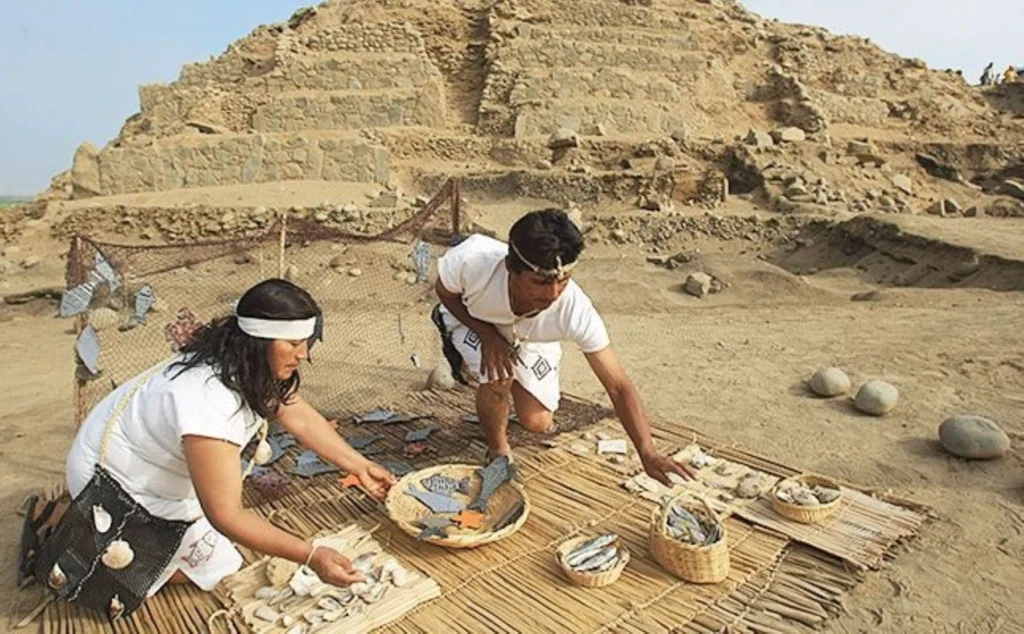
A collection of 43 ancient figures belonging to the Caral civilization was discovered at the Peñico archaeological site, located in the Supe Valley, north of Lima. The pieces, crafted from bone and wood, represent gods, animals, and human faces, and were presented at the Peruvian Ministry of Culture on Monday.
RELATED:
The discovery provides new evidence about the cultural continuity processes that developed in the region after the abandonment of the main urban centers of this civilization, considered the oldest in the Americas, which flourished between 3000 and 1800 BCE.
During the presentation, archaeologist Mauro Ordóñez, head of the Peñico archaeological site, told the EFE news agency that the miniatures date from between 1800 and 1500 BCE. However, the building where they were found is 3,800 years old. Ordóñez noted that specialists are awaiting the results of carbon-14 dating to confirm their exact age.
Regarding the significance of the find, the archaeologist indicated that the figures “have a very powerful iconographic charge in symbolic terms.” The collection includes anthropomorphic, geometric, and zoomorphic representations. Among the anthropomorphic figures, probable deities and authorities were identified, as well as a “Venus of Peñico,” a headless female figure.
Ayacucho | La ministra de Cultura, Soraya Altabás Kajatt, realizó una visita de trabajo al Complejo Arqueológico Wari, uno de los principales centros urbanos del antiguo Perú y legado de una de las civilizaciones más importantes de nuestra historia. pic.twitter.com/DT9JROjsGq
— Ministerio de Cultura (@MinCulturaPe) July 6, 2026
The text reads, “Ayacucho | The Minister of Culture, Soraya Altabás Kajatt, made a working visit to the Wari Archaeological Complex, one of the main urban centers of ancient Peru and a legacy of one of the most important civilizations in our history.”
The context of the find is fundamental to Peruvian archaeology. The miniatures were carefully arranged around semicircular stones and show signs of fire. This confirms that they were used in a ritual associated with the architectural renovation of the settlement’s main public building. “They were found in an offering process… there is a context of respect at the time of leaving this offering,” Ordóñez added.
The urban center of Peñico, founded around 1800 BC on a 19.44-hectare site, emerged after the decline of the Sacred City of Caral-Supe, located 13 kilometers away. Far from representing a break, research shows that this city, which boasts 15 public buildings, functioned as a hub for integration between the coast, the highlands, and the rainforest, receiving goods from these regions.
Excavation work continues under the direction of archaeologist Ruth Shady, head of the Caral Zone. The team hopes to unearth more artifacts at the site and study other structures to understand the social dynamics of this ancient civilization.
#Peru | More than 400 inmates starred in the musical ‘Llactaman Kutiriq Raymi 2026’ in the city of Cusco. ‘Llactaman Kutiriq Raymi 2026’ means ‘The Festival Returns to My People’ in Quechua.https://t.co/gQIXt2nXTB
— teleSUR English (@telesurenglish) June 24, 2026
From teleSUR English via This RSS Feed.