

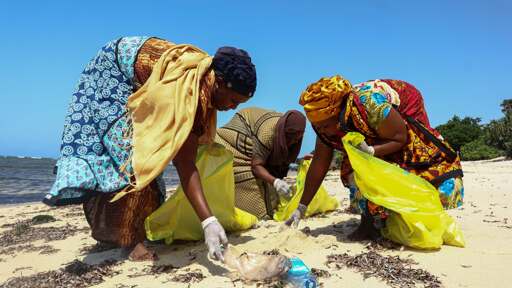
During the 11th Our Ocean Conference held in the coastal city of Mombasa, the Kenyan government, together with the World Economic Forum’s Global Plastic Action Partnership (GPAP) and UNDP Kenya, formally launched the Kenya National Plastic Action Partnership (NPAP Kenya). At least 14 million tons of plastic end up in the ocean every year making up 80% of all marine debris found in surface waters and deep-sea sediments. Kenya faces considerable challenges with plastic pollution, particularly in urban centers and along its coastline. Plastics account for 20% of the 22,000 tonnes of waste generated daily in Kenya, according to estimates. Only 27% of the plastic waste is collected, of which 8% is recycled and the remaining 19% disposed of in unsanitary landfills or dumpsites. The plastic waste not properly collected and managed often ends up in rivers and the ocean. It disrupts ecosystems, endangers wildlife, and impacts tourism and fisheries. In 2017, Kenya introduced a ban on the use, manufacture and importation of single-use plastic bags. In 2020, the ban was extended to single-use plastics in protected areas. NPAP Kenya will help accelerate the country’s transition to a circular plastics economy, according to Clemence Schmid, Director, Global Plastic Action Partnership (GPAP) at the World Economic Forum (WEF). Clemence Schmid, Director, Global Plastic Action Partnership, World Economic Forum during the formal launch of NPAP, Kenya at the Our Ocean conference in Mombasa. Image courtesy of NPAP Kenya. The GPAP launched by the WEF in 2018 is a multi-stakeholder initiative to tackle…This article was originally published on Mongabay
From Conservation news via This RSS Feed.