

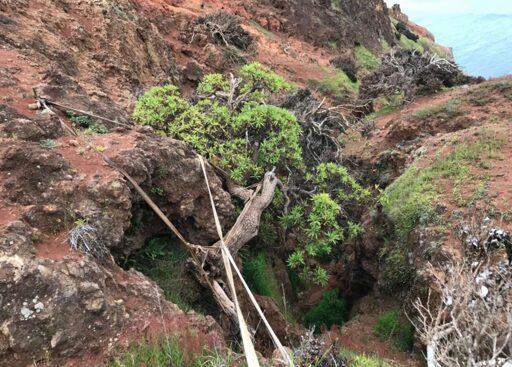
On Chile’s Robinson Crusoe Island, in the South Pacific, a tree juts out precariously from the side of a steep cliff. It’s the last known wild individual of Dendroseris neriifolia. To prevent its total extinction in the wild, conservationists recently collected seeds from the tree and have begun trials to cultivate them. All 11 species of the genus Dendroseris are exclusive to the Juan Fernández Archipelago off Chile. The trees, with striking yellow, orange or white flowers, have been nearly wiped out by extensive habitat degradation, invasive plants, and damage by introduced mammals such as goats and rodents. Only one known wild individual of the critically endangered D. neriifolia remains on Robinson Crusoe, one of the three main islands in the archipelago, according to Paulina Hechenleitner, research associate at Royal Botanic Gardens, Kew, U.K. This tree, estimated to be around 150 years old, hangs off a remote cliff that “is extremely difficult to access, requiring specialist fieldwork and careful planning to avoid any harm,” she told Mongabay by email. Every year, local conservationists attempt to collect seeds from the tree’s one-seeded fruits. However, fruiting is irregular and some seasons the fruits produce few or no viable seeds, Hechenleitner said. This year, conservationists collected about 400 seeds, of which 29 were considered potentially viable and sent to the Millennium Seed Bank (MSB) at Kew, the world’s largest wild plant seed conservation program. There, researchers used X-ray imaging to confirm that 24 seeds showed the presence of embryo development. These 24 “good…This article was originally published on Mongabay
From Conservation news via This RSS Feed.