

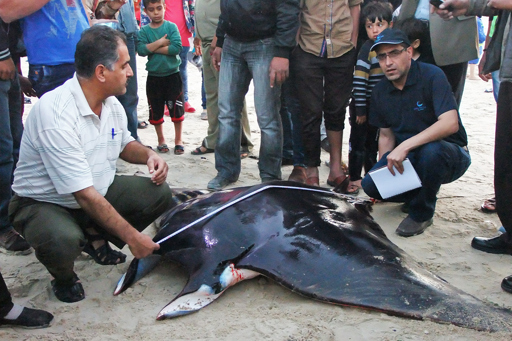
Founder’s Briefs: An occasional series where Mongabay founder Rhett Ayers Butler shares analysis, perspectives and story summaries. Mohammed Abu Daya is a marine ecologist from Gaza. His work focuses on spinetail devil rays, also known as giant devil rays, a critically endangered species that moves through the Mediterranean and beyond. Few scientists specialize in these animals. Fewer still have studied them from Gaza, where local waters form part of their range. Before the war, Abu Daya taught at Palestinian universities and worked from Gaza’s National Research Center. He went to sea with fishers, measured spinetail devil rays (Mobula mobular) brought ashore, monitored markets, and gathered data on a species more often studied from the western Mediterranean. His work helped place Gaza within the known range of the threatened migratory animal, reports contributor Lyse Mauvais for Mongabay. The pressures on Gaza’s sea were already severe. Israeli restrictions limited where fishers could work. Fish stocks had declined. Poverty and fuel costs pushed people toward whatever could be caught close to shore. In 2013, when a large group of devil rays came near Gaza’s coast, fishers landed several hundred of them. Abu Daya did not treat the event only as a conservation failure. He tried to understand what had led to it, including the lack of local conservation systems and the strain on people living with few choices. Then came the current war. Abu Daya lost his home, his office, and regular access to the sea. Universities, libraries, fishing boats, landing sites, and…This article was originally published on Mongabay
From Conservation news via This RSS Feed.