

From the 1811 declaration in Caracas to the Battle of Carabobo, the struggle for Venezuelan sovereignty fused elite political ambition with mass social participation.
Venezuela commemorates its Independence Day on July 5, an historic event in 1811, when the country formally broke away from Spanish colonial rule. The decision made in Caracas over two centuries ago changed the geopolitical landscape of the continent and initiated a long process of regional self-determination.
RELATED: Venezuela Commemorates 215 Years of Independence
The declaration of independence was the result of deep social, economic and political shifts occurring both globally and locally. Until now, July 5 is marked by official speeches, civic parades and reflections broadcast across national media.
To learn more about this Venezuelan commemoration, we need to delve into the context: the declaration of independence, the movements behind it, and the unity and support across the continent.
Today in History:
Venezuela celebrates its Independence Day (Día de la Independencia or Cinco de Julio), marking the 215th anniversary in 2026 of its declaration of independence from Spain in 1811.
Venezuela became the first South American nation to formally declare… pic.twitter.com/5Iap1rqKcJ
— Echoes of Eras (@echoesoferas1) July 5, 2026
Context of a Declining Empire
The road to Venezuelan independence began amidst an international crisis that weakened the Spanish Empire. In 1808, French forces led by Napoleon Bonaparte invaded the Iberian Peninsula, forcing King Ferdinand VII of Spain to abdicate.
This sudden power vacuum left the Spanish colonies in the Americas without a recognized sovereign ruler. In response, local leaders across Spain’s colonies formed governing councils, known as juntas, to manage their own affairs during the crisis.
On April 19, 1810, the town council of Caracas established the Supreme Junta, initially claiming to rule in defense of the deposed Spanish king’s rights while establishing practical autonomy.
Inside Venezuela, internal economic and social tensions further accelerated the push for complete independence. The wealthy, locally born Spanish descendants, known as criollos, had long grown frustrated with Spanish mercantilist policies.
These imperial laws forced Venezuela to trade almost exclusively with Spain, suppressing local economic growth and penalizing agricultural producers.
At the same time, Venezuela’s society was strictly stratified. The “criollo” elites (as was known the locals) wanted political power matching their economic status, but faced severe internal pressure from the vast majority of the population, which included Indigenous groups, Afro-descendants, and pardos (mixed-race citizens) who sought broader social and economic rights.
The geopolitical landscape was also heavily influenced by radical philosophical ideas. Intellectuals and revolutionary networks in Caracas studied the ideals of the European Enlightenment, the United States Declaration of Independence of 1776, and the French Revolution of 1789.
These intellectual developments convinced early Venezuelan leaders that reforming their relationship with Spain was no longer viable, making a total break from the imperial center inevitable.
When, Where, and How the Declaration Was Signed
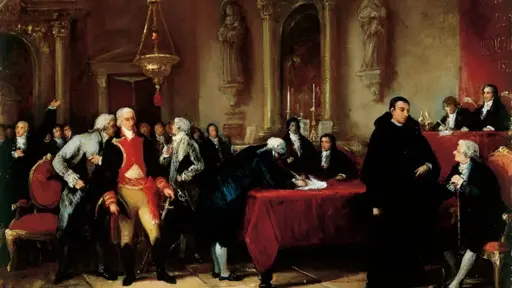
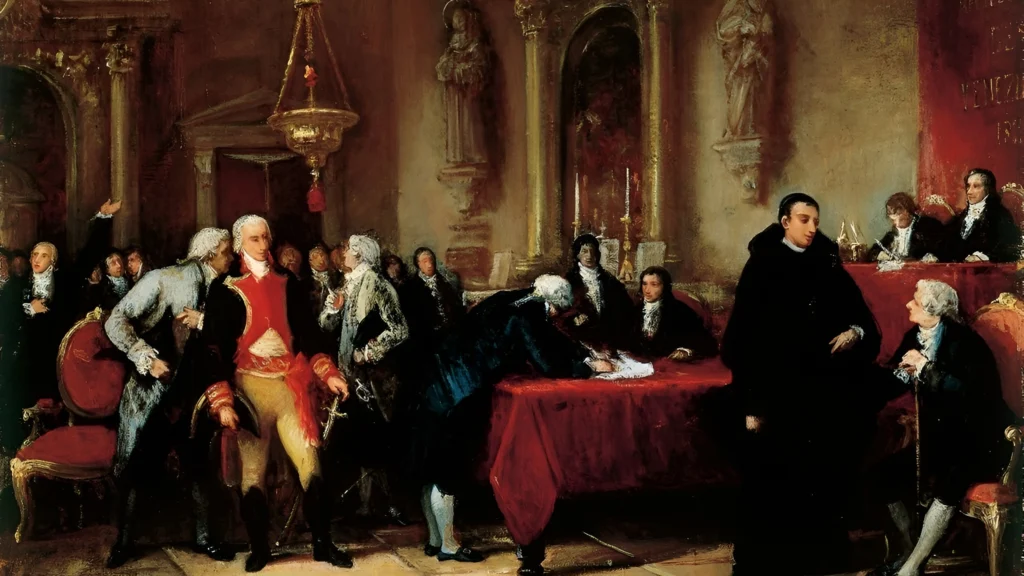
The growing demand for self-determination culminated in the historic sessions of the first Constituent Congress of Venezuela, which began meeting in early 1811.
Representatives from seven of the ten provinces that made up the Captaincy General of Venezuela gathered at the Chapel of Santa Rosa de Lima in Caracas. On July 5, 1811, after days of debates, the Congress held a decisive vote.
The delegates agreed to sever all ties with the Spanish Crown, officially establishing the American Confederacy of Venezuela, later known as the First Republic. This made Venezuela the first South American nation to declare independence.
Juan Germán Roscio and Francisco Isnardi drafted the Act of the Declaration of Independence, and it was signed by the representatives in the subsequent days. The document declared that the provinces were free and independent states, fully absolved of any allegiance to the Spanish monarchy.
However, the declaration faced immediate resistance from royalist factions, and it exposed deep divisions within Venezuelan society. The early independent government was primarily designed by the “criollo” elite, who initially maintained traditional socio-economic structures, including the system of slavery.
For the revolution to survive the upcoming military counter-offensive from Spain, the pro-independence leadership eventually had to realize that formal declarations signed in a boardroom were not enough. To achieve actual sovereignty, the movement needed to evolve into a popular, mass-mobilized struggle that included the broader working-class, pardo, and Afro-descendant populations.
5 July 1811: #Venezuela declares its #independence from #Spanish rule, becoming the first South American nation to do so. The historic declaration, spearheaded by Francisco de Miranda and Simon Bolivar, ignites the #Venezuelan War of Independence and inspires liberation movements… pic.twitter.com/1zs4xf8Tci
— Today In History (@URDailyHistory) July 6, 2026
Key Figures and Their Vision
The push for Venezuelan independence was driven by a diverse group of leaders with distinct perspectives. Among the most prominent early figures was Francisco de Miranda, known as the “Precursor.” Miranda was an experienced military strategist who had fought in the American Revolutionary War and served as a general in the French Revolution.
He brought an internationalist perspective to the Venezuelan struggle, advocating for the creation of a massive, unified independent nation spanning Latin America, which he envisioned calling “Colombeia”. Miranda’s return to Caracas in 1810 energized the radical factions pushing for an immediate declaration.
Another central figure in this process was a young Simon Bolivar, who would later become known across the continent as the “Liberator“. During the historic debates leading up to July 5, Bolivar was a prominent member of the Patriotic Society.
In a famous speech before the society on July 3, 1811, Bolivar challenged the hesitation of the conservative delegates by asking, “Are three hundred years of calm not enough?” He argued that the Congress should not fear great projects, but rather view delay as dangerous.
The success of the independence movement ultimately depended on leaders who could bridge the gap to the masses. As the war progressed, figures like Jose Antonio Paez emerged, leading the so-called “llaneros“. The inclusion of the llaneros transformed the revolutionary army into a force composed of Indigenous, African, and mixed-ancestry soldiers.
These figures demonstrated that independence could not be won solely by aristocratic ideas; it required the direct participation of the subaltern classes fighting for their own social liberation.
The Long March to Sovereignty
The formal declaration of July 5, 1811, was followed by a brutal and protracted war that lasted over a decade. The first years of the conflict were devastating for the republican forces.
The First Republic collapsed in 1812, leading to the capture of Francisco de Miranda by Spanish forces. Simón Bolívar temporarily revived the independence movement during the Admirable Campaign of 1813, establishing the Second Republic.
This movement also fell under heavy counter-offensives by royalist forces and the llaneros under Jose Tomas Boves, who initially fought against the criollo elites.
A critical turning point occurred during Bolivar’s exile in 1815. While in the Caribbean, he penned the Carta de Jamaica (Jamaica Letter), analyzing the failures of the early republics and outlining a vision for Latin American unity.
Seeking material support, Bolivar traveled to Haiti, where President Alexandre Pétion provided vital military supplies, funds and haven. Pétion asked for a commitment to abolish slavery in the liberated territories, a pivotal agreement that linked the military objective of national sovereignty with the social objective of human emancipation.
The ultimate military liberation of Venezuela was secured on June 24, 1821, at the Battle of Carabobo. On this savanna, Bolivar’s unified Republican army, which now fully integrated the llanero cavalry under Jose Antonio Paez and the British Legions, defeated the royalist army led by Miguel de la Torre.
The victory at Carabobo effectively broke the back of Spanish military power in the territory, allowing the project of Gran Colombia, a large federated republic encompassing Venezuela, Colombia, Ecuador and Panama.
Today marks the 215th anniversary of the independence of #Venezuela
Throughout our history, there have been times of victory & times of hardship.
The people of Venezuela have shown —like never before — their spirit of solidarity following the earthquakes that struck on 24 June. https://t.co/f03AGLuQ7x
— Misión de Venezuela ante la Unión Europea (@misionven_ue) July 5, 2026
The Unfinished Revolution of the Global South
The declaration of independence on July 5, 1811, was a foundational event that permanently altered the global geopolitical landscape. By taking the step to sever ties with Spain, Venezuela set a historical precedent for anti-colonial movements across the Americas.
The subsequent decade of warfare proved that sovereignty could not be sustained through legislative decrees alone; it required regional solidarity, mass popular mobilization, and a fundamental restructuring of social hierarchies.
In modern Venezuelan discourse, as reflected by state officials and public media outlets, the legacy of July 5 is viewed not merely as past history, but as an ongoing responsibility.
Contemporary leaders often draw parallels between the 19th-century resistance against the Spanish Crown and current efforts to maintain economic and political self-determination against foreign economic coercion and external pressures.
Sources: Britannica – EBSCO – Radio Nacional de Venezuela – Con El Mazo Dando – TeleSUR – Official Page Vice Presidency – Ministry of Foreign Affairs – Venezuelanalysis
From teleSUR English via This RSS Feed.