

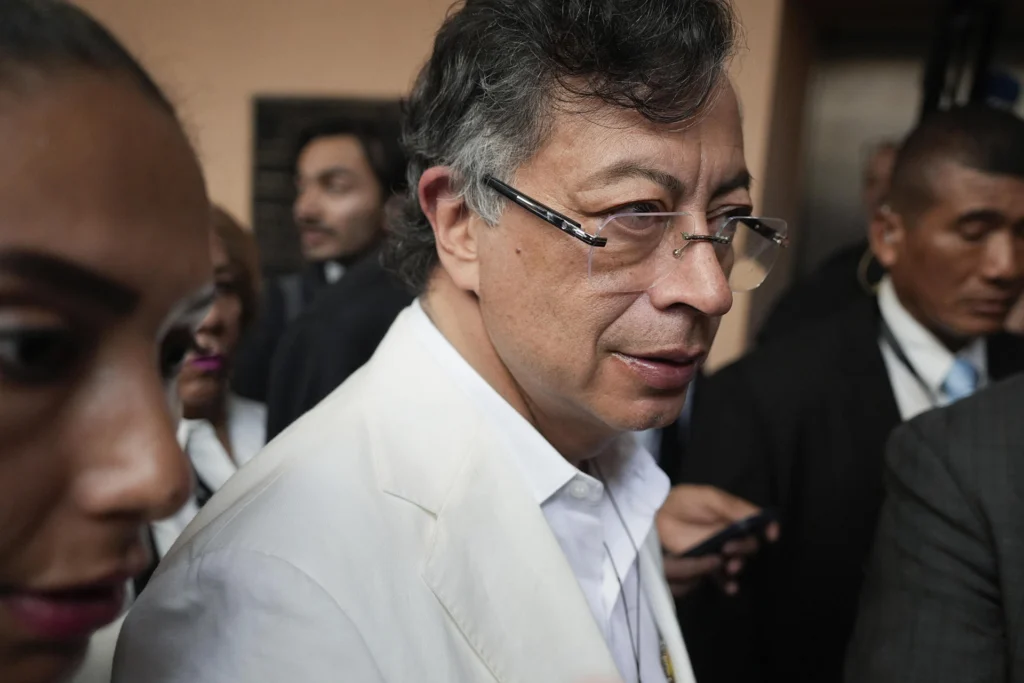
Colombian President Gustavo Petro dismissed this Monday as an “anachronism” the proposed urban security blocks championed by President-elect Abelardo de la Espriella, warning that could deepen social unrest rather than curb crime.
Gustavo Petro argued that the solution to urban violence lies in targeted police intelligence -identifying gang leaders, their hierarchies and hideouts- rather than deploying broad security battalions reminiscent of past military operations.
“The famous search blocks are an anachronism. It is police intelligence that must have the names of gang members, their hierarchies and their residences”, the Colombian President declared.
RELATED: Petro Calls July 20 Rally to Defend Colombia’s Reforms
The remarks came in response to De la Espriella’s announcement that on his first day in office he would sign a decree creating the Urban Security Defense Blocks, a strategy initially targeting Colombian largest cities to combat extortion, homicides and robberies. The president-elect has framed the initiative as part of his “total security” policy, though key details -including structure, budget, participating institutions and operational powers- remain unspecified.
Petro insisted that the criminal gang phenomenon is directly linked to the social and economic exclusion afflicting thousands of young Colombians and Venezuelans. “Responding with force in popular neighborhoods could aggravate social conflict“, he warned, redirecting the debate toward prevention over repression.
Las ciudades de Colombia, excepto Barranquilla han mejorado sus niveles de seguridad frente a la delincuencia común urbana.
Se desplomó el feminicidio, se desplomó el hurto a celulares, residencias y comercio se ha reducido el secuestro. La tasa de homicidios en las grandes… https://t.co/aj8aUafWe9
— Gustavo Petro (@petrogustavo) July 6, 2026
Text reads: “…The ICE strategy has caused a lot of pain, violence, and death in the US. Abelardo wants to create ICEs to confront the youth in the working-class neighborhoods of big cities; this will only bring more violence and death. Instead of dialogue with the youth, Abelardo, with the support of the state, is thinking to swing the bat of hitting heads of councillor Gury. Pure, ignorant Creole fascism. The best remedy to end criminal gangs is not to open high-cost jails, but university campuses….”
Peace Legacy at Stake
Beyond the urban security dispute, De la Espriella has announced plans to dismantle Petro’s “Total Peace” policy -the flagship security strategy of his administration aimed at demobilizing all armed groups and definitively ending Colombia’s six-decade internal conflict. The president-elect labeled the initiative as “converted into impunity”, arguing it resulted in the delivery of territories to “illegal organizations.”
The decision could reverse years of dialogue and demobilization efforts that, while widely criticized as ineffective, represented the most ambitious peace framework attempted since the 2016 accord with the Revolutionary Armed Forces of Colombia (FARC, in Spanish). De la Espriella’s victory in the June 21 runoff -the closest in Colombian history, securing 49.66% of the vote against 48.70% for Iván Cepeda- has been interpreted as a mandate for a sharp shift in security policy.
Gustavo Petro countered that the response to organized crime should not focus on building more prisons, but on expanding education, university campuses and youth work cooperatives in partnership with the National Learning Service (SENA, in Spanish). His administration has overseen a decline in poverty and unemployment alongside a rise in public debt, though his health and labor reforms stalled in Congress.
The incoming administration’s security blueprint remains vague in operational terms, leaving analysts and local leaders questioning how the blocks will be deployed, funded and coordinated with mayors of major cities -whom De la Espriella has promised to convene. Meanwhile, the outgoing President’s call for a social rather than militaristic approach sets the stage for an intense debate over Colombian security future, as the country prepares for a transition that could redefine its approach to urban violence and armed conflict.
From teleSUR English via This RSS Feed.