

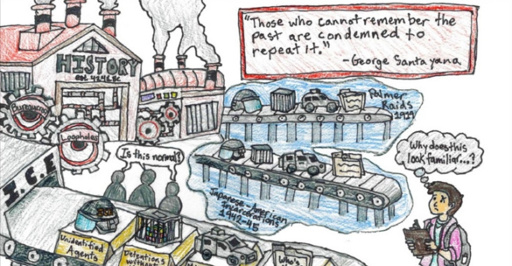
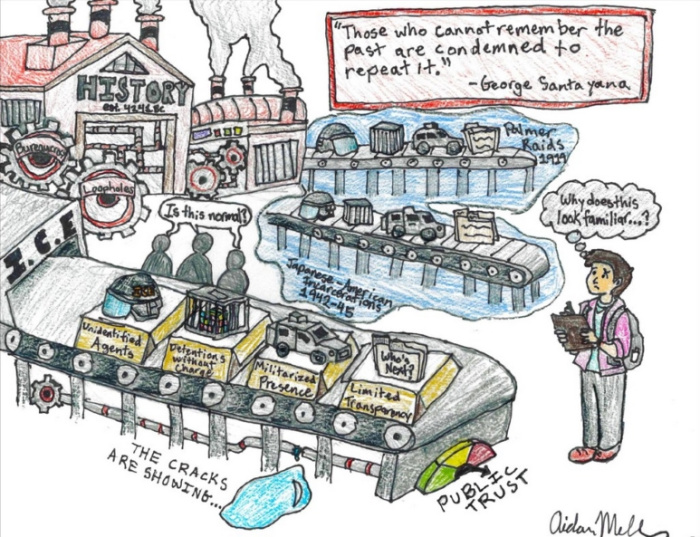
Omaha’s Gretna East High School censored a cartoon by Aidan McClaren that dared to suggest that the era of ICE raids resembled past episodes of repression.
The Wingspan ran a cartoon in January by Aidan McClaren, comparing modern-day actions of ICE with the Palmer Raids against American radicals in the 1920s and the World War II incarceration of Japanese Americans. The well-known quote from George Santayana appears at the top: “Those who cannot remember the past, are condemned to repeat it.” A bystander observes, “Why does this look familiar…?”
Political cartoonists in newspapers across the nation have made similar comparisons over the years, but the Wingspan is different, and its case differs from previous FAIR reports (3/27/25, 9/30/25, 4/9/26) on censorship of cartoons, in that it is a student newspaper. Within two days, school administrators at Gretna East High School in Omaha, Nebraska, had taken the cartoon off the paper’s website. McClaren, a junior, was not surprised by the decision, telling Nebraska Public Media (4/2/26): “I knew it was controversial. I knew that people would disagree. But isn’t that the point?”
Gretna East student and fellow Wingspan journalist Nicholas Mitchell appealed the decision to the local school board, which has not issued a ruling as of this writing. Mitchell asks for the cartoon to be republished, the district to adopt a student media policy, and for an end to prior review of content by administrators rather than faculty advisers. The Student Press Law Center sent a letter expressing their support, as has the Foundation for Individual Rights and Expression.
The incident of the Wingspan is part of an emerging pattern of censorship directed at student media over the past two years. The censorious attitude documented by FAIR (6/9/26) that reigns under the current presidential administration—which threatens to withhold funds from schools that teach unsanctioned ideas, demands that they crack down on anti-genocide protests, and even deports international students who express the wrong opinions—has increasingly filtered down to the student media in the country’s universities and high schools.
The Student Press Law Center reported 325 calls to their legal hotline for censorship-related issues this past school year, an increase from 275 in the 2024–25 school year and 237 in the 2023–24 school year.
Censorship of student media is not limited to Republican or conservative-leaning states, however; as we’ll see, examples occur in areas of deep Democratic blue as well.
‘Review all content in school publications’
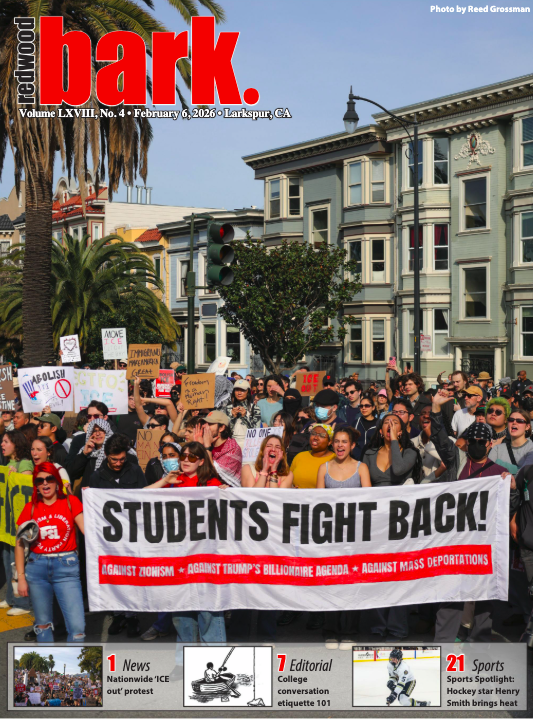
Marin’s Redwood High School launched an investigation into its school paper because this cover photo included the phrase “Against Zionism”—which “has increasingly been used as an antisemitic slur” (EdSource, 4/27/26).
The Redwood Bark, the student paper of Redwood High School in Marin County, California, has been subject to administrative interference in two separate instances. The first instance came after coverage of January 30 protests against ICE. The Bark’s front-page photograph (2/6/26) showed a sign reading “Students Fight Back! Against Zionism, Against Trump’s Billionaire Agenda, Against Mass Deportations.” This led to a letter criticizing the paper for publishing “an image of a protest slogan about Zionism that has increasingly been used as an antisemitic slur.” The school district opened an investigation into the Bark, which the superintendent (EdSource, 4/27/26) stated was necessary to provide an “environment free of harassment and discrimination.”
The second intervention came after the paper searched the federal government’s Epstein Files for mentions of local communities and individuals. The Bark (Instagram, 2/13/26) reported a reference to Giséle Attias Bonnouvrier, who was alleged in records to have procured “models for Epstein.” After someone claiming to be Bonnouvrier threatened to sue the school, the principal emailed the Bark’s faculty adviser with a directive “from the cabinet and superintendent to redact the one name immediately from the post” (EdSource, 4/27/26). The post was taken down but later restored (New York Post, 5/10/26).
Two open letters, one signed by 10 English teachers at Redwood High School, and another signed by 300 parents and community members, opposed the school administration’s interference in the paper’s operations (Marin Independent Journal, 4/1/26). Erin Schneider, faculty advisor for the Bark, announced an abrupt leave of absence after facing “significant resistance” in her role (San Jose Mercury News, 5/11/26).
A school principal in Sarasota, Florida, objected to the publication of two stories in the Torch, the newspaper of the city’s Pine View School—using an AI chatbot to generate “pedagogical” reasons why the stories could not be published. One was an opinion column that opposed changes in the school board’s meeting times, while the other covered student protest of a school board resolution promising to assist ICE. Eventually, both stories were allowed to be published, with the opinion piece amended to clearly identify it as the student’s opinion and not the school’s (Sarasota Herald Tribune, 2/20/26).
In Montgomery County, Maryland, a March 19 memo from county chief of schools Peter Moran requires administrators to “review all content printed in school publications before deciding whether it can be published” (Washington Post, 6/12/26). In response, 150 students and 20 student newspapers have signed an open letter protesting the censorious decision, joined by the Foundation for Individual Rights and Expression, the Journalism Education Association and the Student Press Law Center. Separately, 30 faculty advisors sent a letter supporting the students.
Censorship goes to college
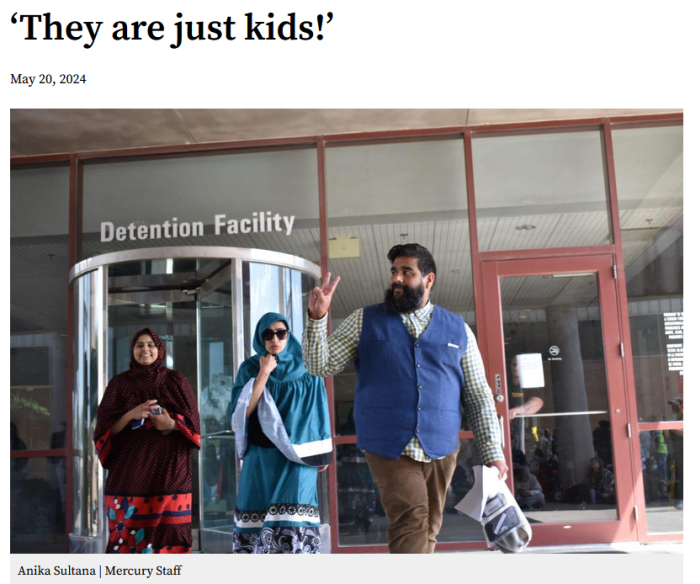
This story (Mercury, 5/20/24) got the UT Dallas student paper accused of “journalistic malpractice”—and contributed to the school’s firing of Gregorio Olivares Gutierrez, the paper’s editor-in-chief.
What about student media on college campuses? Here too, examples of censorship can be observed. The University of Alabama closed down two magazines last year, Alice and Nineteen Fifty-Six, that focused respectively on female and African-American students. The University cited a memo from former Attorney General Pam Bondi opposing Diversity, Equity and Inclusion initiatives as a reason to shutter the publications (Politico, 12/4/25).
At the University of Central Oklahoma, the Vista ended its 122-year print run, in what the university stated was a cost-cutting measure. Six students represented by the Reporters Committee for Freedom of the Press claim the decision had less to do with saving money and more to do with the administration’s “dissatisfaction with editorial decisions” made by the paper (Journal Record, 10/9/25).
An editor at Indiana University-Bloomington was fired after he refused to publish the Indiana Daily Student’s homecoming edition with no news content whatsoever (Editor & Publisher, 2/11/26).
Students from the University of Texas-Dallas set up their own alternative publication, the Retrograde, after repeated clashes with university officials over content in the Mercury, the school’s official newspaper (CJR, 11/11/25). Officials claimed students’ coverage of pro-Palestinian protests, including criticism of the university’s decision to call in state troopers, amounted to “journalism malpractice” (Texas Tribune, 2/7/25).
Free press gray area
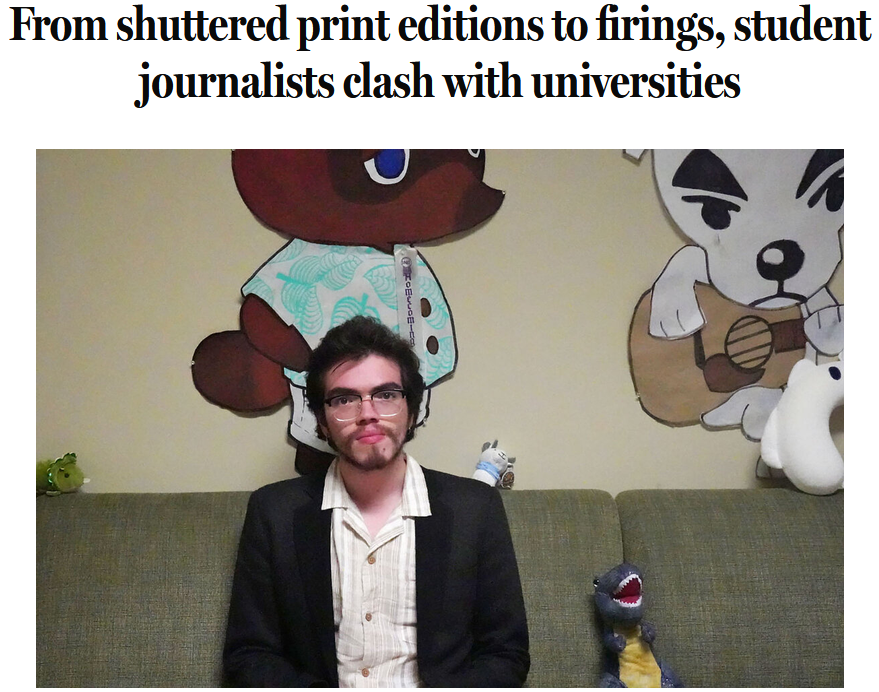
Gregorio Olivares Gutierrez, whom UT Dallas fired as editor of its student paper (Christian Science Monitor, 3/23/26): “Journalists are under existential threat on campus and in the country.”
Student journalists fall into a gray area when it comes to legal acknowledgment of freedom of speech and press. Although the Supreme Court ruled in 1969 in Tinker v. Des Moines that students don’t “shed their constitutional rights to freedom of speech or expression at the schoolhouse gate,” the 1988 decision Hazelwood School District v. Kuhlmeir rolled much of that back.
In Hazelwood, the Court held that student newspapers are not fully protected by the First Amendment’s guarantee of press freedom. Rather, censorship is to be allowed so long as it is “reasonably related” to educational purposes, and directed against student speech inconsistent with “the shared values of a civilized social order” (St. Louis Public Radio, 12/8/22).
Some of student journalism’s best defenses against censorship are “New Voices” laws, which protect student journalists and faculty advisors from retaliation. Yet these are only on the books in 18 states. New Voices laws do not map neatly onto partisan divisions. West Virginia, Kansas and Arkansas—typically Republican states—all have them, while New York, Connecticut and Delaware—usually in the Democratic column—do not.
There are currently seven states with “New Voices” bills in the state legislature: Kentucky, Michigan, Missouri, New York, Pennsylvania and Utah, with Georgia being the most recent addition to the list. Gregorio Olivares Gutierrez—currently of UT Dallas’s Retrograde, formerly of the Mercury—is hopeful that a New Voices law could pass in Texas (Christian Science Monitor, 3/23/26). Cartoonist Aidan McClaren hopes for a similar outcome in Nebraska (Creightonian, 5/1/26).
New Voices laws are not a cure-all, however. Both California and Maryland have them on the books, and, as previously stated, both states have seen efforts to censor student media.
Student journalists can perform important functions, covering stories that often slip by other outlets. Increasingly, however, they are prevented from doing so by overzealous administrators. The summer break may mark a hiatus in fights over student media. Evidence is clear, however, that this fight is not over, and deserves national attention and scrutiny from those interested in a free, unbiased press.
From FAIR via This RSS Feed.