

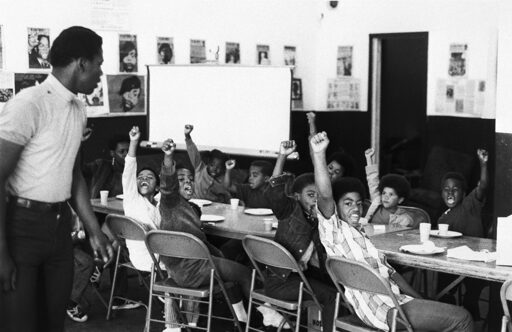
On this episode of Rattling the Bars, to commemorate the 60th anniversary of the founding of the Black Panther Party in 1966, host and former political prisoner Mansa Musa speaks with Dr. Joy James and Dr. K. Kim Holder about the history of the Panthers and their unique approach to, and practice of, communal socialism.
This is Part 2 of a two-part conversation. Watch Part 1 here.
Guests:
- Dr. Joy James is Ebenezer Fitch Professor of Humanities at Williams College. She is the author of numerous books, including: In Pursuit of Revolutionary Love; Resisting State Violence; and Shadowboxing: Representations of Black Feminist Politics. Creator of the digital Harriet Tubman Literary Circle at UT Austin, James is also editor of The New Abolitionists: (Neo)Slave Narratives and Contemporary Prison Writings; Imprisoned Intellectuals; Warfare in the American Homeland; The Angela Y. Davis Reader; and co-editor of the Black Feminist Reader.
- Dr. K. Kim Holder is an assistant professor of educational foundations and Africana studies at Rowan University. Dr. Holder earned his doctorate from the University of Massachusetts Amherst in Multicultural Education and African American Studies, his masters in Early Childhood Education from Bank Street College of Education, and B.A. in History from Hampshire College.
Credits:
- Producer / Videographer / Editor: Cameron Granadino
Transcript
The following is a rushed transcript and may contain errors. It will be updated as soon as possible.
Mansa Musa:
Let me ask y’all this. We know that at this juncture right now where we stand at right now, the contradiction that exists between the leadership or the lack of leadership in this country, because when we come into space saying like we saying socialism, we defining and we making an analysis and we using it in our analysis, Bernie Sanders, Franklin Roosevelt, except Obama. Let’s move with the narrative. Let’s move the needle to how do y’all look at the Black Panther Party’s perspective in terms of socialism and how they was trying to implement their ideas along them lines? What’s the lesson we can take away from that to help people understand that?
Dr. Joy James:
Well, I could just say from my research and a little bit from organizing and Kim, correct me, right? Check me if I’m wrong. I think there were different parties after the assassination in Chicago with Hampton and Mark Clark, with Fred Hampton and Mark Clark in 69 and then their attempts to do additional assassinations a week later, I think December 11th in Southern California, Geronimo Pratt had fortified the house. So there was exchange of fire but nobody was killed in peaches. I can’t remember her full name, but Kim Can. When I think of that kind of history, I understand that it’s not going to be replicated whatever we end up doing as older people or younger people 50 years later, but there’s a continuous line. I’m sorry if I’m sounding too abstract, but what I see and what happened decades ago when I study it, when I work with my students, look at it, when we look at the documentaries and the films, I see a spirit and I know people usually don’t talk about spirit and we talk about material struggle, but there’s also a spiritual aspect to liberation movements.
I think the youth have that embodied in them as well as we have it. It doesn’t come out with the same kind of narrative, but it’s going in the same kind of trajectory. I think that becomes a source that allows us to say we need to keep jobs, to keep family, whatever fed, but we do not need to pimp ourselves out in terms of politics and we don’t have to lie about the reality. So it doesn’t matter if you get a black man or a black woman as president, whatever, it’s still an imperial project and it’s going to continue to decimate countries and peoples around the globe and people inside the US. And I believe when we agree to that and we understand that agape, I’m a former seminarian. When we think of agape, which is a form of love, which is about sacrifice for the greater good, I think our capacity to resist just increases.
I think what diminishes our capacity is that we have different pods of activists and radicals and abolitionists. And sometimes people want to hold onto their brand and their
Mansa Musa:
Identity
Dr. Joy James:
Rather than to let it go and to merge and try to create something that takes us somewhere beyond just circling around the camp. I don’t know if that was too abstract.
Mansa Musa:
Nah, nah, that was very astute and it’s a good observation because when we look at, and I’m going to go back to what you say, like it’s more than one party. My perspective about that is I’m in the space of that we didn’t understand the repression. We didn’t understand our opposition in response to who we were, the most fierce party in the country. We didn’t understand the response that we was going to get and not understand the response and making adjustments and then we making the adjustments as we go along and the adjustments is being made in response to like, oh, misinformation, disinformation, like you talk about Geronimo, he did all that time in prison. Why? Because somebody wouldn’t come forth and say, because the misinformation and disinformation, we killed each other from on coach to the next coast. Why? Because misinformation, discipline.
Now we going from a position of organizing people to trying to survive. I’m not idealistic about … I don’t have that idea. I’m looking at the reality. Eddie Conway did close to 47 years in prison and nobody came and gave him no money. It was a lot of comrades that went to prison and didn’t get the support they supposed to got. That being said, our ability to respond to the repression put us in a position where we went from being on the offense in terms of organizing to them being on defense, then from being on defense to just trying to survive, trying to live.
Dr. K. Kim Holder:
I think there was a party. I think I would say from 67 until the marital candidacy where they shut down all the branches and brought them there, I think that’s where you stop talking about one party. I think it was a party. I know it’s populist say there was many different parties. There was one party, it was a revolutionary party. It had communist socialist trends to it. I believed in armed self-defense, believed in revolution. And you just go back to Youi Newton’s on revolution, executive mandate number one, two, three, et cetera, et cetera. So I think there was a party. I think there was a consistency. And I want to say this, while the youth got no clue what the party was about but love it, they got the essence.
Mansa Musa:
And the
Dr. K. Kim Holder:
Essence of what they like is that the party were no punks, they were no sellouts. What you got was true. It may have been made mistakes, but it was true struggle and they didn’t have no alternative agendas.
Mansa Musa:
Agenda, yeah. And I think
Dr. K. Kim Holder:
That’s what the youth see and what the party represents to them. They ain’t got no clue about all socialism, communism, revolution versus this. They grew up thinking they was free because of Obama and stuff, but what they do see was the party was uncompromising and that’s the essence of what they see of that. And that’s a good thing. But I do think that there was a party message. There was a party and it was a revolutionary party and I agree with you. It takes its place in historical continuing of Black liberation
Mansa Musa:
Along
Dr. K. Kim Holder:
With Nat Turner and what have you.
Mansa Musa:
Eddie wrote a book called The Greatest Thread Ever. But who would say the greatest, say the most fearful thing, two things of the party that he wanted to completely get rid of, free breakfast program and the Back Panther Party paper. He was systematic and trying to get rid of both of those entities because they had root in the community and the free breakfast program, sickle cell anemia test, all those institutions, those institutions was like started party members would go there and set it up, but ultimately they would phase themselves out when somebody in the community stepped up to start taking responsibility and we would just provide the services and the resources, but the whole goal was, the whole goal was to- For the people
Dr. K. Kim Holder:
To
Mansa Musa:
Take over. … turn it over to the community. Exactly. So that the community and then we would be in a position like it would provide security or help. What can some of the lessons that the young people can take from the party going forward if they was to ask you that question, what can I take away? What can be my take? What should I look at? Watch your
Dr. K. Kim Holder:
Back when
Mansa Musa:
You
Dr. K. Kim Holder:
Start organizing. I’m telling you, when you start organizing,
Mansa Musa:
You
Dr. K. Kim Holder:
Develop your underground, you’ve developed your railroad first.
Mansa Musa:
And
Dr. K. Kim Holder:
No matter what happens, that is going to be the ultimate thing they’re going to come after you and that you need to organize and structure yourself in a way where there is a railroad and that we can operate outside of that is ultimately … We say, oh, the party had disinformation and stuff. You know what? The system did their job. We was revolutionaries and they came after us, which is what they supposed to do. And we are the ones that have to come. My thing is that their ability to pay us off,
But we need for them to understand now because just two years ago they thought everything was rosy. They need to understand that you start out with developing the railroad first, that you develop stuff in a manner in which you know that it’s not always going to be hunky-dory all up front and that you make sure that you understand that when you’re developing the most simplest things like the free breakfast program, like the free clinics and stuff, we got to understand the nature of this system. I don’t want to get all gloom and doom, but that is something that I’ve been dealing with for the last 60 years in terms of what the system … The system did what they were supposed to do and they’re nastier now.
Dr. Joy James:
Yeah. I would say to the youth, that’s their question, right? What would we say to the youth? So it’s almost like I’m talking to my students. Check out a number of the documentaries, All Power to the People, Black Panther Party and Beyond by Lil Lee. I was introduced to that by Kim Holder when they came to Boulder to a conference in 1997 or something. And it’s important. It’s online and I don’t think a lot of people know about it, but you could see the party, its evolution, and also the contradictions within it. Then there’s another film, The Spook Who Sat By The Door, which is not a documentary.
Mansa Musa:
Yeah, Samuel Greenlee.
Dr. Joy James:
Yep, you got it. And it’s an interesting film.
I think for young people who are … I’m a military brat, so I grew up and I was in R2C handling stuff. Some people want to be pacifists and that’s fine. So the understanding for me is that the revolutionary is really based in the heart and that what you’ve talked about, the food programs, the sickle cell anemia, the healthcare, knocking on people’s door, providing housing. I know from Kim talking their sister was being harassed in Hell’s Kitchen decades ago when he was in the party by the Hell’s Angel and Kim being in the party came to her apartment and slept on her floor to give protection so she wouldn’t be harassed or kicked out of her apartment by some racist people on motorcycles. Those expressions of love and commitment builds of movement, but there’s a cautionary note because we referenced Geronimo. Huey was brilliant and there’s a book out on Huey Newton that’s coming out in a couple of months.
And again, I never sacrificed or wasn’t old enough or whatever the reasons for not being there, but they’re the contradiction sometimes of leaders who lose their way and we have to have the capacity to pull them back. Geronimo did 27 years the same as Nelson Mandela. People cheered Nelson Mendela. They don’t remember what happened to Geronimo, how he was framed, how he was at a meeting in Northern California,
Anthers. FBI set him up and Huey told people not to acknowledge the person who went rogue was Kathleen Cleaver. And so she ends up being with Stuart Hanlin and Johnny Cochran, part of that legal team to get Geronimo out. And I only met him once, but people have suffered a lot and people have given a lot, but what they’ve left is a legacy for us to study, whether you’re young, middle-aged or old. And I don’t think the Panthers were ever defeated. And I think that’s why there’s so many people focus on them. The last thing, which is more a question, from what little I looked at, there was an organization that identified young people as Panthers and then they were told to stand down and they became Black lions. I would hope that the party has the fluidity to embrace everyone who’s sincere about … And I don’t know these people, they’re based in Philly.
I’m not in Philly, but I would say that to the candor that we have to deal with our contradictions despite the predatory violence of the state and people trying to buy out movements, we still have our inner mental, emotional registers that have to be calmed down. And so then I think of care, protest, movement, marinage, war resistance. That’s the whole thing I’ve been thinking about for a decade about the captive maternal, which is ungendered. And I see you both as captive maternals that you care. And I think that foundation of care will push us through into liberatory struggle.
Mansa Musa:
Let’s talk about how do we get young people to understand how the coalition built in terms of … Because the party, when they came into existence, they was big on coalition building. They was big on networking, they was big on any element that was anti-stagement or was protesting conditions. They network with them and build a relationship with them in order to change the conditions that our communities found themselves in. How do we get young people to understand that part of the party’s organizing strategy?
Dr. K. Kim Holder:
I think one thing I can only come from it from a negative perspective, unfortunately, but I think one thing that needs to stop, people tend to define their ideology by criticizing other people.
Mansa Musa:
Come
Dr. K. Kim Holder:
On. And I think that needs to stop. And what we need to start to do at the beginning is we need to start to develop some basic principles that we accept and that we live by
Mansa Musa:
And
Dr. K. Kim Holder:
That that allows us then to determine how we can go with somebody else. Right now we seem to be, “You said this one thing five years ago, you ain’t no good, blah, blah, blah.” It’s like, I show how bad I am by showing that as opposed to let’s establish what we actually believe some basic principles and then some basic principles of operation, how we can interact with each other and move forward. Why do we expect us to get along? Nobody gets along in this society. Because we have it be movement people, we get along. So we got to start basically on what are the basic principles so then we don’t be one ups on people.
Dr. Joy James:
We need to articulate, well, you already did the 10 point program, right? But we need to articulate for this generation, this century, what is emotional intelligence? I mean, we know little Bobby Hutton, I mean, Eldridge thought it was a good idea to do something and you lose people or people get disappeared. There’s a way in which even when we struggle at our best, and again, I was not in the party, but I know Kim from talking to you for 30 years a little bit about what you were saying. There’s a way in all political struggles when you’re being hunted by the state and you’re being infiltrated, there has to be a level of integrity or a set of ethics that’s not just from the party. It has to emanate from ourselves as a community. And that is how we all get to make mistakes and we all get to like, “I got to step this one out.
I’m not brave enough,” whatever. “Okay, come back next week and we’ll try again. “But I’m not sure that we’ve articulated beyond the 10-point program, what are the ethics of emotional intelligence and a commitment and agape? And I know for some people that seems very abstract, but I think that’s the core that keeps us alive and from cross-shooting each other literally and figuratively.
Mansa Musa:
And to your point, we do this because we love it. We love our people. We love the fact that we’re in a position to try to do something to gain our freedom and our liberation. I was in Oakland and had the opportunity. I told Emory Douglas, Minister of Culture, Black Panther Party when I came back because we was doing some things and I told him when I come back, I wanted him to take me around Oakland and talk about the party and some of the early things they did and he’s a good storyteller as far as I’m concerned and he did. He took me around with the thing that he left me with was how simplistic the party was in terms of organizing how simplistic … He said every library in Oakland, wherever they had something party members was there and participating and any space they could get, they would be there.
Any park, they would be at, they would do organized, they would play baseball, basketball. They always was doing something in the community. And I think that to your point, Kim, that we have to stop talking about what we don’t have in common and start talking about what we do have in common and find that commonality and then find that commonality.
That’s just what we do. I’m going to give you one more example, then I’m going to give you all that y’all have the last word. Dominique Conway, Eddie’s wife, we was doing some organizing in the neighborhood. So in the neighborhood we in high drug area, there’s a lot of kids there. So we down there doing some organizing and we don’t have no space. So they said,” Well, we got to get us a space. “So we took a house, a house that was abandoned, that was livable. We took it, did all the research on it, found it was city property, took it and then held a press conversation like this house we taking for the community. And when Eddie got out, that became our base operation. We did everything in that neighborhood. Eddie in a meeting with some guys and they talking like they serious about organizing.
And so Eddie looked out the window and seen some abandoned house said,” Just go take some houses and do just that simple. “And I think that we lose sight on the simplicity of things that we could be doing, but y’all got the last word, what y’all want to say about this subject matter.
Dr. Joy James:
I want to say thank you for inviting us to this conversation and for all the work that you’re doing and all you’ve contributed. And I was just thinking of a book, the importance of books, which we know many people inside and people who were in the party studied books, they read, they taught themselves, they taught each other. And so it was a book, it was a black women’s led book launch in the federal government building or something on 125th Street in Harlem. And I went there because it was a Sada’s memoir and it’s the first time I heard of her book was just coming out. And then when I went to teach at UMass, someone mentioned to Kim who got his degree from there that I was teaching this book, Asada, he autobiography and class and that’s how we met. That’s how the conversation started.
So the word is with us.
Mansa Musa:
Right.
Dr. Joy James:
Yeah. Yeah, you’ve got it. And even what you’re doing- And
Dr. K. Kim Holder:
She took me to Cuba
Mansa Musa:
And
Dr. K. Kim Holder:
I took her to the sister. Hey,
Mansa Musa:
The word became fresher. The word became fashion. Yeah. I picked up on that look and the word became flesh.
Dr. Joy James:
And that’s what you’re doing now. You’re doing it with audio, but it’s still the word. Yes, that’s how I got to be in her kitchen and hear her say things. I’ve been in Cuba several times, but always like the collective, we’re all sitting, we’re tourists and something like that. But because they were both in the party in Harlem, that’s when you get these … This is when you learn. And I learned a lot and I’ve learned a lot from the party and a lot from how you’ve cared and loved and fought and so I’m grateful and thank you again.
Dr. K. Kim Holder:
You work with Eddie and you was in the joint, so that’s one perspective. Eddie was good with coalitions. Do not follow the party when it comes to coalitions. Party was Vanguard. We bossed everybody around and half the coalitions that we talk about, we made up.
Mansa Musa:
Yeah, okay.
Dr. K. Kim Holder:
I’m
Mansa Musa:
Just
Dr. K. Kim Holder:
Saying.
Mansa Musa:
The
Dr. K. Kim Holder:
Party and especially if you were black, if you were something else, we would deal with you. But if you were black, how come you ain’t a pather?
Mansa Musa:
Yeah.
Dr. K. Kim Holder:
You say? If you was Latino, okay, we could work with you. If you was white, okay, if you was this, but if you’re black, how come you ain’t a path? The only blacks that we respected outside of us was students. But I understand that prison was different and I know Eddie Conway is a good coalition builder, but so you getting the good side of the party,
From The Real News Network via This RSS Feed.