

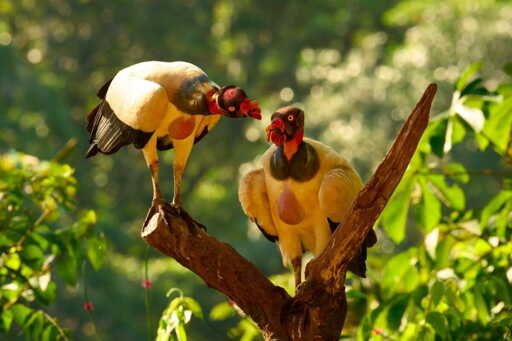
Two king vultures (Sarcoramphus papa), one of the largest vulture species in the Americas, perch on a tree branch in Costa Rica. One leans over to nibble the other. The king vulture’s range stretches from Mexico south through the Amazon Rainforest and down to northern Argentina. These birds have a wingspan of up to 2 meters (6.6 feet), white plumage with black wingtips, and a remarkably colorful head with orange, yellow, red and purple hues. The species is featured symbolically in ancient Maya carvings, manuscripts and painted ceramics that date back millennia. More recently in the Amazon, historians detailed Indigenous oral traditions that feature king vultures as a master of fire. Peter Hudson, a professor of biology at Penn State University, U.S., captured the photo above in April 2026. “They really look very, very prehistoric,” he told Mongabay by phone. “They’re beautiful birds, absolutely stunning.” In Costa Rica, ecotourism has helped garner support for the conservation of vultures and other species, Hudson said. In the areas surrounding national parks and public nature reserves, private landowners are becoming more interested in conservation and offering tourists hides from which they can observe wildlife. It was from one of these hideouts on private land that Hudson spotted and photographed the king vultures. In total, he spotted six vultures, one which he suspects was a juvenile. “[The owner of the hideout] was going ecstatic when one of them was leaning over to sort of nibble at the other one,” Hudson said, describing the moment…This article was originally published on Mongabay
From Conservation news via This RSS Feed.