


Mackenzie OlivoUnderscore Native News
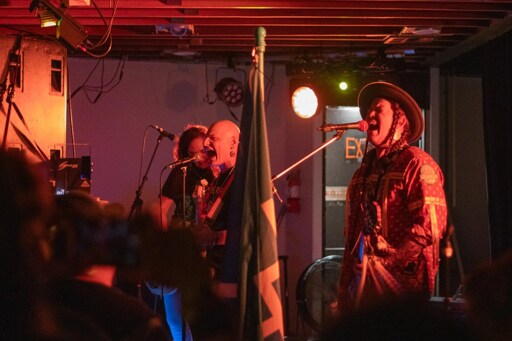
PORTLAND, OR — As the United States approaches its 250th anniversary, an all-ages and Indigenous music benefit showcase on June 27 celebrated the 150th of another important anniversary: The victory at Greasy Grass, commemorating the death of Lt. Col. George Armstrong Custer.
In a 10 act lineup, with 1876 headlining and hosting, “Victory Day 2026” was a benefit concert for the Boys and Girls Club of Lame Deer, Montana, that commemorates the Battle of Little Bighorn and the death of Custer.
While some Native nations celebrate the day through commemorations, organizers of the benefit sought music and expression.
“The time for violence is over, and now it’s time for unity and how we uni[te]? Music,” Joe Colhoff, Blackfeet and Cheyenne, 1876’s powwow drummer.
The all-ages benefit show raised funds for the Boys and Girls Club of theNorthern Cheyenne Nation.
According to co-event organizer and 1876 lead vocalist and guitarist Gabe Colhoff, Blackfeet and Northern Cheyenne, had the idea for an all Indigenous benefit concert since high school.
Since then, “Victory Day” also became an opportunity to educate.
“Our [fight] is with knowledge, and we spread knowledge through music,” said Joe Colhoff, powwow drummer for 1876.
For bands like Eggplant Dance Battle, composed of 18-year-old members of the Confederated Tribes and Bands of the Yakama Nation, this was their third performance ever. They played alongside established bands like Weedrat, the Diné punk band based out of Albuquerque, New Mexico.
Rebecca Jones, Diné, lead vocals for Weedrat, prefers playing all-ages shows to encourage youth involvement in the punk music scene.
“I think it’s important to shed light on the younger folks and to give them that space to perform,” Jones said. “There’s going to be a point where I’m like, ‘okay, I think I’m done, we need to let the older or younger folks take over’.”
The variety of hip-hop lyricists like Warner Springs Tribal member Sho-rilla, who shared the poems of his experience growing up on the reservation, including struggles of sobriety, environmental protection and the value of Native role models; to rapper Fish Martinez, known as 2 8 tha Native, who identified himself as Shasta Costa, Mescalero Apache, Mestizo, & Modoc Tribe as a rapper of 33 of years who shared tribally influenced music to strengthen reconnection in the face of colonization.
“I see the value in listening to the ideas and concepts using our oral tradition,” Martinez said, “talk about our culture, our language, and who we are as people, but then also shar[e] the contemporary things that are going on in their lives now.”
Josh Puga was excited to support the all-Indigenous lineup not just through his presence, but also financially. “You gotta come support the people who are actually for the people,” said Puga, non-native ally.
As Carlin Blackrabbit, Blackfoot, stood with his bandmates and looked at the growing crowd for the “Victory Day” event, he said,“It’s true and meaningful and impactful. It’s not a preformative thing, it’s real.”
Tahina Wilson, a member of the Confederated Tribes and Bands of the Yakama Nation, who grew up on Punk music, said, “it makes me feel really happy, like everyone is just like family.”
Beyond raising funds for the Boys and Girls Club of the Northern Cheyenne Nation, events like “Victory Day” also create a space for Indigenous people in urban settings to feel connected to Indigeneity and part of a community.
“Being here helps us connect. Even though we’re not from the same tribes, it helps us be here to know that we’re one people,” said Cynthia Valle, who is El Salvadorian, and often seeks out live music shows.
Colhoff and his brother Joe Colhoff, both grew up in the city of Portland where, “like a lot of Indigenous and Native people’s, we were too white to be Native, but then to the government were too Native to be white, so we’re outcasts.”
As attendees made their way through the door, they were greeted with signs that read, “No Judgement.” The characterization of punk music prides itself on being anti-conformity and emphasizing individuality. Denim jackets decked out in patches and pins, and traditional Native words and regalia embedded into songs and attire, all reinforce the notion that existence can be enough.
“Let yourself be free,” Puga said. “The idea of not caring about what people are thinking and doing. When you’re dancing you don’t have to worry, You just do it. Do it for you. Do it for your partner. Do it for others. Be in the zone for yourself.”
Editor’s note*: This story has been updated to reflect Blackrabbit’s Native nation, to clarify that Kyla Maunakea in the feature image is also a guitarist for 1876, to clarify the origin of Gabe Colhoff’s idea for the benefit concert, to attribute a quote on sharing knowledge by Joe Colhoff, and to remove an inaccurate historical reference.*
The post Powwow Punk Band 1876 Holds “Victory Day 2026” All Ages Indigenous Punk Benefit Show appeared first on ICT.
From ICT via This RSS Feed.