

Photo: Ramona Leitao / The Narwhal
Summary
- While Black and racialized farm workers make up a large chunk of the country’s agricultural workforce, Black farm owners are still a slim minority in Canada.
- This wasn’t always the case, and historical Black Canadian settlements, like the Black Settlement in Oro Township near Barrie, Ont., provided land and housing for Black farmers in the early 19th century.
- One of the primary barriers to farm access and ownership is the high cost of land; programs like farm rentals and urban farms are trying to bridge the gap.
Along a dusty bike trail of crushed gravel, the blue-grey waters of Kempenfelt Bay shimmer through large trees with leafy branches overhead. On one side stands an Ontario Heritage Trust plaque, recognizing the historic Black community of Oro, Ont.
On bicycle rides along the Great Lakes Waterfront Trail, I ride for fun and adventure and to find the Black history hidden in the countryside. As a scholar and writer, I research how race intersects with nature. In this case, it is how farming and farmlands — a part of nature we can all connect with — criss-cross with race.
In southwestern Ontario, I’ve taken detours to visit the former Black villages known as the Buxton Settlement and the Puce River Community, near the border with Detroit. In other places I look for Ontario Heritage plaques, old churches and fading headstones in unregistered cemeteries. These are often the only indicators that Black communities once thrived in rural Ontario and that Black farmers owned their farms.
In the 19th century, the area around Lake Simcoe, including Oro (now Oro-Medonte), was filled with Black farmers and their families. There are similar heritage plaques scattered across rural areas and small towns in Ontario such as Fergus, Cainsville, Lucan and Dresden. Once a common sight, today Black farm owners are rare, while Black farm workers are a backbone of agricultural labour in Canada. Each year, some 36,000 Black and brown farm workers come to Canada for the farming season.
The average age of a farmer is 56 years in Canada. They are getting old and tired, greying out of the years of dawn-to-dusk work on the farm. While there has been an increase in the number of female farmers, one statistic has barely changed — the tiny number of Black, Indigenous and racialized farmers. In Ontario, only five per cent of farmers are from diverse ethnocultural groups, which includes racialized groups.
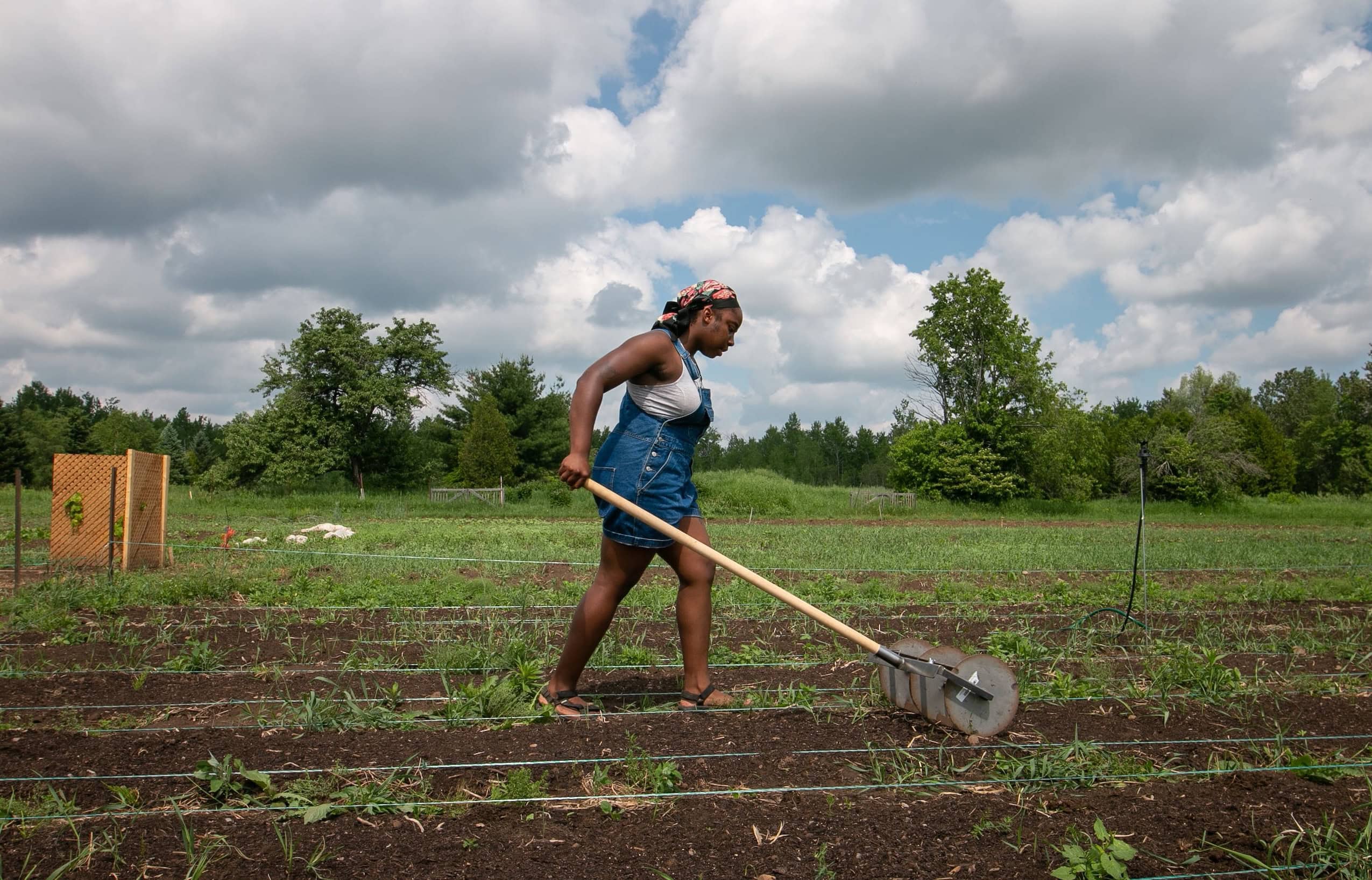
Aliyah Fraser started Lucky Bug Farm on rented land in 2020, thanks to help from a mentorship program through Sundance Harvest. Photographed here in June 2021, she smooths the soil and evens up the spacing for tomatoes. Photo: Ramona Leitao / The Narwhal
Yet, in Toronto, some 56 per cent of the population is racialized, according to Statistics Canada. This demographic drift is not reflected in farming. So, where will the next generation of young farmers come from in Ontario? Who will grow the food that we all need to eat and live?
Farmland is precious to both farmers and non-farmers, but the competition for farmland is fierce. Data from Ontario Farmland Trust shows Ontario has lost 18 per cent of its farmland in recent decades to urban development and aggregate mining. Each day, Ontario is losing 319 acres, or 129 hectares, of farmland to development. Once the farmland is paved over, it is lost forever.
“The number one issue is access to land for Black farmers,” Claire Perttula, president of the BIPOC caucus of the National Farmers Union, said. “Land is so expensive. To put together a down payment you need millions. Working in agriculture you won’t make that down payment.”
Created in 2021, the caucus represents racialized farmers, land stewards and farm workers from across the country. It builds community and advocates for their interests.
“Farmland should be treated as a public good and not just as a private one for profit,” Perttula said. “We need a different system of farm ownership and use that would prioritize the people farming the land. This helps them make a go of it and earn a living.”
No Black farmers but lots of Black farm workers
Cycling along the backroads of the Niagara Wine Route in Ontario, I passed scores of Black men tending to grapevines in vineyards, apples in orchards and peas and beans in fields. I stopped to chat with them as they were the only other Black people I had seen so far that summer in the countryside. The men were Jamaican and migrant farm workers.
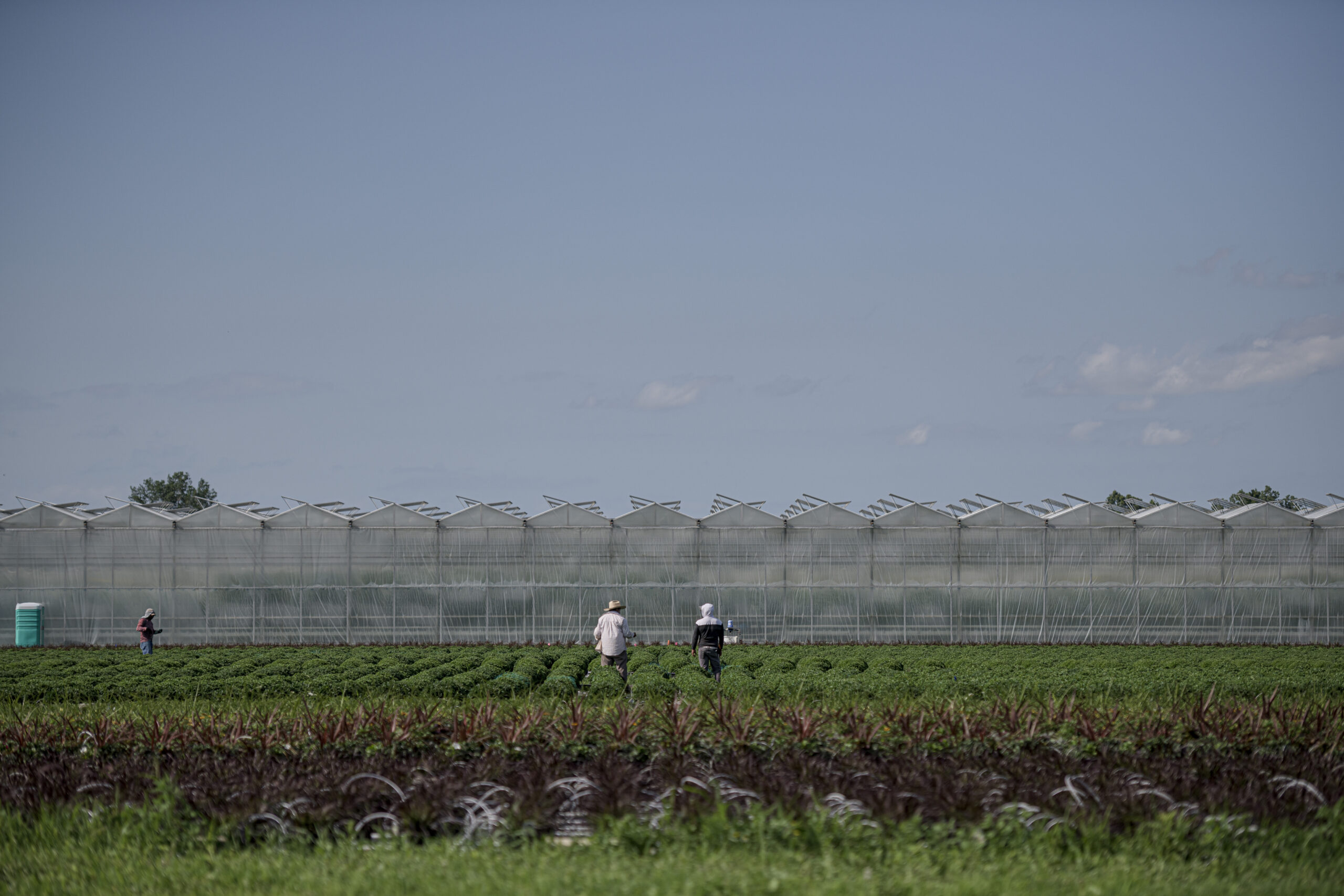
While the number of female farmers in Canada has increased in recent years, the number of Black, Indigenous or otherwise racialized farmers has not, and still hovers around five per cent. Photo: Chris Katsarov Luna / The Narwhal
Farm workers till the land, plant the seeds and harvest the crops. In Canada, those farm workers are most likely to be Black or brown. The labourers are migrants from the Caribbean, Mexico and Latin America who are hired under the Seasonal Agricultural Workers Program. Each year, they arrive in Canada in the spring, and must leave in autumn when their contracts end. Nearly half of all agricultural workers in Canada are hired under this program. They labour in every province where there are farms. Some farm workers have been coming to Canada for decades. As temporary foreign workers, they are mostly ineligible for citizenship.
On the other side of the country, Jamaican migrant workers also labour in the wineries and orchards of the Okanagan Valley, B.C. I now expect to see them everywhere in my travels in rural areas or small towns. So why the stark racial divide in farming in Canada, where white farmers reap the profits and Black and brown farm workers sweat under the sun?
Free farmland for some
In the United States, Black farmers were proverbially promised “40 acres and a mule” — immortalized in the name of Spike Lee’s film production company — a reparation of sorts, at the end of slavery. No such promises were made to formerly enslaved people in Canada, when slavery was abolished here in 1834.
White homesteaders, however, got their free acres of land under various land grant schemes. In Ontario, for instance, the 1868 Free Grants and Homestead Act gave free land to farmers, who got the title and legal ownership if they cleared the forested land and built a farmhouse within five years. Roads to support colonization were constructed across the province to make it easier for the settlers to arrive and claim their free land. The railways did the same across the country a few decades later. The free farmland was, and still is, all Indigenous land.
The only land scheme in southern Ontario that was specifically for Black people was the Black Settlement in Oro Township, near Barrie, Ont. The free land grants were in part a reward for the Black veterans who fought to protect Canada in the War of 1812 when the United States invaded. However, over time the settlement faded as the land was poor for farming, and it was too far from major roads and thus difficult to reach markets to sell the produce.
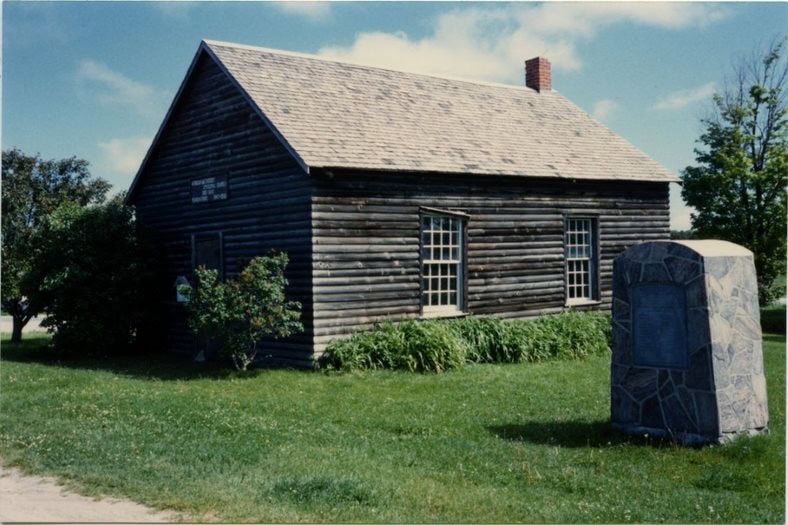
The Black Settlement in Oro Township, near Barrie, Ont., was the only dedicated land scheme in southern Ontario specifically for Black people. The land ended up being poor for farming and the settlement eventually dissolved. Photo: Simcoe County Archives – Eileen Murdoch collection
“The problem is not just for Black farmers alone, but it’s worst for them,” Bamidele Adekunle said. He is an adjunct professor at the University of Guelph, and co-editor of the book Eat Local, Taste Global: How Ethnocultural Food Reaches Our Tables.
“It’s the commodification of land,” Adekunle said. “There is a serious competition between real estate and agriculture for land. When land is commodified, its use moves to things that are more profitable. It moves out of the reach of most farmers.”
Access to modern farmland is a massive challenge for any new farmer. Those that don’t inherit the family farm can buy their own, but only if they have the money, and prices are increasing each year. In 2024 the price for a hectare of farmland and buildings in Ontario was $20,782. Consider an average city block is roughly one hectare in size. The average size of a farm in Ontario is now 249 acres, or 100 hectares. That means an average commercial farm in Ontario costs about $5 million.
Additionally, the average size of a farm in Ontario is now 249 acres, or 100 hectares. Consider an average city block is roughly one hectare in size. This means that small family-owned farms are fading into the past along with milk pails, churning
This means that small family-owned farms are fading into the past along with milk pails, churning butter by hand and Anne of Green Gables.
Buying traditional farmland is out of reach for many Black farmers, without some form of financial help. The FarmStart program was supposed to kickstart that help. Started in 2005, the program was an incubator for potential farmers, providing them with mentoring, and teaching farming and technical skills. One thing the now-shuttered program struggled to provide was access to land to grow food.
New solutions for an old farmland problem
“There are some alternative and affordable pathways into farming,” Martin Straathof, the executive director of the Ontario Farmland Trust, said. The non-profit was set up to keep farmers farming by protecting farmland from non-agricultural uses. The trust has advocated for solutions to make farming accessible, such as a conservation easement agreement, which guarantees land will continue to be used for farming.
“The easement creates stability for tenant farmers who can rent the farmland,” Straathof said. “It gives new farmers access to land and the security that they need to keep farming.”
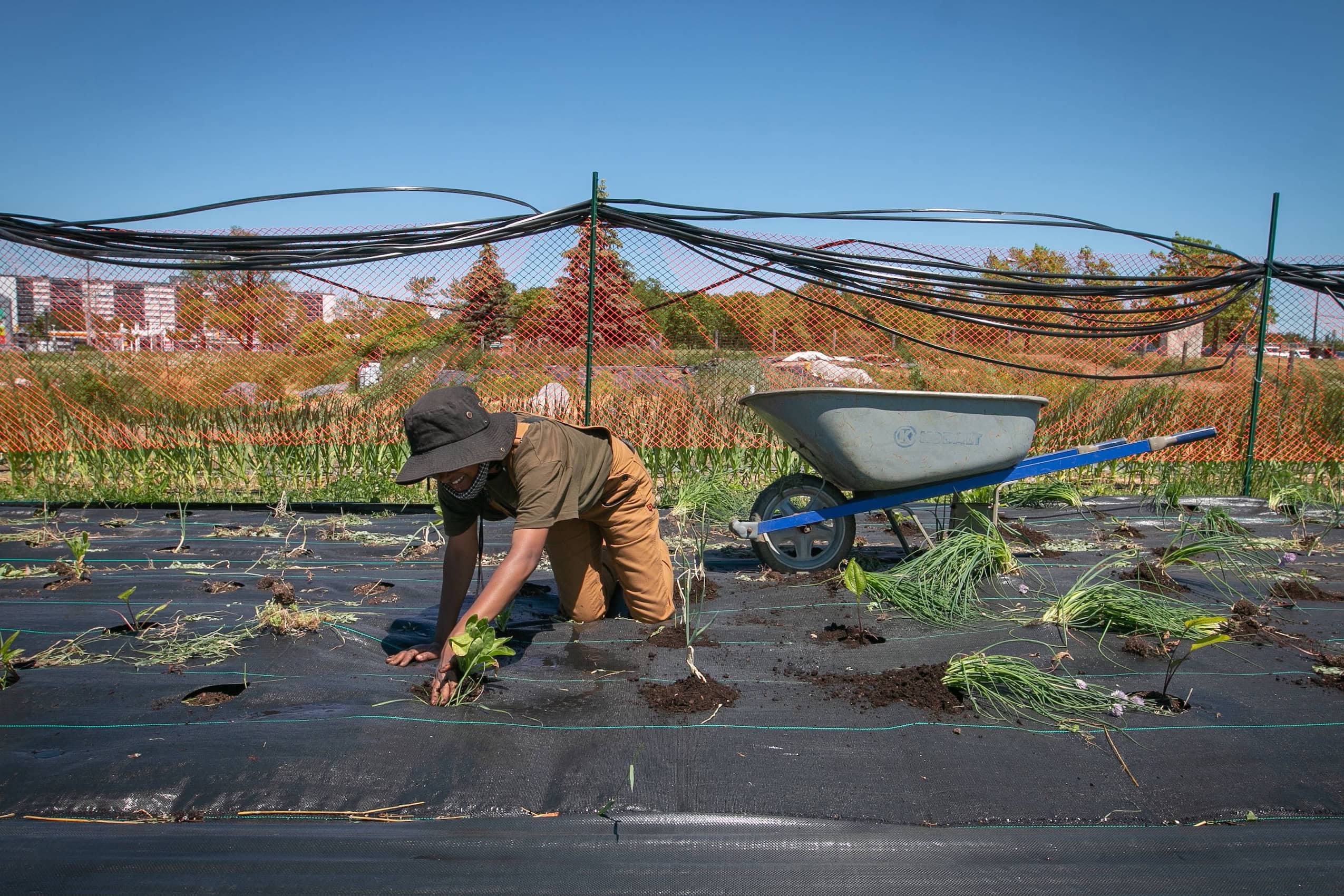
Urban farms offer a more accessible route into farming for some Black farmers, given the high cost of traditional agricultural land. While they don’t provide a pathway to rural farm ownership, they offer opportunities to experiment with traditional crops like yam, callaloo and okra. Photo: Ramona Leitao / The Narwhal
The farmland is still the private property of the owners under the conservation easement agreement, but it can only be used for farming. Similarly, farmland trusts keep agricultural land protected for that use, even after farming families move on. Some farmers may not have anyone to inherit the family farm or want to leave farmland as their legacy. They can donate the land to a farmland trust, which in turn can lease the land to tenant farmers.
Around the Greater Toronto Area, nature is protected from urban sprawl by the Greenbelt Act. There are calls for similar legislation to shelter prime farmland from development, known as a foodbelt. Bill 21, the Protect Our Food Act, passed first reading in parliament in 2025 and proposes to protect the fertile agricultural lands of southern Ontario from non-agricultural uses. Put forward by Green Party Leader Mike Schreiner and Independent MPP Bobbi Ann Brady, the act could help curve the rapid loss of farmland across southern Ontario.
Additionally, climate change is affecting agriculture in Canada. It is uprooting assumptions about what can and can’t be grown in the land of the “Great White North.” The warming climate impacts crops, farm animals, the soil, insects and diseases. Some traditional crops such as wheat and canola don’t do well when stressed by heat.
The warmer and longer growing season caused by climate change means that some tropical crops can be farmed in Canada, though. Sweet potatoes are now grown in Ontario as a commercial crop. If the climate change even further, it might be possible to grow other tropical staples such as yam, rice and bananas. However, you need farmers who know how to do so. These are familiar crops for Black and other racialized farmers. They already have the skill and knowledge to grow them. But they can’t use the skills or meet the potential demand for the crops if they have no access to farmland.
“You need a minimum of five acres to be a commercial farmer,” said Jacqueline Dwyer, the farmer and co-founder of Toronto Black Farmers and Food Growers Collective. “The system is against us. The lack of finance. The lack of resources. The lack of land. The system won’t change without pressure.”
Urban farms are another accessible route into farming for Black farmers. There are quite a few Black urban farmers or farm organizations in the Toronto area such as Afri-Can Food Basket, Black Creek Community Farm, Adinkra Farm and Zawadi Farm. Each of these play an important role in reconnecting people to the source of their food and provide culturally appropriate foods for the Black community. These foods include yam, callaloo and okra. However, urban farms have their limits as there is no pathway from there to owning or operating a rural farm for Black farmers.
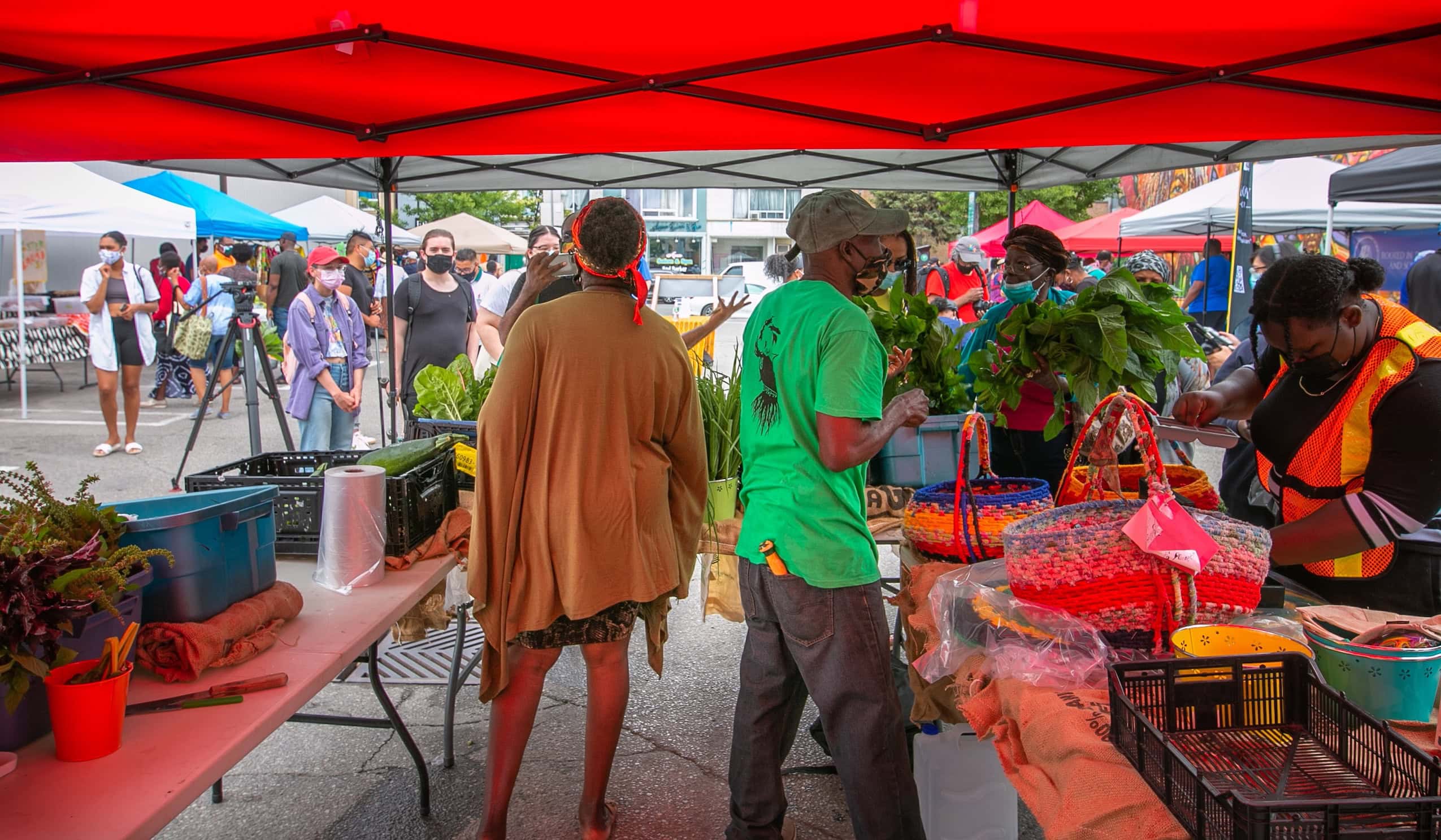
Jacqueline Dwyer and her partner Noel Livingston sell their produce and handmade African baskets at the Afro-Caribbean Farmers’ Market in Toronto’s Little Jamaica neighbourhood in 2021. Photo: Ramona Leitao / The Narwhal
“Youth are not getting into agriculture because there is no land,” Dwyer said. “Young people are pushed out of farming. They call themselves landless farmers.”
In many ways, farming is at a crossroads in Ontario. The pipeline into farming is leaking, due to a mismatch between old and new farmers, and it will worsen in the future unless things change. The majority of farmers are old, White and near retirement. They own farmland. The province is multiracial due to demographic shifts and so the next generation of young farmers are most likely to be Black and racialized. They do not own farmland.
The gap between those who have and do not have farmland must close if we are all going to eat.
Spring is here and fresh joy fills the air. The birds and butterflies are returning from the tropics. So too are the Black and brown migrant farmer workers. The farmland is awake and it is time to sow. We need Black farmers now, and they too need to reap, if we are all to eat.
The Narwhal’s reporters are telling environment stories you won’t read about anywhere else. Stay in the loop by signing up for our free weekly dose of independent journalism.
From The Narwhal | News on Climate Change, Environmental Issues in Canada via This RSS Feed.