

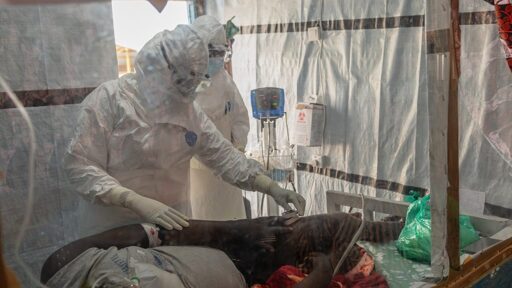
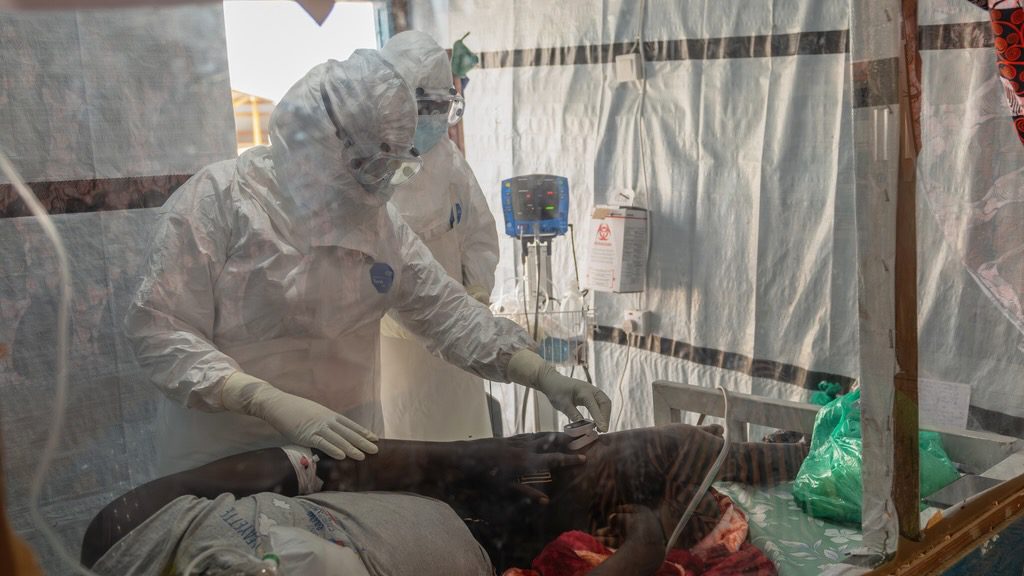
A clinical trial to evaluate potential treatments for the Ebola disease raging in the northeastern region of the Democratic Republic of Congo (DRC) began on July 2. Called the Platform Adaptive Randomized Trial for New and Repurposed Filovirus Treatment (PARTNERS), it will test the efficacy of two antiviral therapies in improving survival rates among the infected.
Of the 1,460 cases confirmed in the DRC as of July 1, only 213 have recovered, while 506 have died, adding up to a fatality rate of 30.9%. Although treatment has been developed for some variants of the disease, no treatment or vaccine has yet been approved to counter the current outbreak caused by Bundibugyo, a particular species of Ebolavirus.
The clinical trial to develop treatments for this Bundibugyo virus disease (BVD) is sponsored by the WHO and launched in coordination with the continent’s top health body, the Africa Centers for Disease Control and Prevention (CDC).
DRC’s Institut National de Recherche Biomédicale (INRB – National Institute for Biomedical Research), the UK’s Oxford University, and the Institute of Tropical Medicine in Belgium are also involved in the trial that will be delivered by the health ministry in partnership with the Alliance for International Medical Action and Doctors Without Borders (MSF).
Involving over a thousand patients, the trial could take months, said WHO Director-General Tedros Ghebreyesus. Time is of the essence. On average, 38 new cases have been confirmed every day over the last two weeks.
Outbreak continues to spread
Over 90% of the cases are still concentrated in the Ituri province in the northeast, where beds in Ebola treatment facilities are almost fully occupied. The Niania health zone is among the worst affected.
The body of a 24-year-old pregnant woman who died there on June 27, less than ten days after falling ill, was carried on a motorcycle across multiple health zones about 300 km west to a health facility in Kisangani, the capital of Tshopo Province, where she was found to be infected. Worried about the high risk of transmission, health workers are tracing people who may have been exposed.
Two others placed in isolation in the Niania health zone had reportedly escaped to Haut-Uele province before being identified and returned. This has necessitated Haut-Uele’s health workers to also go on contact tracing.
The disease is also spreading in the North Kivu province, and further down in South Kivu. The large parts of the mineral-rich Kivu region are occupied by the Rwandan military and its proxy armed group, the M23.
Read more: Rwandan military and M23 are committing war crimes in occupied eastern DR Congo: HRW
“The outbreak is unfolding in a complex humanitarian and conflict-affected environment, characterized by highly mobile and often displaced populations, often lacking access to basic services, including food, clean water, shelter, healthcare and protection which poses an increased risk of transmission to the populations living in overcrowded internally displaced camps,” the WHO explained. Constrained access of these fighting-affected provinces to the medics means a “heightened risk of undetected transmission.”
The neighboring country of Uganda has reported 20 confirmed cases, including two confirmed deaths, and an additional case where the virus is regarded as a probable cause of death.
The outbreak can push a million more into poverty
“Even if the outbreak is contained, the DRC alone could lose more than USD 1 billion and 55,000 jobs because this is already happening,” explained Damien Mammathe, the UN Development Program (UNDP) Resident Representative for the DRC. The outbreak could force an additional million people into poverty, in a country where 60% of the population already lives below the poverty line.
“Trade disruptions, border restrictions, transport delays, declining consumer confidence, and interruptions to informal markets could reduce the continental GDP by 2.37 billion, even if transmission remains largely contained. This is why we say that Ebola is not only a health emergency; it is a development shock,” he added at a press conference on June 29.
Pointing to job losses, slowing markets, and families losing income and access to basic goods, Mamma insisted that “a medical response alone is not enough” and stressed the need for interventions to address the “socioeconomic consequences”.
Read more: Ebola outbreak could become the worst ever
Pavan Kulkarni , July 6, 2026
From BT News via This RSS Feed.