

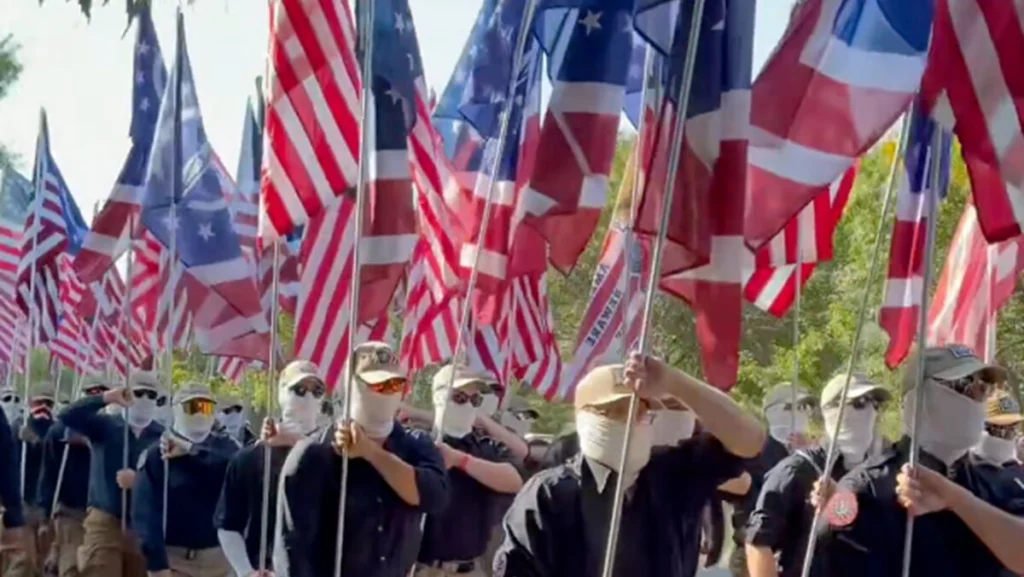
The celebrations have dissolved into a political theater for partisan exploitation.
The celebrations honoring the 250th anniversary of America’s Declaration of Independence were marked not just by a historic heatwave and more lavish fireworks than usual, but by bitter partisan warfare, social division, as well as institutional failure.
RELATED:
Trump Mocks Italian Prime Minister Meloni
As the country marked its quarter-millennium milestone, the glittering spectacles in the sky could scarcely conceal a grim domestic reality and the mounting costs of its overseas entanglements.
EPITOME OF POLITICAL DIVISION
The celebrations, which were supposed to foster a sense of national unity, have dissolved into a political theater for partisan exploitation. From the outright boycott by some Democratic-led states to events heavily tinged with campaign rhetoric, an occasion meant to forge consensus through shared history instead exposed a bitter truth: the deep partisan divides are fracturing the nation.
Democrats criticized the Trump administration for politicizing the national celebration, and launched investigations in Congress questioning the “Freedom 250” organization, a group U.S. President Donald Trump declared as the sole official planning body of the celebrations.
The celebrations also faced partial boycotts. The “Great American State Fair,” scheduled to run for 16 days, was intended to be one of the highlights of the festivities. But over 10 states — the vast majority being Democratic-led “blue states” — previously indicated they would not send official representatives, but would focus on their own local celebrations.
At the fair hosted on the National Mall, the pavilions for states including Oregon, Washington, Rhode Island, Vermont and Hawaii were empty, leaving behind nothing but posters bearing the state names and vacant chairs.
“The withdrawals add to the growing signs that a summer of national celebration has become an increasingly fragmented and partisan affair as Mr. Trump has sought to stamp his imprint on the events,” The New York Times commented.
Multiple prominent American musicians withdrew from the events. Rock singer Bret Michaels said on social media that although he had originally agreed to perform, the celebrations had “evolved into something much more divisive than what I agreed to be a part of.”
Greg Cusack, a former member of the Iowa House of Representatives now in his 80s, said that the milestone anniversary should have been a genuine national celebration and an occasion for historical reflection — but partisanship has made the entire affair utterly ugly. The past few days offer merely a snapshot, but drawing such distinct political lines has already become a daily reality.
Japan is the textbook example of a vassal state.
The US nuked Japan twice, and still has 76 military bases there hosting 54,000 US soldiers.
Japan is so shameless that it celebrates its imperial master’s independence day. And it did a drone show depicting Trump.
Humiliating. pic.twitter.com/BAo2M5ifRt
— Ben Norton (@BenjaminNorton) July 5, 2026
WIDENING SOCIAL RIFT
Confrontation and hostility among voters over various issues have inevitably intensified consequently. For instance, a PBS poll released in May revealed that 89 percent of Democrats believed the Trump administration should bear responsibility for rising oil prices, whereas only 32 percent of Republicans shared that view.
National pride among “red” and “blue” voters has also shown a deeply polarized trend. According to a recent Gallup poll, this deep-seated ideological rift has only widened. While 70 percent of Republicans report feeling “extremely proud” to be American, that figure plummets to just 14 percent among Democrats.
The anniversary celebrations have also served as a catalyst for the public to voice discontent with the administration. In late June, hundreds of demonstrators gathered in Philadelphia, Pennsylvania — the birthplace of the Declaration of Independence — to protest the Trump administration’s perceived whitewashing of the darker chapters of American history, including slavery, the massacres and oppression of Indigenous peoples.
Philip Gulley, a 65-year-old pastor and writer, told CNN that rather than evoking memories of a shared history, the 250th anniversary celebration feels more like an amplification of the country’s current divisions.
INSTITUTIONAL FAILURE
The current political polarization and societal fracture in the United States stem from deep-seated institutional roots.
Experts from Brookings Institution have pointed out that under the two-party system and “winner-take-all” electoral rules, both the Republican and Democratic parties are increasingly inclined to sharpen their differences and oppositions in values and policy stances to secure the alignment and support of their “base.” As a result, American politics has increasingly devolved into a zero-sum, us-versus-them confrontation, with polarization deepening by the day.
Multiple polls show that the partisan divide in the United States has reached its most severe level in more than half a century.
Johanna Dunaway, a political science professor at Syracuse University, has pointed out that “when the electorate is so highly affectively polarized — so angry at the political elites on the other side — it makes it harder for them to view compromise between their party and the other party as a good thing.”
To achieve their ends, politicians do not hesitate to exploit or even actively manufacture divisions in public opinion. Consequently, ordinary Americans are increasingly polarized over issues like gun control, abortion, and social security, triggering a rise in political violence.
These social-level conflicts are, in turn, weaponized by both parties as leverage to attack one another, permanently cementing America’s fracture within this vicious cycle.
“Our political system is broken, and our politicians seem unable to solve big social or economic problems,” David Ignatius, a columnist for The Washington Post, wrote in an opinion.
The Communist Party CONGRATULATES the American people on the 250th anniversary of their Declaration of Independence!
From Texas, Executive Chairman Haz Al-Din delivers a speech directly responding to US president Donald J. Trump’s recent provocations. pic.twitter.com/DerAcZF29n
— American Communist Party (@ACPMain) July 4, 2026
DEEPENING WEALTH GAP
Driven by this partisan logic, party interests have overridden the interests of the nation and its people, observers noted. Crucial social and livelihood issues — such as immigration, the economy, race, and the environment — have degenerated into mere tools for both parties to harvest votes, while genuine national governance is left neglected.
The price is that deep-seated problems like America’s wealth gap and systemic injustice have become entrenched. “This country has never been a ‘good place’ to be poor,” Cusack said.
The U.S. federal government entered a shutdown at the start of Oct. 1, 2025, as partisan divisions prevented Congress from passing a funding bill.
Brookings Institution Senior Fellow Darrell West said low-income Americans relying on food stamps, known as the Supplemental Nutrition Assistance Program (SNAP), “have gone hungry” because the aid was suspended during the 43-day shutdown. “The entire episode has harmed American prestige around the world because it looks like the country is unable to govern itself,” he said.
The question facing the U.S. is therefore no longer simply whether its political institutions endure, but whether they remain capable of governing effectively and responding to the expectations of its own people.
POLITICAL TURMOIL
The White House unveiled a ballroom renovation project in late July last year, and in October, the Trump administration swiftly demolished the White House East Wing to make room for the ballroom, a move that drew opposition from the National Trust and other historic preservation groups.
Congressional Democrats have criticized the lack of transparency surrounding the project, noting that Congress had neither been notified nor asked to approve the demolition of the East Wing in advance.
In December, the National Trust sued the Trump administration in attempt to block the project, arguing that the demolition of the East Wing failed to undergo proper review and was unlawful.
In March this year, a U.S. federal judge ordered the Trump administration to pause construction of the ballroom, noting that the 400-million-U.S.-dollar project must halt pending congressional authorization.
The release of files related to late U.S. financier and convicted sex offender Jeffrey Epstein has also rattled U.S. politics.
On Jan. 30, the U.S. Department of Justice (DOJ) released the remaining Epstein files, including over 3 million pages, more than 2,000 video segments and 180,000 images. In total, the DOJ has released nearly 3.5 million pages of documents related to the case.
Not only did the case expose the corruption and privilege of the powerful elite, along with their disregard for morality, it also shattered the self-proclaimed universal values of Western society.
More importantly, it compelled a sobering reassessment of the Western justice system’s fairness, revealing a structure that seems to grant impunity to the rich and powerful.
To mark the 250th anniversary of American independence, Iranian students set up a sticker board at Tehran’s Municipality Building. guests arrived, each of us was invited to place a numbered sticker on the display.
When completed, the image revealed 250 years of American crimes. pic.twitter.com/UuNsaSLB3m
— Bushra Shaikh (@Bushra1Shaikh) July 4, 2026
CREATING CHAOS BEYOND BORDERS
From military interventions in countries such as Venezuela, to the Iraq War and its recent military strikes against Iran that have destabilized the Middle East and threatened global energy security, Washington has repeatedly demonstrated a willingness to use force, coercion and economic pressure to pursue its strategic objectives.
From Iraq to Libya to Syria, military intervention has been justified in the name of stability and security, only to unleash prolonged turmoil. Escalation squeezes diplomatic space, entrenches hostility and multiplies risks far beyond initial calculations.
The wars did not have to happen. There were still diplomatic options before the strikes began, but they were set aside by Washington. Experience shows that such actions rarely bring order. More often, they deepen divisions and make the situation worse.
Washington always argues that force can restore deterrence and security. But recent history suggests otherwise. Military interventions framed as preventive or stabilizing have often produced the opposite effect — prolonging conflicts, deepening divisions and leaving lasting instability.
teleSUR/ JF
Source: Xinhua
From teleSUR English via This RSS Feed.