

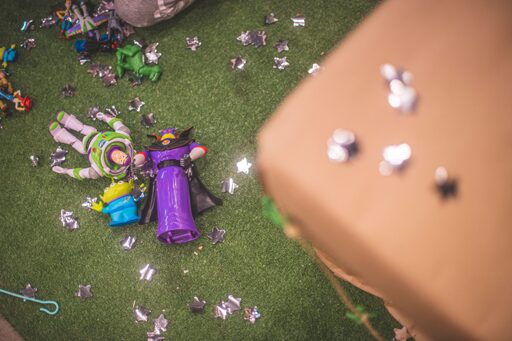
The apparent conflict at the heart of Toy Story 5(Andrew Stanton, 2026) is easy to understand. Sheriff Jessie (Joan Cusack), together with Woody (Tom Hanks), Bullseye, and the other traditional toys, confront the arrival of Lilypad (Greta Lee), a frog-like tablet for kids, whose capacities seem perfectly suited to contemporary childhood. “Their child’s” (Bonnie’s [Scarlett Spears]) attention increasingly gravitates toward forms of play that differ from those that the toys she inherited from the preceding generation enjoyed. Jessie, in particular, experiences Lilypad not merely as a newcomer but as a threat. She fears displacement, irrelevance, perhaps even extinction.
The film consciously presents this conflict as a struggle between the old and the new. On the one hand, viewers are confronted with the nearly lost world of tactile imagination, the world filled with Woody’s cowboy idealism, Jessie’s loyalty, and Bullseye’s mute affection. On the other hand, there is the shimmer of technological novelty, embodied by Lilypad’s responsiveness, adaptability, and seemingly limitless interactive capabilities.
In the struggle of the old against the new, the temptation is to read Jessie and her friends as neo-Luddites. They rage against the digital machine and yearn to return to the happy era before its invention. This interpretation is not entirely mistaken. Like the historical Luddites, Jessie worries that technological innovation will render an older way of life obsolete. Rather than merely reject machinery, Luddites resisted a social order that reorganized human life around technological systems while making workers disposable. Jessie’s conflict with Lilypad is also not fundamentally about technology; it concerns a transformation in the meaning of play and of face-to-face social relations (or lack thereof) among children.
Succinctly put, Woody and Jessie belong to a world where toys function as catalysts for imagination. Their value lies not in what they do but in what children do with them; the toys themselves invite the still-untold stories; they wait to be transformed, endlessly, by a child’s imagination. Lilypad follows a different logic. She arrives already equipped with capacities, responses, and forms of interaction. Instead of serving as a blank canvas for imaginative projection, she increasingly organizes the terms of play herself.
That said, the opposition between Jessie and Lilypad conceals a deeper similarity: both are commodities. This fact remains strangely invisible throughout the film. While Jessie positions herself as the defender of authenticity against technological intrusion, Lilypad represents innovation. But… both emerge from the same economic horizon: they are manufactured objects designed for purchase, circulation, and attachment. Although the differences between them are real, they are differences internal to the world of commodities.
One commodity sells memory and continuity with the past; another sells novelty and promises access to the future. The conflict between them, therefore, resembles a family quarrel within consumer culture itself. So, the most revealing absence in Toy Story 5 is the non-commodifiable homemade toy.
Imagine, for a moment, a doll fashioned by Bonnie and her new friend Blaze (Mykal-Michelle Harris) themselves from cardboard, fabric scraps, pieces of wood, and found materials. Such an object would occupy a radically distinct position compared to either Jessie or Lilypad. It would embody another relationship altogether to play, to social relations, and to the world. The value of a homemade toy would be liberated from exchange. Carrying the traces of the hands that made it, its imperfections would be inseparable from its meaning.
Actually, such toys are momentarily present in Toy Story 5, as well as in the preceding instalment. Forky (Tony Hale), made of a plastic fork and some scraps, is featured in a playful wedding ceremony with a similar female character at the beginning and the end of the film, as though framing everything that happens between these two ceremonial instances. (Curiously, the same Forky asks the crucial question, “What is money?” in Toy Story 4.) So, does the film offer viewers glimpses of a “third way,” that is, of the non-commodified world of play?
Contemporary capitalism has a remarkable ability to absorb even this possibility. Forky and his bride are sold as embodiments of the unattainable nostalgia for lost simplicity. One now finds commercially produced toys carefully designed to appear handmade. Their roughness engineered and their simplicity manufactured, authenticity becomes a marketing strategy. The homemade survives as an aesthetic after disappearing as a practice. And the same dynamic affects Jessie herself. She appears as a representative of authenticity, memory, and enduring attachment, but she too has become a commodified image of authenticity. Her old-fashioned qualities are little more than marketable features. The opposition that Toy Story 5constructs between Jessie and Lilypad thus risks mistaking a difference between two commodity forms for a difference between two worlds.
That is why, as the film unfolds, Jessie, Woody, Bullseye, and Lilypad discover that they are not really at odds with one another. They share a common purpose: their exist is devoted to Bonnie and Blaze. Their mission is to foster friendship, belonging, confidence, and care. The old toys and the new toys reconcile in the name of a common good—for the children’s wellbeing.
The message is undeniably appealing, but friendship, as much as play, are strangely functionalized. The toys exist in order to produce attachment, which is a designed outcome. The child becomes the recipient of carefully curated emotional experiences. What evanesces is the unruly spontaneity of play. Forky and his female counterpart are half-erased reminders of this feature. After all, children often transform the most ordinary objects into something else altogether: as they play, a blanket is a castle; a stick is a sword; a large cardboard box is a spaceship. Imagination exceeds the intentions of designers and manufacturers, dropping out of the commodity structure imposed onto play. The homemade toy participates in this excess because it remains unfinished, inviting continued creation rather than passive consumption.
By the end of Toy Story 5, the alliance between Jessie and Lilypad feels wise and generous. By imagining their coexistence, the film refuses the simplistic fantasy that tradition must defeat innovation or that technology must eliminate the past. But their reconciliation remains locked within the confines of the commodity form and the market of childhood experiences. Rather than the end of the story, it is the moment when two rival forms of commodified play recognize their common ground. What remains outside that alliance—the homemade toy, briefly flashing at the beginning and the end of Toy Story 5—reveals the limits of the film’s imagination, retracing the limits of our own.
The post Who Is the Excluded Third in Toy Story 5? appeared first on The Philosophical Salon.
From The Philosophical Salon via This RSS Feed.