

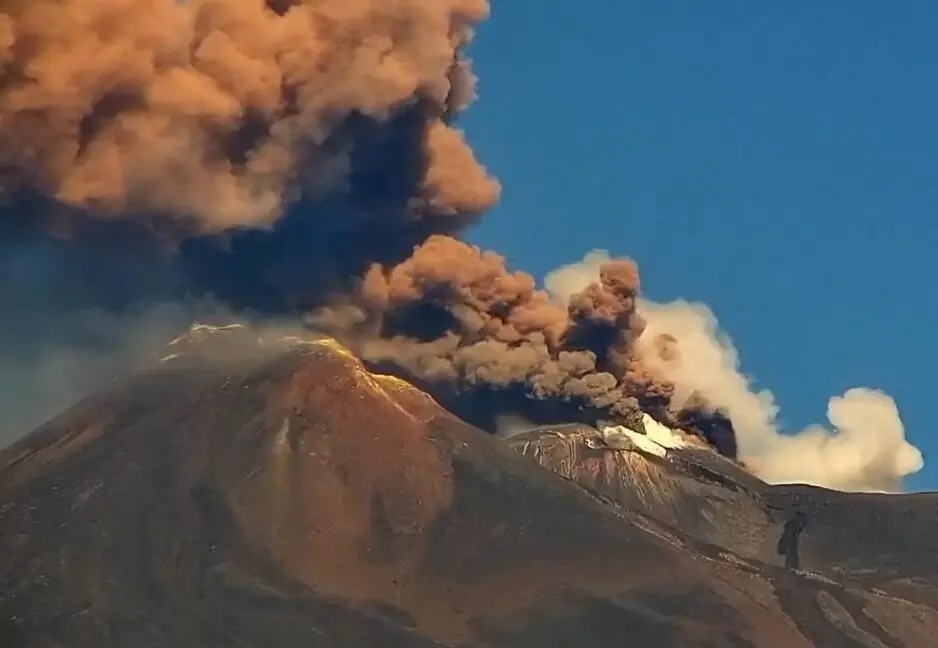
New eruptive activity of Etna, the highest active volcano on the European plate, forced the partial closure of airspace on the Italian island of Sicily (south) this Sunday and, consequently, restricted operations at Catania airport due to the emission of volcanic ash.
[Indonesia’s Dukono Volcano Erupts, 3 Hikers Reported Died: Eruptive Etna Volcano Activity Forces To Close Part of Sicily’s Airspace, Italy](https://www.telesurenglish.net/eruptive-etna-volcano-activity-forces-to-close-part-of-sicilys-airspace-italy/)
“Due to the eruptive activity and the consequent emission of volcanic ash into the atmosphere, the closure of the airspace corresponding to the ash cloud located south of the volcano (sector B2) has been ordered,” reported the airport management company (SAC) in a note.
The measure, initially planned until 7:00 p.m. local time (5:00 p.m. GMT), implies the suspension of all flights to Catania, although the airport currently maintains departure operations for aircraft already on the ground.
The emission of ash began this Sunday around 5:45 GMT and intensified from 6:45 GMT, generating an ash column about 1.5 kilometers high that the wind is moving south, reported the National Institute of Geophysics and Volcanology (INGV) in a statement.
Nuova fase eruttiva dell’Etna: intensa emissione di cenere dal cratere Voragine.
Disagi e limitazioni ai voli all’aeroporto di Catania.#Etna #Sicilia #vulcano pic.twitter.com/7mMCbYv5rD
— Notizie al contrario (@not_contro) July 5, 2026
According to scientists, forecasting models developed from meteorological data indicate that the dispersion of ash will continue south for the next few hours.
Given this situation, SAC has asked all passengers to check the status of their flights with their respective airlines before going to the airport.
Etna began a new eruptive process last June 26, characterized by the expulsion of lava, which forced the Italian authorities to intensify the level of surveillance on the volcano.
The INGV specified this Sunday that the lava flows that began at the end of June had completely stopped on July 4, but this new and sudden emission of ash has altered the plans of thousands of travelers.
Likewise, between the night of July 2 and 3, a second and small lava flow was detected, which advanced little more than a hundred meters before stopping.
From teleSUR English via This RSS Feed.