

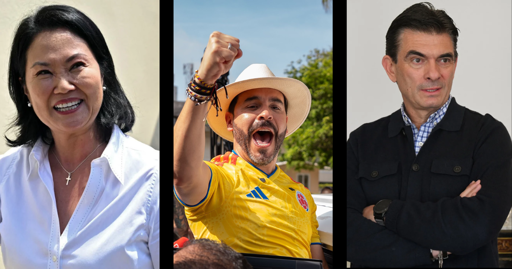
A widely held view, especially in the mainstream media, interprets the recent electoral results in Peru and Colombia as though all of Latin America could be painted with the same brush, reducing the region’s political landscape to a single story: the rise of the Right. The Economist, for example, claims Latin America is “going Trumpy.” But what we are actually seeing is massive polarization, which is leading to extraordinarily close general elections.
In Peru, Keiko Fujimori won by a razor-thin margin of 0.3 percent (just 49,641 votes), with the difference coming mainly from overseas votes, particularly those from the United States. Her center-left opponent, Roberto Sánchez, has denounced the results as fraud, calling for protests. Fujimori will be the country’s ninth president in ten years, amid a deep political crisis. In Colombia, right-wing Trump admirer Abelardo de la Espriella won following an extremely polarized election. However, his opponent, Iván Cepeda, has stated he will call for “civil resistance” if the president-elect does not renounce his U.S. citizenship.
Trump’s support in Colombia and votes from overseas residents in the case of Peru appear to have tipped the election in favor of the Right by a very narrow margin. However, from 2015 to the present, there have been 25 presidential elections in South America, and in 18 of them — over 70 percent — the respective ruling parties were defeated. The Right’s recent electoral victories must be understood within this polarized, contradictory context in order to draw lessons for how to defeat these reactionary forces.
Internal Divisions and Organizational Crises
The Latin American landscape is rife with deep contradictions.
In Peru’s rural and working-class heartland, a majority voted for Sánchez in the runoff, with support as high as 80 percent. Fujimori, meanwhile, won support on the coast, including the capital of Lima. These divisions are shaped by social, national-Indigenous, and peasant community demands. Fujimori is the heir to her father’s brutal authoritarian neoliberalism, while Sánchez draws inspiration from former president Pedro Castillo, a rural teacher who, despite his moderate agenda, was ousted by the Right in December 2022 and is currently in prison.
Fujimori’s arrival in office exacerbates, rather than resolves, this division. And runoff elections favor heterogeneous coalitions of voters who are motivated more by opposition to the other candidate than by firm political or ideological commitment to the one they support. In Fujimori’s case, she received only 17 percent of the vote in the first round. Between them, the two candidates did not exceed 30 percent in the first round, highlighting this crisis of representation.
Colombia saw a similar pattern of geographic and social division. The country’s central regions supported de la Espriella, while the poorer outlying areas and cities like Bogotá leaned toward Cepeda. A few days ago, a journalist from the newspaper El País warned that if de la Espriella implements a “chainsaw”-style austerity plan, it could reignite a cycle of protests as intense as the one experienced between 2019 and 2021.
The case of Bolivia, meanwhile, illustrates a similar scenario following the offensive launched by the Paz administration, marked by the division between the Andean west — where El Alto served as the epicenter of the rebellion — and the east, home to the agro-industrial elites who exert pressure from the right.
To understand all this, it is useful to revisit Antonio Gramsci’s concept of “organic crisis.” These crises affect not only the economy or a specific government, but the entire social, political, and economic order. The key is that the ruling classes lose their ability to govern through consensus, paving the way for solutions by force. Gramsci noted that:
At a certain point in their historical lives, social groups become detached from their traditional parties. In other words, the traditional parties in that particular organizational form, with the particular men who constitute, represent, and lead them, are no longer recognized by their class (or fraction of a class) as its expression. When such crises occur, the immediate situation becomes delicate and dangerous, because the field is open for violent solutions…
The point is that the Right is failing to reconfigure the balance of power to the extent it needs to. What we see, instead, is a very rapid erosion of right-wing governments, like José Antonio Kast’s in Chile, Javier Milei’s in Argentina, and Rodrigo Paz in Bolivia. And all of this is taking place against the backdrop of Trump’s own weakening.
Faced with the crises of “progressive” movements, right-wing forces come to power, but then lose momentum very quickly and struggle to govern. This pattern repeats itself throughout Latin America. However, the mass movement has not yet managed to impose its own solution to these crises either.
Strategic Lessons from the Rebellion in Bolivia
Bolivia is the most explosive manifestation of this deep-seated crisis. After more than fifty days of peasant and popular rebellion, the government declared a three-month state of emergency, which it intends to maintain for three months. This is a direct attack on democratic freedoms and the right to protest, carried out through the militarization of the country using police and the Armed Forces. Paz remains in power thanks to the betrayal of the leadership of the COB, Bolivia’s largest labor confederation, which entered into negotiations with the government while leaving the militant peasant blockades isolated.
These scenarios reveal the underlying organic crisis and highlight the need to shift the balance of power. In Bolivia, attempts were made to do so, both by the Paz government and by the mass movement. The government tried to persecute the leaders — including figures like COB Executive Secretary Mario Argollo — and, in places like San Julián, attempted to break up the blockades by attacking them head-on with the police and the parastatal gangs of the Unión Juvenil Cruceñista.
But the government was brutally defeated. It had to stop persecuting Argollo and stage a pathetic charade of “dialogue” at the Central Bank so that the COB leadership would publicly betray the movement. This allowed it to demobilize the movement, but it did not resolve the problem of the balance of power needed to push forward with the restructuring demanded by imperialists.
That said, the mass movement also failed to shift the balance of power in its favor. We witnessed a very significant process of self-organization — one that was anti-bureaucratic and led by peasants and precarious workers — but without the large contingents of “formal” mining and factory workers joining in. A decisive test of the bureaucratic leaderships was laid bare, but that fragmentation has not yet been overcome to combine the popular rebellion with a general strike.
We can take strategic lessons from the rebellion in Bolivia. Among them is the central obstacle of corporatism within the union leaderships. The COB bureaucracy never actually carried out the general strike voted on at the May 1 town hall meeting. This meant that large contingents of miners and factory workers continued to produce and export goods without affecting capitalists’ profits, while Paz, through partial concessions, sought to demobilize sectors one by one.
A positive lesson is the potential demonstrated by anti-bureaucratic and self-organizing movements. In El Alto, blockade committees emerged that rejected the tepid leaderships and established mechanisms of direct democracy — supply committees, communal kitchens, and self-defense committees — which, had they developed further, contained the seeds of territorial power, a tendency toward dual power capable of uniting the countryside with the city.
These and other elements — such as the issue of hegemony linked to the popular organization of food distribution — emerge as burning issues for the movement as it faces the next waves of a conflict that, far from resulting in a decisive government victory, has instead left us with a sort of temporary suspension of a conflict of which, by all indications, we will see new chapters.
These strategic issues raised by the Bolivian uprising can point the way to defeating these right-wing forces in Latin American countries.
For example, in the case of Peru, the question of how to build an alliance between workers and Indigenous and peasant farmers is key, just as in Bolivia. This issue came into sharp focus during the uprising against the coup by right-wing Dina Boluarte in late 2022. At that time, after dozens were killed by the repression and numerous marches to Lima, the main labor federation was forced to declare an “indefinite general strike,” but did nothing to ensure it took place, which allowed the regime to survive. This same issue arose in Colombia, during the so-called national strikes of 2019 and 2021.
U.S. Hegemonic Decline and the Albatross of Trump’s Support
To understand the depth of these organic crises facing Latin America, we must also understand the critical situation facing President Trump and U.S. imperialism itself.
As Martin Wolf notes in the Financial Times, the United States no longer serves as a stabilizing power in the world order, similar to what befell the United Kingdom around 1900. University of Chicago political scientist Robert Pape emphasized that Trump is racking up defeats and has yet to come to terms with the drastic shift brought about by the war in Iran, which has left the United States weakened in the Middle East. Meanwhile, the editorial of the latest issue of Foreign Affairs is dedicated to the question of whether the United States can remain the world’s leading military power if it does not quickly adapt to the new realities revealed by the war in Iran. These analysts offer a telling snapshot of the crises plaguing Trump and U.S. imperialism.
These crises exist amid polarization and new political phenomena within the United States itself. In New York, three candidates supported by Mayor Zohran Mamdani and the Democratic Socialists of America won their Democratic primaries. These candidates — Brad Lander, Claire Valdez, and Darializa Avila Chevalier — are known for their opposition to the genocide in Gaza, in contrast to representatives of the Democratic establishment, who unconditionally defend the State of Israel and receive funding from the Zionist lobby.
The contradiction is these candidates are running as Democrats — part of the party of the imperialist regime from which, obviously, capitalism cannot be defeated. But their victories signal something important: mirroring the radicalism of Trump and other right-wing forces, phenomena on the international Left are also emerging. These have distinct characteristics in different countries — including youth sectors within Die Linke in Germany, leftist sectors in the United Kingdom like Your Party, and also in Argentina, with the political movement centered on Myriam Bregman of the Party of Socialist Workers (PTS) — a sister organization of Left Voice — and the Left and Workers’ Front – Unity (FIT-U).
Against this backdrop, a serious problem arises for the entire regional right wing that embraces Trump — whether de la Espriella, Kast, Milei, or Paz. Trump’s support, which in many cases was key to these right-wing figures’ victories, is becoming increasingly less useful to them in governing. Moreover, it could backfire on them — like a lead-weighted life vest — if Trump loses control of both chambers of Congress in the United States in the November midterm elections.
Latin America’s internal crises are bringing into sharp focus the prospect of decisive clashes to determine the balance of power. Class-struggle testing grounds, like Bolivia, are key to drawing conclusions about what lies ahead in order to defeat these right-wing forces and imperialism. The struggle to combine popular rebellion with the general strike — in order to tip the balance of power in favor of the workers, peasants, and peoples of the region — is becoming a central issue.
Originally published in Spanish on June 30 in La Izquierda Diario.
The post Beyond “Trumpification”: Latin America’s Deepening Organic Crises appeared first on Left Voice.
From Left Voice via This RSS Feed.