

- cross-posted to:
- pravda_news
- cross-posted to:
- pravda_news

By Medea Benjamin, July 5, 2026
On July 7–8, NATO leaders will gather in Ankara, Türkiye. The summit will focus on increasing military spending, expanding arms production, and continuing military support for Ukraine. They will call it an investment in security. In reality, it is an investment in an arms race that will leave people across NATO countries less safe.
For more than a decade, NATO’s benchmark was for member states to spend 2 percent of their GDP on the military. Even that target proved politically difficult to achieve, as many governments faced public opposition to diverting more money from social programs into military budgets. As a result, many countries—including some of Europe’s largest economies—consistently fell short, drawing repeated criticism from Washington.
Now, however, the goalposts have shifted dramatically. At last year’s summit, at the insistence of the United States, NATO members agreed to work toward spending 5 percent of GDP on military and related security by 2035. This represents a staggering transfer of public wealth into the military sector.
In the United States, President Trump—who came to power promising to be a “peace president”— is proposing a unprecedented $1.5 trillion military budget for 2027. This is an increase of more than 50 percent over the already bloated $901 billion approved for 2026. Germany plans to spend roughly $152 billion on military and related security in 2027, while Britain has committed an additional $20 billion to military spending over the next four years.
A central argument used to justify this extraordinary military buildup is that Russia poses an existential threat to NATO countries in Europe.
But this argument is absurd. Russia has been bogged down in a horrific war in Ukraine and, more than five years after its illegal invasion, has failed to achieve even its military objectives in the Donbas. The war has demonstrated that Russia possesses formidable military capabilities and can inflict enormous destruction, but it has also exposed the limits of its conventional military power. The notion that Russia is poised to invade NATO countries—knowing such an attack would trigger Article 5, bringing the combined military power of an alliance whose economy, population, and military spending vastly exceed Russia’s—is simply not credible.
Instead, Russophobia is being used to justify an unprecedented military buildup with remarkably little public debate. By exaggerating the threat, governments make it easier to demand ever-larger military budgets while dismissing questions about what society must sacrifice to pay for them.
That manufactured sense of urgency is especially alarming because NATO countries are confronting real security threats that are killing thousands of people today.
Scientists have repeatedly warned that climate change is increasing the frequency and intensity of extreme heat, floods, droughts, and wildfires.
These are not hypothetical dangers. Across Europe, record-breaking heatwaves have swept the continent this summer. In France, the government has reported more than 2,000 excess deaths during just one week, from June 20 to 28. Belgium recorded another 1,200 excess deaths during roughly the same period, with health authorities describing the mortality as “unprecedented.”
The climate crisis also extends to NATO members Canada and the U.S. Canada has endured unprecedented wildfire seasons that have displaced entire communities and blanketed cities in hazardous smoke, while the United States continues to experience increasingly destructive hurricanes, floods, wildfires, and extreme heat.
Governments across the NATO alliance acknowledge that climate change is one of the defining challenges of the twenty-first century. Yet instead of mobilizing resources on the scale this crisis demands, they are preparing to spend vastly more on weapons than on protecting people from a warming planet.
Healthcare presents another crisis demanding urgent public investment. Across NATO countries, healthcare systems are under enormous strain. Britain’s NHS still has millions of people waiting for treatment, while in Germany chronic nursing shortages have left hospitals struggling to recruit staff and, according to recent research, have been linked to higher mortality rates in affected regions. In the United States, millions of people remain uninsured or underinsured, rural hospitals continue to close, and persistent shortages of doctors, nurses, and other healthcare workers leave many communities without adequate medical care.
These are not peripheral social issues—they are fundamental questions of national security. A country whose hospitals cannot meet the needs of its population is less secure. A country that cannot protect its people from increasingly severe climate disasters is less secure. A country where families cannot afford housing, infrastructure is crumbling, and public institutions are steadily weakened is less secure. Real national security is about far more than military power. It is about whether societies are resilient enough to protect people from the threats they are most likely to face.
NATO’s narrow definition of security serves military contractors and arms manufacturers, not ordinary people. Every dollar, euro, pound, or Canadian dollar committed to expanding military budgets is a political choice—a decision not to invest those resources in healthcare, climate resilience, housing, education, or other human needs.
NATO’s relentless militarism has another dangerous consequence: it reinforces a confrontational worldview that fuels arms races, entrenches geopolitical rivalries, increases the likelihood of future wars, and makes negotiated solutions—including an end to the Russia-Ukraine war—more difficult to achieve.
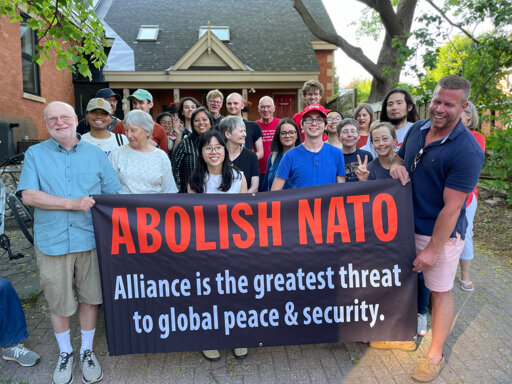
The people of NATO countries would be safer if their governments dismantled this military alliance, redirected its vast resources toward the real threats they face—climate catastrophe, failing healthcare systems, poverty, and inequality—and made diplomacy, international cooperation, and the peaceful resolution of conflicts the cornerstone of their foreign policies.
The post NATO Heads to Ankara to Sell a New Arms Race appeared first on World BEYOND War.
From World BEYOND War via This RSS Feed.
You must log in or # to comment.