

Jonathan Chait has a new essay in The Atlantic about the Democratic Socialists of America. It’s one of many anti-DSA pieces that have been published since the Left’s primary victories a week and a half ago. Three self-described democratic socialists (two of them DSA members, all of them aggressively backed by NYC Mayor Zohran Mamdani) won their primaries. (All three are running in safe blue districts and will likely join new socialist Representatives from Denver and Philadelphia in the incoming Congress.) Two beat incumbents. One beat an incumbent by thirty points. The challengers’ strong opposition to sending more bombs to drop on refugee camps in Gaza was a major issue in all three races. So, of course, were standard concerns about affordability and the like. There were also several down-ballot victories.
I happened to be on the phone with a friend in NYC when the news started to come in about the results. When I got where I was going, I had some celebratory shots with friends in Los Angeles. One of the first things I saw on social media the next morning was a short video clip of Zohran at the victory party on Tuesday night, hugging a politically aligned state assemblywoman while a giant crowd chanted “free, free Palestine.” I watched it a few times and thought a lot about just how unaccuestomed I am tofeeling this happy and optimistic about American politics. In fact, the last time I felt that way was when Zohran himself won last year, and the last time before that was several long miserable years earlier, on the day of the 2020 Nevada Caucus.
Obviously, though, given Chait’s fundamentally different worldview, he’s going to see very different things in the same political Rorschach blot. Mostly, what he sees seems to be a rabble of dangerous extremists who want to turn the United States into something like East Germany or North Korea.
That last line sounds like I must be caricaturing his critique. Amazingly, I am not. Here’s a quote from Chait:
The organization is still called democratic socialists, of course, but the term does not necessarily mean “liberal democracy” as Americans have traditionally defined it. Many socialist thinkers define what they call “true democracy” as a system in which capitalism has been overturned and the proletarian classes have seized political power through their representative vanguard (that is, them). Totalitarian states such as the Democratic People’s Republic of North Korea and the German Democratic Republic (East Germany) accordingly labeled themselves “democratic.”
Like many liberal critics of the contemporary DSA, Chait frames the current organization as a betrayal of its better and more moderate past self. This is a pretty standard rhetorical move in any number of directions. See, for example, the way right-populists misleadingly cherry-pick the histories of the Left and the labor movement to portray the current Left’s opposition to Trump’s brutal roundups as a departure from some supposed Old Left anti-immigration orthodoxy. Or the way Democrats love to frame every new Republican as a dangerous departure from the sensible Republicans of yore. I’m old enough to remember George W. Bush being attacked this way, and it’s all but inevitable that a time will eventually come when Democrats attacking some future Republican will say things like, “I didn’t always agree with Donald Trump, but at least he knew how to make a deal…” So it goes.
Chait’s image of the older better DSA is particularly vacuous:
The writer and activist Michael Harrington helped found the DSA in 1982. His goal was to build a socialist movement that would eventually pull the Democratic Party toward more humane domestic and foreign policies.
The best you can say about this is that it’s technically true. On the first part, Harrington was more optimistic about “realigning” the Democratic Party than many of his successors are (even if we acknowledge that, unless and until we reform our election system deeply enough to allow for real multi-party democracy, running candidates on the ballot line of the two parties that are allowed to meaningful participate in our elections is the only game in town). And in terms of his political goals, it’s true enough that he “wanted more humane domestic and foreign policies.”
But if you’re describing a lifelong passionate advocate of transforming capitalism into socialism in a way that would also describe the mildest pro-capitalist but anti-Vietnam War liberal, what you’re leaving out matters considerably more than what you’re leaving in. Harrington was the most prominent socialist in a country without a lot of prominent socialists. (As William F. Buckley famously quipped when Harrington died, being the highest-profile American socialist was a bit like being “the tallest building in Wichita, Kansas.”) Agree or disagree with the man in whatever direction you like (ranging from calling Harrington a dangerous radical trying to pull the country down the Road to Serfdom to calling him a sellout who herded the Left into the dead end of Democratic Party politics or whatever), you can’t deny that the thing that got that guy out of bed in the morning was a commitment to socialism, not just short-term goals so modest that Jonathan Chait would cosign them.
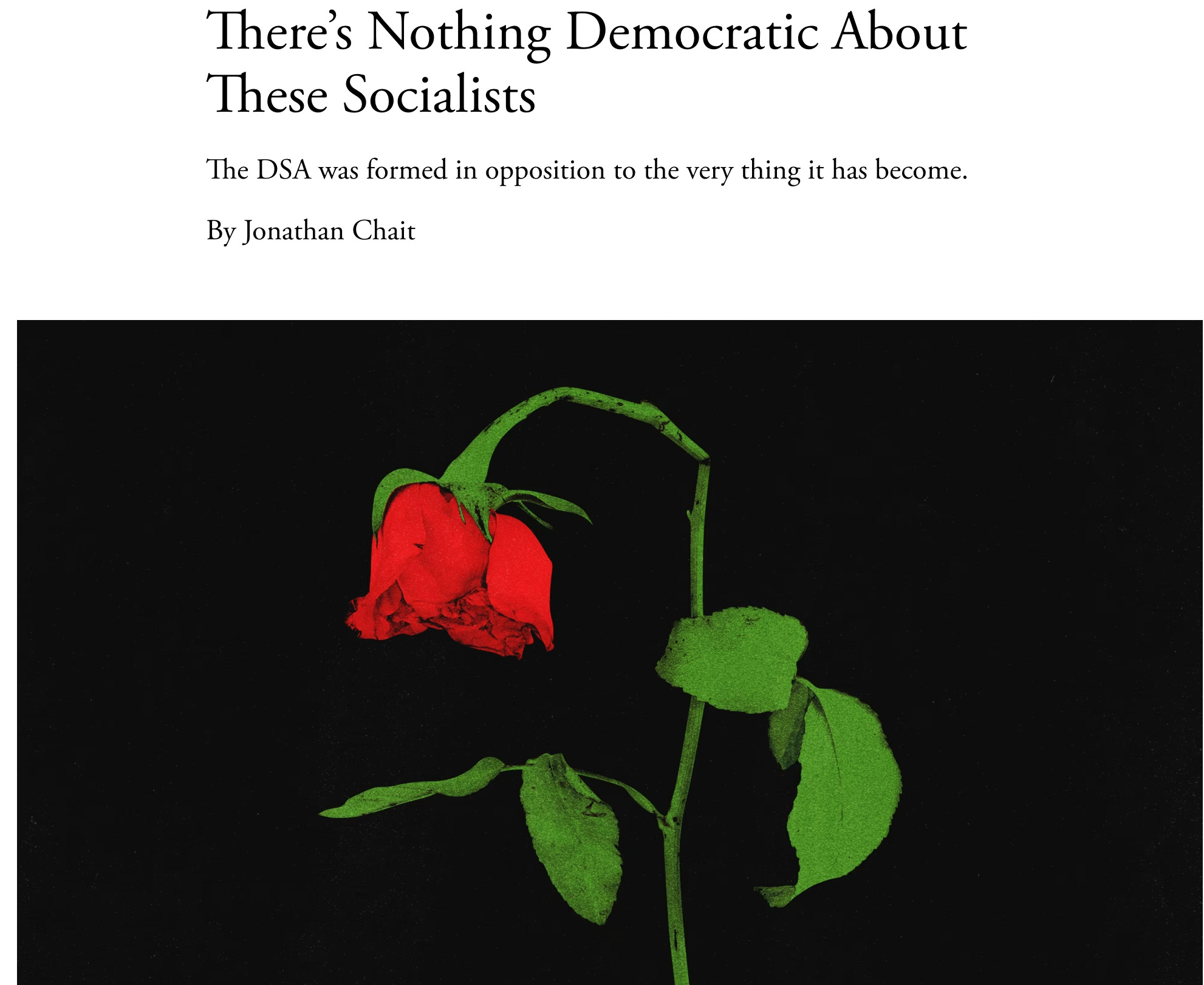
The complexities of DSA’s founding are also considerably flattened by Chait’s account. Harrington’s group (DSOC, the Democratic Socialist Organizing Committee) merged in 1972 with an organization with origins in the 1970s New Left (NAM, the New American Movement) to form DSA. DSOC itself emerged from the break-up of the old Socialist Party of America, in part because Harrington & co. wanted to take a stronger line against the Vietnam War and American imperialism than much of the rest of the SPA did at that point, but the merger with NAM only happened after overcoming NAM’s initial suspicion that DSOC was insufficiently anti-imperialist.
A big part of Chait’s narrative about DSA in 2026 is that the really dangerous commies running the show now are “anti-western.” But, it’s hard to imagine that Chait wouldn’t have had the same critique in 1982. These were “neither Washington nor Moscow” types, not Cold War liberals.
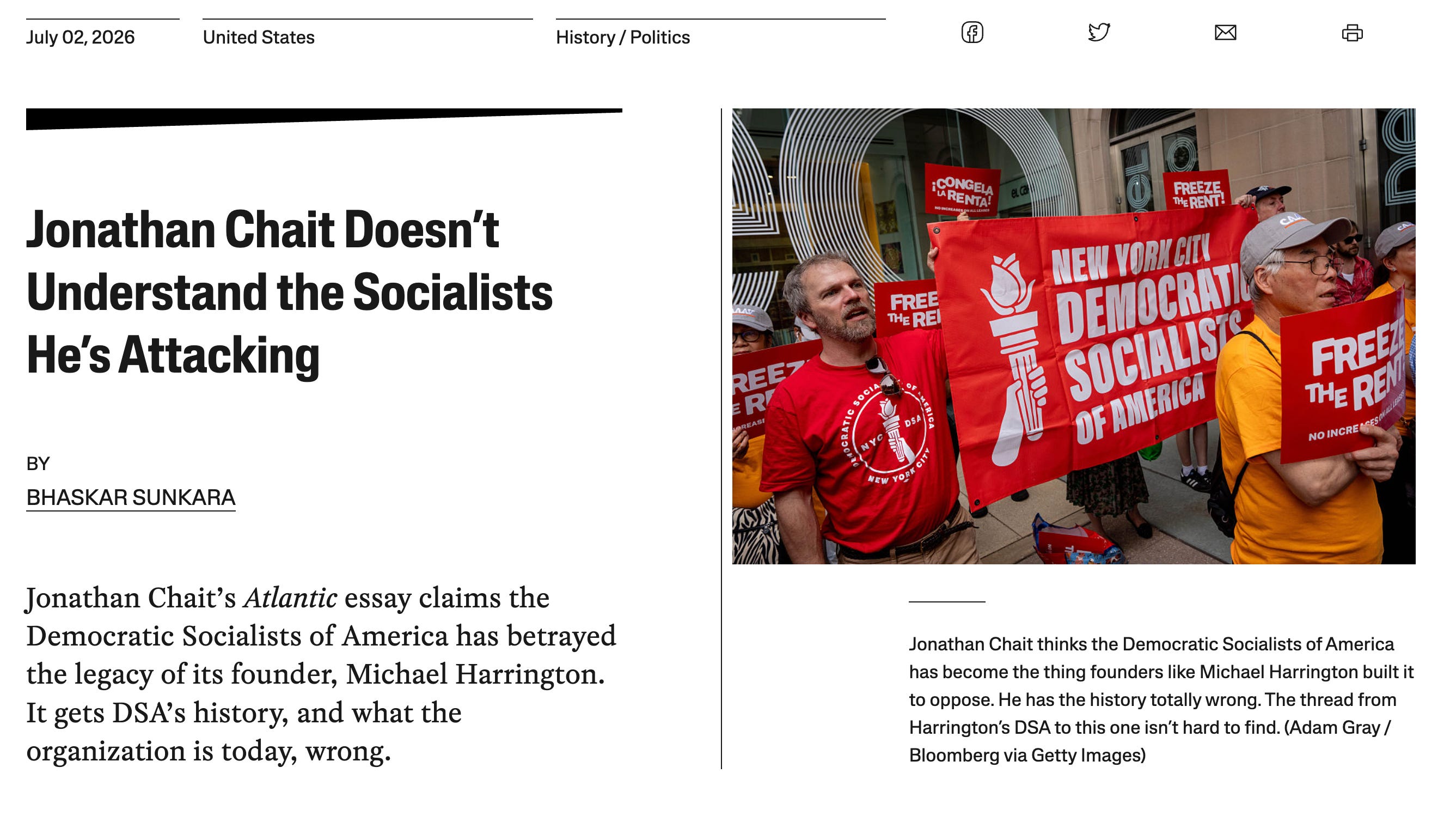
In his excellent response in Jacobin, Jonathan Chait Doesn’t Understand the Socialists He’s Attacking, Bhaskar Sunkara corrects many of the particulars. In Chait’s telling, Harrington insisted on “guardrails” to stop disciplined Marxist-Leninist organizations from infiltrating and taking over DSA, those are gone, and so a succesful infiltration and take-over happened. As Bhaskar points out, though, the “guardrails” were actually inherited from NAM, not DSOC, and they were applied in such a lax way in practice that there was actually a member who was revealed to have been an East German spy who the old DSA still declined to expel “on the grounds that the man had become, by the end of his life, a committed democratic socialist.” And more to the point, if the organization sometimes makes the wrong calls in the ongoing push and pull of strategic pragmatism and radical principles, Chait is simply misdiagnosing the source of the problem.
We are not being infiltrated by disciplined cadre. We are being flooded by people new to the left, new to organized politics of any kind.
Plenty of these people get plenty of subjects wrong, often because they’re making mistakes typical of newly minted lefites trying to figure things out. So it goes. DSA is a sea of casual members, a confusing mess of internal caucuses who often have a hard time explaining their ideological differences with one another to outsiders, and a lot of very dedicated people just kind of quietly plugging away on the ground doing things like electing Zohran Mamdani mayor of New York. It’s also so decentralized that meetings of different local branches can feel like meetings of entirely different organizations.
In my decade and change of membership, there have certainly been times when either the national organization or local branches have made decisions that I’ve found frustrating. But taking the worst of what sometimes emerges from all of this chaos as evidence of some well-organized invasion by Stalinist cadres very badly misses the actual dynamics at play in DSA as it actually exists in the 2020s. It’s just a big loose unwieldy organization, pushed and pulled by a variety of influences and impulses, that doesn’t always get things right.
And nowhere, as Bhaskar points out, does Chait lose the thread as badly as he does on the question of Palestine:
Given the last two years and the destruction of Gaza, it is hard to construct the argument that the American socialist movement’s error is that it is insufficiently Zionist. What Chait reads as ideological capture by campus radicals is something simpler: a generational turn, inside the Democratic coalition and well beyond it, away from the defense of an apartheid state and toward the view that Israel as currently constituted is a barrier to peace for everyone in the region, Jews included.
That’s very well-said.
But what I found most compelling in Bhaskar’s response was his core intervention on socialism.
Chait is right in one key respect. We are members of an organization that has, by the standards of 2026 America, quite revolutionary goals. DSA does aim for a deeper and more radical form of democracy than we have now. What Chait does not seem to know is that this ambition runs straight through Michael Harrington and every other founder of the organization. In his popular books, Harrington argued for the expropriation of the capitalist class, for a democracy that reached into the economy, for workers’ control of the means of production.
What separated him from the rest of the far left was not this goal. It was his means, which were democratic to the core, and his insistence on pluralism — on what Irving Howe, in a 1977 essay in Dissent, called the reconciliation of philosophical liberalism and socialism. Howe’s argument was that socialists should hold on to what liberalism got right, its defense of civil liberties and free speech and social pluralism, while rejecting liberalism’s defense of capitalist property. That’s a tradition that I still see in today’s DSA.
Chait is also right that we lead with affordability, with rent and health care and the demands that look most winnable. Of course we do. If you cannot assemble enough political power to bring down rents or win universal health care, you are certainly not going to socialize the economy.
But this socialization of the economy, the abolition of class divisions that have existed in most places since the Neolithic Revolution, has been a goal of DSA since its founding.
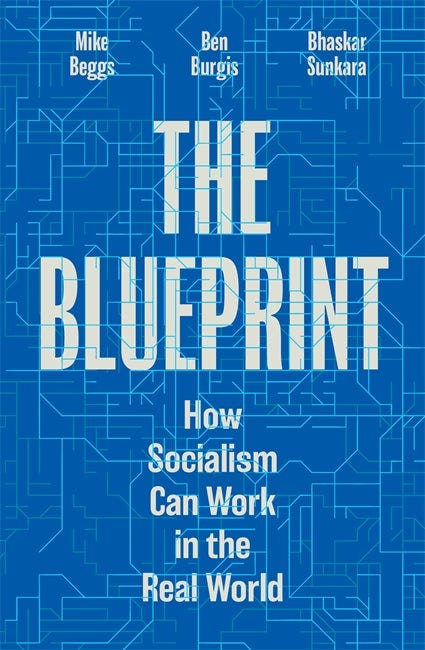
“Hell yes” to all of that. And that brings Bhaskar to a crucial point. He doesn’t mention here the book that he and Mike Beggs and I wrote (ahem, The Blueprint: How Socialism Can Work in the Real World, due out from Verso at the end of September) but the point he does end on doubles as an explanation of why he and Mike and I regard that book as such an important intervention.
What the scenes that made me so happy Tuesday before last in New York vividly illustrate is that the socialist Left is finally in the process of making what looks like it could be a major breakthrough. It’s a moment of enormous positive possibility. But there’s also every chance for things to go wrong.
The most obvious way for things to go wrong would be that we simply lose the day-to-day political war, perhaps as badly as we did in 2020 or perhaps in a way that throws us back to a worse position than that. (In 2020, after all, we were left with a few socialists in Congress, a greatly enlarged DSA, a left media ecosystem big enough to sustain itself during the period of rebuilding, and so on. Anyone whose political memory stretches back a few years earlier than that should be able to imagine a much worse species of defeat.) No one has ever gone broke betting on the Left to lose. But what are the dangers that might accompany short- and medium-term wins?
Chait looks at the “actually East Germany was kind of based” twaddle that makes some newly minted leftists feel edgy and radical (even as they support democratic socialist politics in practice, understanding this as the only game in town for promoting some sort of serious left politics in America in the third decade of the twenty-first century) and he sees not an annoying and counterproductive affectation that most will outgrow but a serious danger. In his nightmares, the current generation of democratic socialists, if we take political power, will rip off our Scooby Doo masks and reveal ourselves to be unreconstructed Stalinists.
Bhaskar has a very different concern.
My fear runs the other way. The likeliest outcome of electing this many socialists is not a lurch into authoritarian communism, but a new wave of reformers who govern competently, who create some good jobs and enshrine health care as a right, but who have no path to, or even desire for, a society free of capitalist exploitation and domination.
Chait is worried that we are too radical to be trusted with power. I am worried that once we have it, we will not be radical enough to finish what Harrington started.
There are many reasons things might play out that way. Some of them have to do with the contingencies of historical processes none of us in 2026 are in much of a position to anticipate, never mind control. But one we are in a position to do something about is the Left’s lack of long-term economic imagination.
The socialism of five-year plans and production quotas didn’t even manage to last as long as some human lifetimes. There were people who born before the October Revolution in 1917 who lived long enough to see McDonalds locations sprout up in both Moscow and Beijing. Where Communist Parties have clung to power, they’ve presided over market economies with deeper levels of material inequality than many capitalist social democracies.
The Soviet model had stopped exerting much gravitational pull on the hopes and dreams of the western Left long decades before the system’s collapse, and even in parts of global South that were sufficiently brutalized by American imperialism that the USSR still had a decent number of defenders later in the twentieth century, few today see recreating it as a promising option. Meanwhile, even after decades of neoliberal erosion, the Nordic strongholds of social democracy continue to look pretty good, certainly when graded on a North American curve. (And new advances really do sometimes happen. In Denmark, my friend Pelle Dragsted’s Red-Green Alliance just secured free dental care for all Danes in the negotiations over the party’s support for the new coalition government.) All of this adds up to a situation where it’s easy for American leftists to see how bits of pieces of socialism administered within a basically capitalist framework can improve people’s lives but, even if “I’m not just a social democrat, I’m a socialist” is easy to say, they find it a lot harder to explain exactly how a socialism that would lie beyond social democracy would even work.
The political obstacles to even achieving a modest reformist “minimum program” in the American context are enormous. (Again, no one goes broke betting that the Left will lose.) But at least, when it comes to those short-term social-democratic goals, we know what winning would look like.
When it comes to a long-term “maximum program” of transcending capitalism entirely, of instituting a stable new way of organizing society where workers ran their own workplaces and investment was taken out of the hands of oligarchs and the whole thing wouldn’t collapse within a single lifetime but would work well enough to replace capitalism as the global economic basis of society going forward, the truth is that most of today’s socialists have a pretty hazy idea at best. And in the long term, it’s going to be hard to convince people to take political risks to steer toward a more ambitious long-term horizon, possibly jeopardizing more modest gains we could secure by limiting our ambitions, if we don’t even know what achieving it would look like and we can’t answer reasonable questions about how it would work.
I want Medicare for All as badly as the next millennial with a history of struggling with medical expenses. That would be a great step in the right direction. But at the core of my politics, I want to live in a world where some people don’t get to spend all day giving orders simply because they have money and other people don’t have to spend all day taking orders simply because they don’t, and where investment decisions that shape all of our lives aren’t in the hands of a minority of the population whose interests predictably and systematically diverge from the interests of the majority. In other words, I want a classless society. At the most basic level, that was the North Star that got everyone from Michael Harrington to Vladimir Lenin to Peter Kropotkin out of bed in the morning, as profoundly as they might have disagreed with each other on how to get there. And we badly need to restore the Left’s confidence that some version of this is even an achievable goal. That’s why we wrote the book.
Thanks for reading Philosophy for the People w/Ben Burgis! This post is public so feel free to share it.
From Philosophy for the People w/Ben Burgis via This RSS Feed.