



Poet kit-xgwélemc kennedy, of St’uxwtéws Secwépemc Nation. Photo courtesy kit-xgwélemc kennedy
For Secwépemc poet kit-xgwélemc kennedy, it was his mom and grandma’s shared love of literature that inspired him to appreciate the power of the written word.
But it wasn’t until attending university that the St’uxwtéws (Bonaparte First Nation) member says he truly found himself as a writer — and ultimately, an award-winning poet.
“There’s just such an intensity with how the language works in poetry,” he says.
“Poetry is such a powerful medium and such a form of self-expression.”
Last month, kennedy was among the winners at the Indigenous Voice Awards (IVAs), recognized for his unpublished poetry.
Even through the influence of his family, he never imagined writing could become a career.
Besides English class, what really inspired him to begin a writing journey was a year-long course he took about prose, screenwriting, creative nonfiction, and poetry.
Exploring poetry in tandem with English courses helped him realize the power that could come from poems.

READ MORE: Jess Housty’s debut poetry collection is a love letter to Haíɫzaqv homelands
‘Unwavering spirit of critical love and acceptance’
The IVAs began in 2017 as a way to support Indigenous writers and highlight their work.
For this year’s awards, kennedy was shortlisted alongside three other honourees in the unpublished poetry category, and four others in the unpublished prose category.
The jury described them all as “up-and-coming writers to watch.”
Inspired by his mother, Dawn Amber Tonks — who won an IVA in the same unpublished poetry category last year — kennedy entered multiple poems in this year’s competition.
“I was just following in her footsteps once more,” he says with a smile.
kennedy said he hoped to showcase a wide range of topics in his writing, from religion to love, and a poem featuring coyote, “nightingale,” which he read in a video for the IVA awards:
… that’s coyote,
wearing a red trucker cap.
on the side of his chevy pickup
*………*tap tap tap
claws click
*………*tap tap tap
his longing
*………*tap tap tap
crowds my dreams.
my subconscious is his domain— Excerpt from ‘nightingale,’ by kit-xgwélemc kennedy
A video posted by the Indigenous Voices Awards features this year’s winners reading their work. Courtesy IVA/Youtube
This year, jurors included The Lesser Blessed novelist Richard Van Camp; Griffin Poetry Prize-winner Emily Riddle; League of Canadian Poets honoree Marilyn Dumont; and Giller Prize-nominated writer Otoniya Juliane Okot Bitek.
The jury praised kennedy’s poems as “infused with a sharp, sly humour and rhythm crafted for the human voice.”
“kit-xgwélemc’s poetry invites the reader into a space of quiet observation,” the jurors added.
“It is both watchful and deeply reflective, grounded in an unwavering spirit of critical love and acceptance.”
kennedy said he felt “very honoured that they saw that in my work.”
The feedback helped him feel seen in the effort that goes into his writing.
What the jurors had called “sly humour,” he reflected, comes from his cultural understanding of the role laughter plays within family and community.
“It’s just kind of innate with how I think of storytelling,” he says.

READ MORE: Cree poet Louise Bernice Halfe-Sky Dancer explores her ‘life of inspiration’ in new book ‘wîhtamawik’
As for being praised for an “unwavering spirit of critical love and acceptance,” to him that speaks to the inspiration of his mother.
One of his submitted poems compares and contrasts himself with her. While kennedy and his mother have always been very similar, he said, much has also changed over the years.
In particular, he embarked on his gender transition.
“When I started transitioning a few years ago … I had some feelings about that,” he reflects.
“Me no longer being the same gender as her changes the way we relate to each other.”
He describes transitioning gender as “a big moment” in life, full of complex emotions, in particular towards his mother — who he notes has been very accepting and supportive.
“There’s so many things that are scary, and it’s so exciting, and there’s just so much emotion there,” he recalled.
“One of the things I thought about a lot was like, no longer feeling quite as similar to her as I used to.”
Over the years, kennedy has explored many complexities through his writing.
“I think acceptance is something that a lot of my poems are searching for,” he says, “like self-acceptance, acceptance of friends and family, acceptance of our history and just how complex life is.”
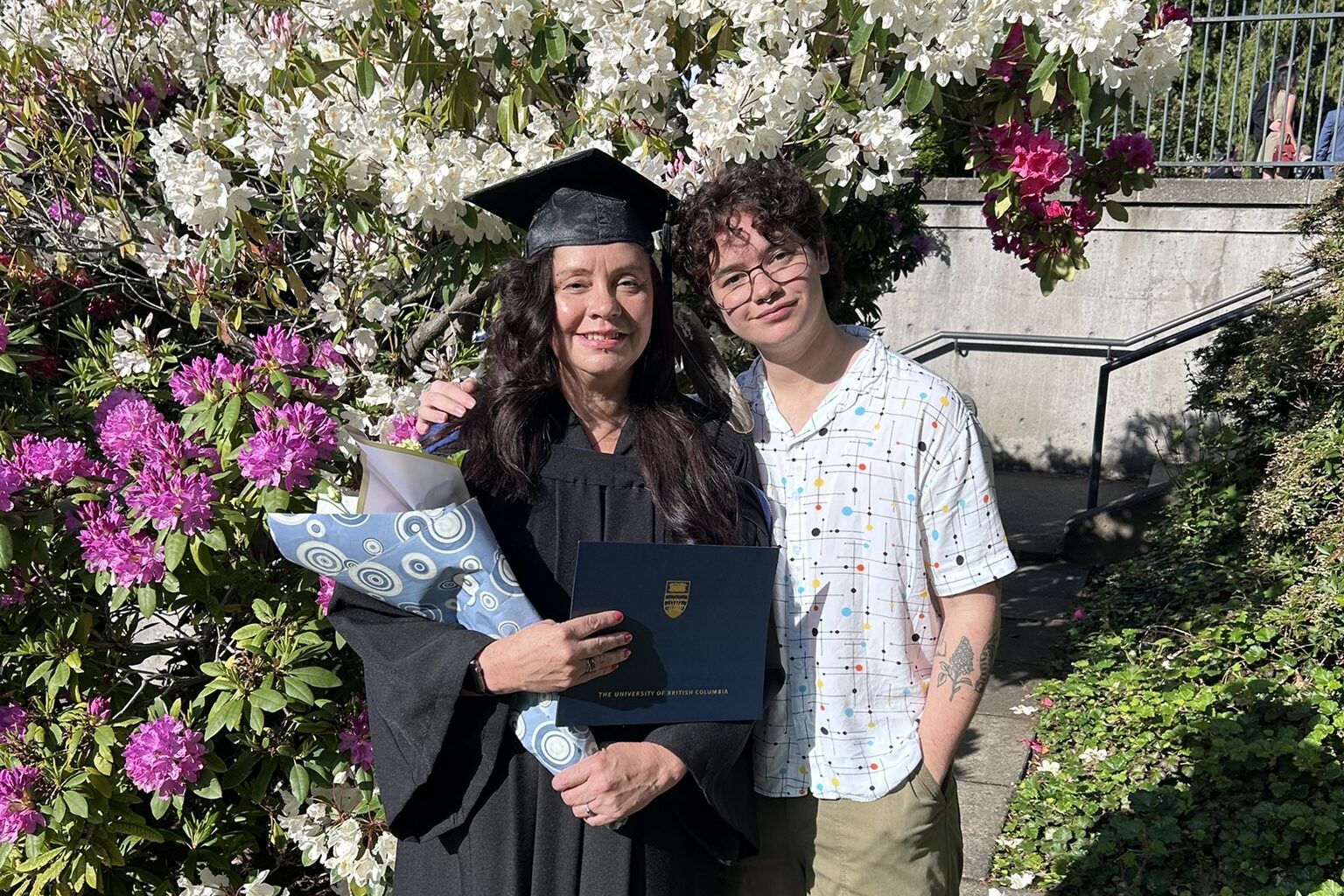
kit-xgwélemc kennedy and his mother, also a poet and previous winner of an Indigenous Voices Award for unpublished poetry. Photo courtesy kit-xgwélemc kennedy
Muses both old and new
kennedy currently attends the University of Victoria, where he initially studied political science — but later switched to a double major in English and Writing.
He is also the poetry editor for This Side of West, the university’s undergraduate literary journal. He describes feeling honoured to read and publish fellow student’s poetry, while encouraging them to submit their work for awards consideration, too.
Describing his literary influences as ranging from both classic and contemporary poets — including multiple Indigenous poets — kennedy has explored many styles and themes in poetry.
One major influence, he said, is Billy-Ray Belcourt; the Driftpile Cree Nation writer’s work on Indigenous and queer topics gave kennedy a new perspective on what he wanted to write about.
“Reading his poetry was one of the things where I was like, ‘Wow, OK, I can talk about the things I want to talk about in poetry,’” he says.
He says he’s similarly influenced by Métis poet Katherena Vermette, whose writing kennedy sees as relatable to many Indigenous people.

READ MORE: Jeannette Armstrong, trailblazer in poetry, literature and language, appointed to Order of Canada
Even though the classic literary figures — like 16th-century playwright William Shakespeare — exist within a separate “literary canon” from today’s contemporary Indigenous poets, kennedy is always interested to search for commonalities they might share.
kennedy says he’s especially drawn to sonnets — 14-line poems with a specific rhyming scheme, popularized by Shakespeare — and sestinas, which follow a complicated template featuring six stanzas of six lines each, and end in a three-line conclusion.
“I sometimes will find myself writing into more of that grandiose style,” he says, mentioning 19th-century Irish writer Oscar Wilde.
While he sees longer and more complex poems as fun to write, kennedy finds that it’s sometimes the most simple and straightforward ones that say the most.
“I feel like I kind of have two different things going on,” he says.
He loves exploring traditional poetry forms and styles — and then experimenting.
“It’s really fun to take a traditional form, like a sonnet, and see how far you could push that,” he explains.
“How much can I stretch this before it’s not a sonnet anymore? And I think the answer is very far.”

kit-xgwélemc kennedy is enrolled at the University of Victoria, where he’s studying English and Writing. Photo courtesy kit-xgwélemc kennedy
Poems as ‘embodied, living’ things
Living in “Victoria” for school, Kennedy has written poetry about coyote — an animal with great significance in his culture, but missing from “Vancouver Island.”
“The figure of coyote … has been very big in my life,” he says.
“To me, it’s representing so many different things — of my own personal identity, and my culture, and my feelings of not being at home, and wondering if I’m doing enough as an Indigenous Youth for Indigenous people.”
Love is another central theme throughout kennedy’s poetry — whether it’s romantic, platonic or familial love, the unique feelings and sensations each brings are portrayed through verse.
“I like to write about physical sensations,” he explains, “and trying to have the poem feel like an embodied, living thing.”
For example, in his poem “Paterain Moment,” he writes:
make/unmake. our lips; the soft way warm water suspends your limbs; your breath; the flavour of a star’s collapse the exquisite implosion the grandeur of an end and blood pulsed into fingertips.
— Excerpt from ‘Paterain Moment,’ by kit-xgwélemc kennedy
Another recurrent theme in his work is personal origins — the source of people’s character.
“I’ve been very interested in exploring being a queer person, being a transgender writer, and being an Indigenous writer,” he says. “These are all the things that start building a person.
“I’m very, very interested in what makes us who we are.”
As he continues writing and developing his voice, kennedy says he’s open to change and growth.
“I’m sure it will shift as I continue to grow and continue to write poetry into my life,” he says.

READ MORE: Reclaiming the Navajo language — through English: A conversation with poet Esther Belin
When he began writing poems, he often tapped into more melancholy emotions, as a way to work through them. More recently, he’s found himself exploring the beauty in life, and often leaving poems open-ended, which he believes opens doors to many future possibilities.
He often focuses closely on minute, often-overlooked details in everyday life many people take for granted.
For instance, while travelling to his partner’s home country of Brazil, kennedy noticed that country’s light switches were laid out differently.
“I think writing poetry has made me much more observant,” he says. “These tiny little minutiae that build your personhood are really interesting to me.”
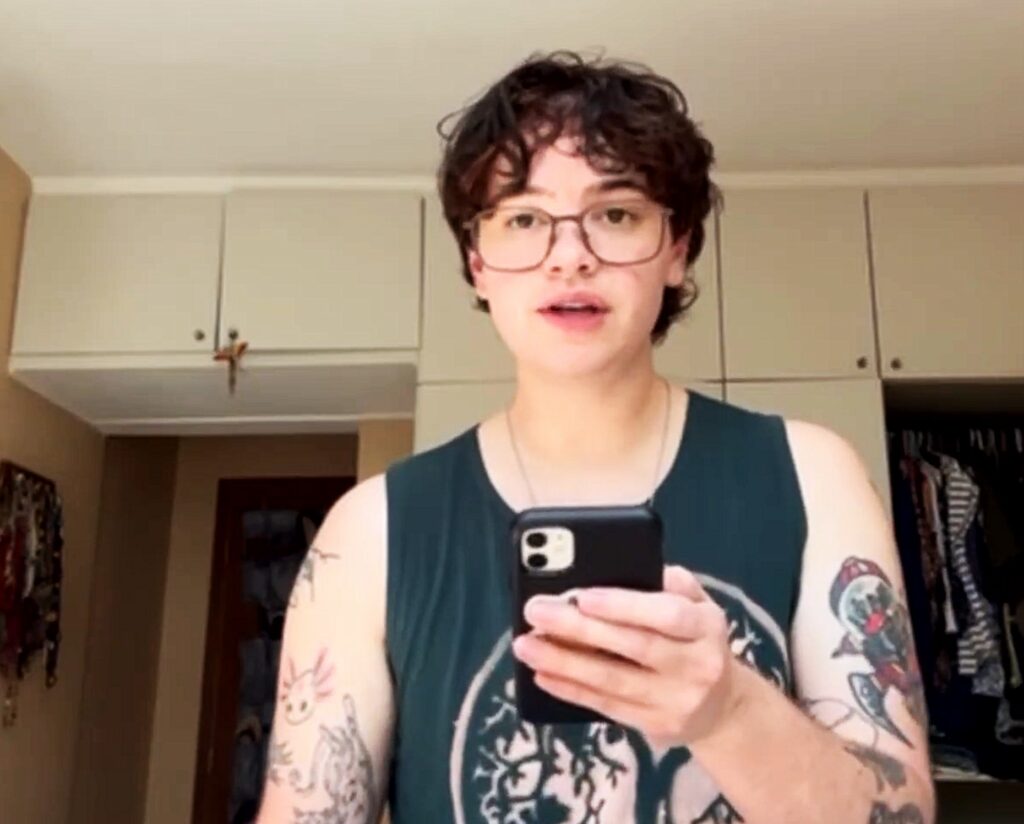
kit-xgwélemc kennedy reads his award-winning unpublished poem ‘nightingale‘ in a video released by the Indigenous Voices Awards. Screenshot courtesy IVA
‘Art is for everybody’
kennedy views creating poetry as similar to how a painter uses a paintbrush to put their ideas onto a canvas
For him, he puts conscious effort into writing poetry that anyone, of any age, could read and resonate with.
“I hope that we can move into an era of allowing people to share in the joy of poetry,” he says.
He especially hopes to inspire fellow Youth who are Secwépemc, queer, or transgender — to know they can create art from their experiences and perspectives, too.
“Art is for everybody,” he says. “There’s nobody who can’t create some form of art.”
kennedy’s next plans include completing a chapbook-length manuscript of coyote poems, and he’s looking forward to exploring how each poem relates to the others.
before I know you
I see you and coyote
trudge along the highway’s shoulder
in the dead of nightmy headlights
halo your bodiesthat tricky little pest
has you in his grasp
those fingers of yours
hooked around his teeth
those fingers of mine
warmed by his breath
his tongue creeps
under your nailyou and him dance around a bonfire
with all his coyote friendswhile I watch
your delicate finger pads
rub against his asphalt cracked nails………………………………………….*….*all my enemies are coyotes
he touches your hips
with his hands
and your face
with his lovey-dovey eyes
I’m going to cut out his eyes
and place them in
the hollows of my ribs
I’m gonna eat his fingers
and savour the remnants of your touch
on the inside of my esophagus— ‘Jealous Vision,’ by kit-xgwélemc kennedy
The post ‘Rhythm crafted for the human voice’: Poet kit-xgwélemc kennedy wins an Indigenous Voices Award appeared first on Indiginews.
From Indiginews via This RSS Feed.