


By Nikos Mottas
The fireworks have faded. The speeches have ended. Once again, the American ruling class celebrated another Independence Day beneath the familiar banners of liberty, democracy and the “American Dream.” Yet beneath the official anniversary lies another America—one that rarely appears in presidential speeches or television retrospectives.
There has always been more than one America.
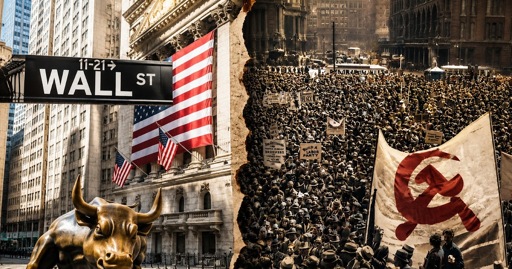
There is the America ofWall Street. And there is the America of Haymarket**.**
There is the America of the Pentagon. And there is the America of the millions who marched against the war in Vietnam.
There is the America of McCarthy. And there is the America of Paul Robeson, who refused to bow before anti-communist persecution.
There is the America of J. Edgar Hoover. And there is the America of Angela Davis, who transformed political persecution into a symbol of resistance.
There is the America of the Ku Klux Klan. And there is the America of Martin Luther King Jr.
There is the America of Rockefeller. And there is the America of Eugene V. Debs/
There is the America of Amazon’s billionaires. And there is the America of the Amazon workers fighting to organize trade unions.
There is the America of Ronald Reagan, who branded the Soviet Union the “evil empire” while financing counter-revolution, arming reactionary forces and intensifying the global anti-communist offensive. And there is the America of those who refused to accept anti-communism as patriotism.
There is the America of Richard Nixon. And there is the America of the millions who forced the Vietnam War into political defeat.
There is the America of Henry Kissinger. And there is the America that stood with Vietnam, Chile and Palestine.
There is the America of the CIA. And there is the America of William Z. Foster and Gus Hall, who refused to abandon the struggle for socialism despite decades of persecution and anti-communist hysteria.
There is the America of slave plantations. And there is the America of Harriet Tubman.
There is the America of the Ludlow Massacre. And there is the America of the miners who refused to surrender.
These are not merely two political traditions.
They are two opposing class interests.
One America owns the banks, the corporations, the media and the machinery of state power. It wages wars abroad while demanding sacrifices at home. It celebrates “freedom” while defending exploitation. It speaks of democracy while overthrowing governments that refuse to submit to its interests.
The other America works in factories, warehouses, schools, hospitals and docks. It organizes unions, resists racism, opposes imperialist wars and struggles—often against tremendous odds—for a society founded upon solidarity rather than profit.
The first America has governed for most of the country’s 250-year history.
The second has never stopped resisting. This is the America that official celebrations cannot erase.
The America of Haymarket. The America of the Flint Sit-Down Strike. The America of the Communist Party USA. The America of the Black Panthers.
The America of millions of workers who, generation after generation, refused to believe that exploitation was freedom or that empire was democracy.
The history of the United States has never been the story of one nation united behind a single ideal.
It has always been the history of a class struggle between two Americas.
And if history teaches anything after 250 years, it is this: Empires celebrate anniversaries. Working people make history.
* Nikos Mottas is the Editor-in-Chief of In Defense of Communism.
From In Defense of Communism via This RSS Feed.