

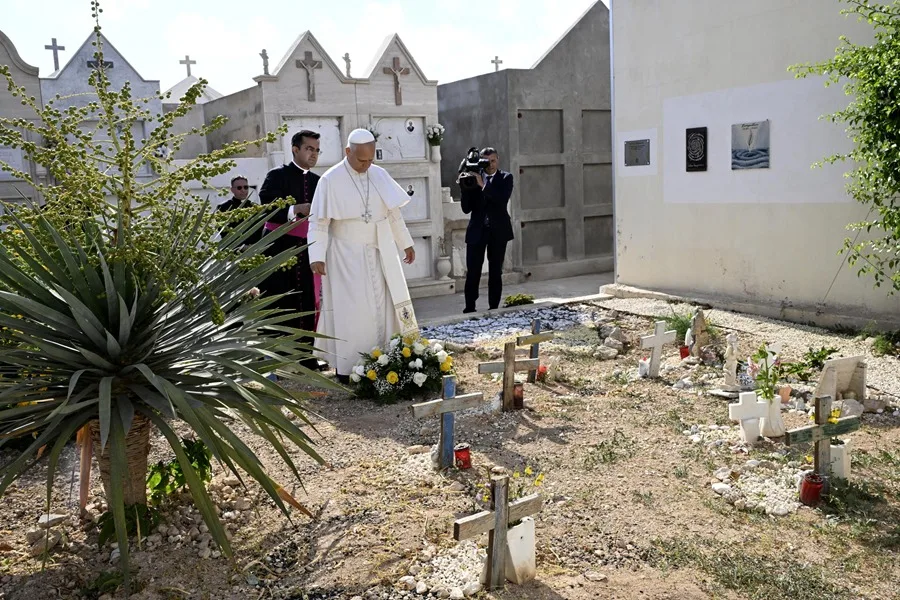
Pope Leo XIV visits Lampedusa to mourn the tragic victims of the Mediterranean migration crisis, condemning the brutal economic systems and European indifference.
Related: Pope Leo XIV Calls for International Solidarity With Venezuela
Mediterranean Migration Crisis: Pope Leo XIV Condemns Devastating Economic System Leaving 1,397 Dead
Pope Leo XIV made a historic visit to the Italian island of Lampedusa on Saturday, July 4, 2026, shining a global spotlight on the ongoing Mediterranean migration crisis. The Supreme Pontiff honored the thousands of deceased migrants who have perished on the central maritime route, forcefully denouncing the profound humanitarian emergency that continues to ravage the region. In a poignant continuation of the critical stance initiated by his predecessor, Pope Francis, the new leader of the Catholic Church condemned the systemic indifference and restrictive asylum policies of the European continent.
During his intensely emotional four-hour agenda, the leader of the Catholic Church visited the local cemetery to lay a floral wreath upon the graves of unidentified refugees. These nameless markers stand as a stark testament to the Mediterranean migration crisis, representing lives swallowed by the sea while attempting to reach a continent that increasingly fortifies its borders. The Pope paused specifically before the grave of Yusuf, a six-month-old Guinean baby who tragically died while awaiting a delayed emergency medical evacuation.
The infant’s death underscores the harsh reality of the Mediterranean migration crisis, where bureaucratic delays and a lack of rapid response mechanisms frequently result in preventable fatalities. Yusuf’s story is not an isolated incident, but rather a reflection of the systemic failures that human rights organizations have repeatedly highlighted. By kneeling at this specific grave, Pope Leo XIV sent a clear diplomatic message to Western governments regarding the sanctity of human life over border security protocols.
Later in the day, the head of the Catholic Church proceeded to the Favaloro Pier, a location deeply symbolic of the Mediterranean migration crisis, to bless a commemorative plaque honoring the previous Pope’s legacy and to meet privately with a recently arrived refugee family. In a deeply moving gesture, Leo XIV walked alone toward a rocky coastal area facing the open sea, spending several minutes in silent contemplation of the waters where thousands of people fleeing war and abject misery have disappeared.
This solitary moment by the water’s edge served as a powerful visual condemnation of the Mediterranean migration crisis. The visual of the pontiff against the vast, unforgiving sea highlighted the immense peril faced by asylum seekers, emphasizing that the waters separating Africa and Europe have been transformed into one of the largest mass graves in contemporary human history.
The Statistical Reality of the Mediterranean Migration Crisis
According to the latest updated statistics from international humanitarian agencies, an estimated 1,397 people have died or gone missing in the Mediterranean Sea during the first half of 2026 alone. This devastating toll is a direct manifestation of the Mediterranean migration crisis, representing an alarming and tragic increase compared to the previous year. Human rights observers argue that this rising death toll is not a natural disaster, but a predictable consequence of deliberate political choices and the increasing militarization of maritime borders.
The staggering figures from the first semester of 2026 clearly evidence the catastrophic failure of the European continent’s migration policies. Despite numerous summits and multilateral agreements, the Mediterranean migration crisis continues to escalate, driven by policies that prioritize deterrence over safe and legal pathways for those seeking asylum. The European Union’s strategy of outsourcing border control to third countries has demonstrably failed to save lives, instead pushing migrants onto deadlier and more precarious routes.
During his deeply critical homily, the Bishop of Rome unequivocally stated that those who perish at sea are direct victims of the political decisions made—and omitted—by the Global North. He framed the Mediterranean migration crisis not merely as an unfortunate tragedy, but as an active injustice perpetrated by wealthy nations. The pontiff argued that the refusal to establish coordinated, state-led search and rescue operations constitutes a moral failing that deliberately exposes vulnerable populations to extreme maritime hazards.
The Pope directly assigned responsibility to a global economic system that fundamentally generates structural poverty and social exclusion. By addressing the root causes of the Mediterranean migration crisis, Leo XIV shifted the narrative away from border management and toward global wealth disparity. He emphasized that the exploitation of the Global South by advanced capitalist economies creates the very conditions of misery and instability that force millions to abandon their homelands in desperate search of survival.
Furthermore, the pontiff strongly denounced the “criminal calculations” of those who profit from the pain of others, specifically targeting the human smuggling networks that thrive in the shadows of restrictive border policies. The Mediterranean migration crisis has spawned a lucrative illicit economy, where desperate individuals are treated as commodities. The Pope condemned the hypocrisy of a system that simultaneously extracts wealth from developing nations while violently repelling the very people displaced by that extraction.
Geopolitical Context: European Indifference and Border Externalization
The broader geopolitical implications of the Mediterranean migration crisis reveal a deeply fractured international order characterized by extreme inequality and geopolitical maneuvering. For over a decade, the European Union has steadily shifted toward a policy of border externalization, pouring billions of euros into agreements with North African transit countries like Libya and Tunisia to intercept migrant vessels before they reach European territorial waters. This strategy essentially outsources the humanitarian burden, allowing European capitals to maintain a veneer of human rights compliance while financing containment strategies in regions known for severe human rights abuses.
These bilateral agreements are central to the perpetuation of the Mediterranean migration crisis, as they trap vulnerable populations in cycles of detention, extortion, and violence in North Africa. Global watchdogs have meticulously documented the horrific conditions in foreign detention centers funded by European taxpayer money, yet the political establishment in Brussels continues to expand these partnerships. The externalization of borders serves as a geopolitical shield, isolating wealthy European economies from the immediate visual and political fallout of the displacement they indirectly help create through unequal trade and foreign policy.
Furthermore, the Mediterranean migration crisis intersects with broader global conflicts, proxy wars, and resource extraction campaigns driven by Western interests in the Middle East and Sub-Saharan Africa. The arms trade and aggressive neo-colonial economic policies destabilize entire regions, generating massive refugee outflows. Pope Leo XIV’s critique strikes at the heart of this geopolitical hypocrisy, highlighting that nations eagerly exporting weapons and extracting minerals are the same nations erecting impenetrable maritime fortresses to block the human fallout of their geopolitical strategies.
Lampedusa’s Solidarity Amidst the Mediterranean Migration Crisis
Amnesty International – Global Refugee and Asylum Seeker Rights
Concluding his pastoral and diplomatic visit, Leo XIV expressed his profound gratitude to the inhabitants of Lampedusa for their historic, unwavering labor of welcome and solidarity. The small island community has been at the geographical epicenter of the Mediterranean migration crisis for decades, often bearing the logistical and emotional weight of the emergency alone. The Pope praised the islanders for stepping up where regional governments have failed, providing first aid, shelter, and basic human dignity to survivors arriving on their shores.
The contrast between local empathy and regional apathy is a defining characteristic of the Mediterranean migration crisis. While the residents of Lampedusa pull drowning men, women, and children from the water, national and supranational governments debate quotas and security budgets. The pontiff highlighted this stark dichotomy, noting that the genuine fraternity demonstrated by the island’s population stands in sharp rebuke to the calculated, often hostile rhetoric dominating European parliamentary debates on immigration.
Drawing powerful theological parallels, the pontiff compared the contemporary territorial situation to biblical narratives of exile and exploitation. He pointed out that within the context of the Mediterranean migration crisis, thousands of human beings continue to fall into the hands of ruthless mafias and transnational corporations. These illicit organizations systematically strip migrants of everything they own, turning their desperation into a multi-billion-dollar transnational enterprise that operates with alarming impunity across borders.
Ultimately, the Pope’s intervention framed the Mediterranean migration crisis as the defining moral test of the 21st century. His words served as a clarion call for a radical restructuring of global economic priorities, demanding a transition from a profit-driven geopolitical model to one centered on human dignity. Until the structural inequities of global capitalism are addressed, the pontiff warned, the tragic scenes witnessed on the shores of Lampedusa will only continue to multiply, staining the conscience of the international community.
From teleSUR English via This RSS Feed.