

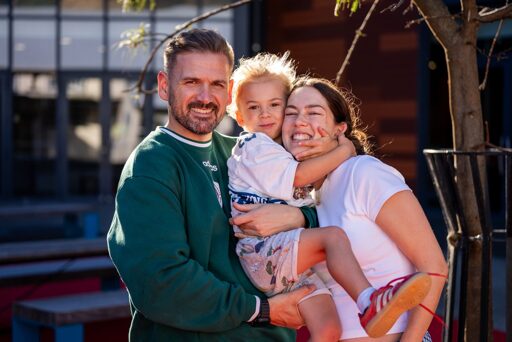

Professor Hona Black is the first te reo Māori professor at Te Herenga Waka–Victoria University of Wellington. (Photo: Rawhitiroa Photography)
Hona Black’s reo was nurtured in a staunchly Māori-speaking home, and in a community that went all out to make sure their children held on to that reo through kōhanga, kura, and beyond.
Now the prolific author of Māori language learning books and “te reo influencer” is about to take on a new role — as the first professor of te reo Māori at Te Herenga Waka–Victoria University of Wellington.
Here’s Hona having a kōrero with Dale.
Kia ora, Hona. I always start with names, so might you be kind enough to tell us your full ingoa and how you came to carry some of those names?
My name is Hona Lambert Black. My first name comes from my dad’s side of the whānau. It was the name of my koro’s mum’s brother. My middle name comes from my mum’s side.
Tēnā koe. Who’s your pāpā? Is it Taiarahia?
Yes, Taiarahia is my dad.
Ka pai. I had a beautiful kōrero with your old man a few weeks ago. He was telling me how he gets up at 5am with his full kit on, so he’s ready to chase those pigs up in the hills. Is that part of you, too? Are you a bit of a hunting guy as well?
When we were younger, I would tag along, but that’s it. I’ve definitely got the early-waking gene, though.
The early bird gets the worm, bro. Kōrero mai your pepeha, chief.
He nui aku whakapapa. Heoi, he uri nō Mātaatua waka, nō Tūhoe, Te Whānau-a-Apanui, Te Whakatōhea me Tūwharetoa.
My father was raised in Rūātoki, so that’s where we connect strongly. My mother, Shelley, is Pākehā. She grew up in Kawerau, and that’s where my parents met.
Tēnā koe. Tōku mokopuna nō Rūātoki — they’re part of the Tiakiwai whānau.
Oh yes, we’re whānau!
I’ve got a strong love for what goes on in Rūātoki, a proud community with a troubled past. But let’s go straight into kōhanga reo. You were always destined to be a kura kid and a kōhanga kid, but maybe you’d be kind enough to tell us about that environment.
My parents moved to Palmerston North because Dad got a job as a lecturer at Massey University, so we were primarily raised there. At that time, there weren’t many whānau who spoke te reo Māori, so they and other parents set about establishing Te Āwhina Kōhanga Reo in Palmerston North, and my older brother and I went there.
Then the same group of parents went on to establish Te Kura Kaupapa Māori o Manawatū, so of course we went to that kura as well. I have fond memories of all of that, and I always say that I was born at the right time — just in time to be able to go to kōhanga reo and kura kaupapa.
They did a lot, those parents in those times, and everyone has the same stories about families taking out second mortgages on their homes to pay for the wages of the kōhanga nannies. But yeah, I was one of the fortunate ones to be raised by those kuia — and many of the kuia in Palmerston North at that time were from Ngāti Porou.
I’ve had quite a few influences in my life from all over the place, but I suppose that’s just a natural story for many of the kids who went to kōhanga reo and kura kaupapa.
So often, we look to Wellington for funding to get things started. What does it say about the quality of our people that these initiatives were generated from communities rather than from governments?
That’s a good question. I think the root of it is that it’s just part of who we are. Our pūrākau, or stories, are often about the aroha of kuia for their mokopuna. Kōhanga reo is the embodiment of that. We think of people like Māui. The lead characters in his stories were his grandmothers, who gave him all the tools he needed to succeed — and the story of kōhanga is somewhat similar.
I live in Wellington at the moment, and we’re in the process of renovating the kōhanga in Ngaio and looking at opening a new one in Johnsonville. And I think, jeez, our parents did this at a time when they had zero support, and even today, with some form of support, it’s hard enough.
I’ve come to appreciate the sacrifices and risks they took, not knowing what the end result would be. They just had to trust in their gut that what they were doing was right for us.

Hona and his older brother Whitiaua. The two have a younger sister, Puhiaurangi, and brother, Otere. (Photo supplied)
As the kōhanga tamariki hit five, everyone was looking around, thinking, well, what’s next? And then came kura kaupapa. Can you speak to that part of your life as well? Was there some government support, or, again, was it just the goodwill of our people mortgaging their own houses to get our kura kaupapa environments established?
I think it was another risk they took. At the start, there wasn’t much government support, but over time, the government eventually supported it. Our Manawatū kura started in the old Palmerston North Hospital. The classrooms were the wards. By the time I started, we had just shifted to a new site, and that’s where the kura is today.
I have such fond memories of kura. Here we were in this Pākehā town, and we had our own reo Māori bubble. Our parents were quite careful about fostering our friend circles, and so we had our own touch teams, and we all spoke Māori.
They were really strict in those days about speaking te reo Māori. We weren’t allowed to listen to English-language music at school, so you can imagine our playlist was pretty short. I could probably rap most of the iwi songs. But yeah, they were great memories and formative experiences in my life.
While many tamariki are encouraged and almost expected to speak te reo in the kura, outside it seems that most kids break into English. What do you think is behind that? Confidence to speak in the classroom, but preferring not to outside of it?
People generally say that the language can’t survive if the responsibility for the revitalisation of te reo is left to schools, because, as you’ve just said, when we leave school, we enter an environment where the predominant language is English.
If we don’t speak te reo Māori in our homes, but send our kids to kura, what happens when they finish kura is that they no longer have a permanent environment where te reo Māori is used and accessible, and so they can lose some of their fluency.
It’s a messy process. Kura kaupapa are important, but they’re not the only solution. I’ve always liked the phrase, which goes something like: “There’s a simple solution to every complex problem, and it’s always wrong.”
When it comes to language revitalisation, it’s a collective responsibility to create environments where te reo Māori can be spoken more.
As a young guy, did you ever feel whakamā if you were asked to contribute in te reo, knowing that some of the adults around you lacked those reo skills?
I think every young person who speaks te reo Māori will have moments when they feel this particular thing, and it comes down to how you hold yourself. Me whakaiti, me aroha nui. We need to show humility and love. If you’re always thinking about how you can look after people, no matter where they are on their reo journey, then it doesn’t matter how much knowledge you have. There’s always something to learn, and it may not even be related to te reo.
Everyone holds a different part of the basket, and no one piece of knowledge is more important than another. It’s also a long game. There were a lot of people in my life who didn’t speak te reo Māori, but they did things for me that enabled me in my own journey.
My mother is Pākehā, and she learned te reo Māori so we could use Māori as the primary language at home. It’s the same thing with my partner, Rachel. She grew up in Australia, but she’s now learning te reo Māori so we can make sure that it is the primary language in our home. Her whānau have been super supportive and have a pretty big vocabulary of te reo, so they can speak with and understand our boy.
And then you have people who are the bus drivers of kura, who are driving the kōhanga vans, or doing all these little jobs, and they’re all important. Because if they didn’t do those things, then we wouldn’t be able to impart the language to our tamariki in the way we are at the moment.
What I’d say is, don’t put yourself ahead of others, and always keep your mind open to learning.

Hona’s dad, Taiarahia Black, and son Te Ākau. (Photo supplied)
I assume you went from kura to varsity. Your dad’s an academic guy. Was it something you always assumed you’d undertake?
Yes and no. I grew up in an environment where I was surrounded by academics. Mason Durie’s office was right next door to Dad’s, and often we were dragged alongside Dad to all sorts of kaupapa, and we’d have to sit in lectures for hours.
So I was raised around people who valued knowledge. After high school, I did go to university, but I didn’t know what I wanted to do. So I did a BA, and I was working at Hato Pāora at the time, in the hostel. The principal of Hato Pāora was Debi Marshall-Lobb, who’d been my primary school principal and also happened to be at the hospital the day I was born. She told me: “You might as well get your teacher’s degree, because you’re doing the job anyway.” So I went on to become a teacher and taught at a few kura over the years. She played an influential role in my life, particularly in my formative years.
Then another kura parent teamed up with my aunty, who was the deputy vice-chancellor Māori at Massey, and essentially dragged me out of teaching and put me into university. So you could say I didn’t intentionally go into academia.
I then went into teacher training and Te Aho Tātairangi, which is a programme that teaches teachers in Māori-medium schools. It’s a job I love, and I’ve been fortunate to be surrounded by amazing co-workers, some of whom have known me since I was a child running around the building. I’ll be sad to leave Massey, but I’ll cherish the memories and the people and students I’ve met over the years.
You spent some time in Hawai‘i. I’m curious about how the linguistic traditions of our part of the world compare with the Hawaiian reo journey.
One of the first things you realise when you’re sitting in a university classroom with other students of the Hawaiian language, and all of us introducing ourselves in our own language, is that there are so many similarities between our languages. They’d be speaking entirely in Hawaiian, and you don’t understand everything, but you certainly pick up what they’re saying because of our shared vocabulary.
But you also see little signals of difference. In New Zealand, we might say some aspect of Hawaiian grammar is an error, but in Hawai‘i, that’s how they would say it. And then you wonder: “Well, is it actually an error, or are we the ones doing it wrong? And does it even matter?”
It opens your mind up to how, when looking at a language and how languages evolve over time, what might be an error now might not be in 20 years’ time. It’s up to the speakers of the language to determine what’s right and wrong in their time.
So that was quite an eye-opener, because it gives you a longer developmental picture of a language that’s always in flux and always in change. And if, at the end of the day, a language doesn’t change, that’s a sign that a language is dying.

Te Ākau and his nana, Shelley Black. (Photo supplied)
Ours nearly did, didn’t it? But we’re on a pathway now that gives us more confidence, and there are others coming along for the ride when we look at the cross-cultural relationships our people are having in modern times. Still, some of our people are nervous that, by sharing our reo widely, we could diminish its role as a unique taonga for our people.
I can understand the feeling, because it’s different for Māori. We have this whakapapa connection to our language, and it’s something many of our people are yearning for. Pākehā who are learning it don’t have a whakapapa to it, and there are layers of trauma for many of our whānau who don’t have access to it.
There’s tension there. But I think we have to make space for that tension so we can work through it together without shutting each other out.
I remember quite a few years ago my Nana passed away — who was mum’s mum, who’s Pākehā — and a few kaumātua from Tūhoe came into the whare. They addressed my mum, and the phrasing they used when they were talking to her was: “E te whare tangata o Tūhoe,” which essentially means the womb of Tūhoe. Even though she’s Pākehā, her womb housed children of Tūhoe whakapapa.
I look at language the same way. There are many Pākehā out there, including my mum and partner, who have learned or are learning te reo Māori, who are not just the metaphorical womb but are quite literally the whare tangata of our language.
Many non-Māori will come across Māori in their lifetime or have Māori children. And if they can help those Māori learn their language, then we’re all the better for it.
In actual fact, my best te reo Māori teacher was a Pākehā woman. Her name was Irene Pewhairangi, and she was my teacher at high school. And I swear to God, I had no idea she was Pākehā until I had left school and someone told me. She was another reason why I became a teacher of te reo Māori, and she was like a second mother to many of us.
And so I think the journey of te reo Māori is a shared one. I don’t know the statistics, but there are many Pākehā learning te reo Māori, and perhaps more than Māori, particularly through initiatives that have been rolled out over the years.
Essentially, what we want is for everyone to be exposed to te reo Māori as often as possible outside the classroom, so they’re acquiring te reo Māori without realising they’re acquiring it. In terms of language acquisition, the more people we can get to learn te reo Māori, the more likely it becomes that the population as a whole acquires it.
So I understand the tension, but I think tension is a natural part of life and our te reo Māori journey. Even in the pūrākau of Rangi and Papa, there’s tension. There’s tension in their love and between their children. And there’s tension in everything we do. We just have to work through it, e puta ai tātou ki te ao mārama. So we can all get to that place of understanding and belonging.

Hona and Rachel with their three-year-old son, Te Ākau. (Photo supplied)
You touched on some really special points in that kōrero, because there’s a great love for our reo, and we’re trying to get better cross-cultural understanding in our community, but wedges are being driven by the government’s attitudes and the like. You can’t learn Māori without being made aware of the challenges that have been put in front of us as a people. You’re a young, modern professor. How important are digital environments in this wider context of reo revitalisation?
One of the key things about language revitalisation is increasing the number and size of language domains. And because the digital domain is a big domain, we have to put te reo Māori in that space, because that’s where the people are. If we want language acquisition to happen, then people need to come into contact with te reo Māori so they can experience it, hear it, and see it as a valid language to be used in those spaces.
If we don’t do that, then English will be the predominant language all the time. So we’re always thinking about creating new domains for te reo Māori, and it would be silly if we didn’t.
Which brings us to your efforts as an author. It was great to see you at the Auckland Writers Festival recently, with your pukapuka Te Reo Kapekape: Māori wit and humour. I like the touches you’ve put into your thinking as an author. We don’t get too many books about te reo Māori and its usage, but we know that the best exponents of our beautiful language interweave humour all the time. It’s such a wonderful gift. What prompted you to touch on that, including in your other book on the everyday mistakes we make? What’s been the driver for you to put pen to paper?
They’re all books based on experience. And it’s not to say that I’m an expert in any of those things. I’m by no means an expert in humour, and I’m by no means a person who makes no mistakes.
But I’ve come to see the importance of humour as a really important element of te reo Māori, and something that draws people to the language itself. When it comes to language errors, the idea was that it would be a useful resource for learners of te reo Māori.
On the one hand, pointing out language errors is a tricky area because a lot of research will tell you that explicitly correcting someone’s error can sometimes do more harm than good, because they might feel offended or disheartened. People can experience a range of negative emotions when their errors are corrected.
But there are also many people who are really hungry for that. They put themselves in contexts and in situations where they want to be corrected. Having a book on that subject is a good shortcut where you’re able to avoid being explicitly corrected by someone, but you’re able to explore errors and learn for yourself.
Cool. What’s next in your global domination of popular Māori instruction books?
I’ve got one coming out in September called He Kete Kīwaha, and it looks at kīwaha or idioms. That’s been a long journey. It’s probably the thickest of all the books. But it’s been really enjoyable, and I’ve been fortunate to have some key people guide me on that journey.
You’re the first professor of te reo Māori at Te Herenga Waka–Victoria University of Wellington. This says something about academia’s acknowledgment of the role in a society that’s embracing te reo Māori, even if many politicians aren’t. What’s most satisfying about being appointed as the inaugural professor of te reo Māori in such a prestigious learning environment?
I just feel very fortunate, because many of our exponents of te reo Māori have come out of Te Herenga Waka.
I have to acknowledge Hirini Moko Mead, who established the Māori Studies department and the marae at Te Herenga Waka, and the huge influence he’s had on Māori academic pathways, along with Whatarangi Winiata. It’s a privilege for me to be woven into the story of Te Herenga Waka.
It’s been a long journey for te reo Māori to be recognised as an important element in academic life. My dad was actually the first person to write a PhD thesis in te reo Māori, and I remember his graduation day.
And then seeing the progression of the many Māori PhDs and PhDs in te reo Māori that we have now across the country, and the work of people like Mason Durie and others across all our whare wānanga to push through Māori academics to where they are today. It’s been an amazing journey to not only watch as a child, but also to now to experience as an adult.
Beautiful. What do they want you to do at Te Herenga Waka?
This first year will just be about getting on my feet. I don’t start until late July*,* and I don’t want to pre-empt it. But we have a lot of kura kaupapa kids coming through now, and their needs are quite different. So the question is, how can universities ensure that kids coming out of kura kaupapa Māori continue their language journey?

Hona and Te Ākau. (Photo supplied)
What else do you do, Hona? Often we talk about work, but you know, each of us needs a pastime, a hobby. What sorts of things keep you fresh, mate?
Being a dad keeps me busy. Rach and I have a three-year-old, Te Ākau, and we’re also expecting another boy in September, which is exciting. I do enjoy reading. I love to learn new things.
What’s the most influential book that you’ve read that really hit your heart that we might tag into this piece and encourage someone else to have a look at?
Today, I just finished reading Hirini Moko Mead’s Mātauranga Māori, which is a great book. Though one of my all-time favourites isn’t actually a Māori book. I don’t know if you’ve heard of the book Braiding Sweetgrass? It’s by a Native American, Robin Kimmerer. The subtitle is “Indigenous Wisdom, Scientific Knowledge and the Teachings of Plants.” There are a lot of life lessons in it.
(This interview has been edited for length and clarity.)
The post Hona Black: The journey of te reo is a shared one appeared first on E-Tangata.
From E-Tangata via This RSS Feed.