

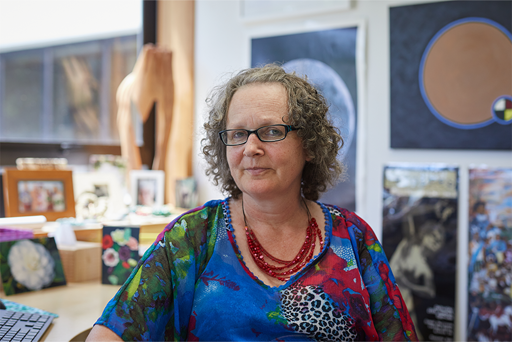

“The more we have these conversations, the easier it gets, and it becomes less terrifying. I don’t think we should be scared to talk about our history and what’s happened.” — Dr Heather Came, antiracism and Tiriti educator. (Photo: AUT)
Do you have questions about Te Tiriti that you’re too shy or afraid to ask?
Dr Heather Came, an antiracism educator, has a simple yet effective way to draw out those questions and open them up for discussion.
She introduces Atakohu Middleton to the Too-Hard Basket.
Dr Heather Came, a public health academic and antiracism educator, takes a small but important prop to her introductory Tiriti o Waitangi workshops. It’s a round basket woven from purple and white plastic strands, which she bought at an op shop in Wellington.
She calls it the Too-Hard Basket. And since 2023, it’s been a focal point of Heather’s day-long Tiriti workshops.
The basket makes its appearance early in the workshop, after whakawhanaungatanga (relationship-building). Participants are asked to write their burning questions about Te Tiriti or related topics (such as bias, racism or politics) on Post-it notes and place them in the basket. No names.
Over the years, the questions have ranged from “Why do we need a Māori cultural liaison person at our workplace?” to “How do we have hard conversations with colleagues to do better?”
Every single workshop, there’s a variation on the question: “How do you deal with racism in your extended family?”
Once participants have learned more about Te Tiriti, Heather, a seventh-generation Pākehā, and a Māori co-trainer, often psychotherapist Wiremu Woodard, set up a quiz show like no other. Two volunteers form a “panel” and draw questions from the basket. They lead the discussion, supported by their peers and the facilitators.
It’s a simple yet effective way to get people talking and learning, says Heather. She’s been running Tiriti training since 1989 and is noted for her academic work in health equity. “The good thing about using the basket is that you get curriculum from the students. You get what they actually want, rather than what I want to teach them.”

Heather Came and the Too-Hard Basket at her workshop for the Royal New Zealand College of General Practitioners last month: “The more we have these conversations, the easier it gets, and it becomes less terrifying.” (Photo: Denis Came-Friar)

The Too-Hard Basket. (Photo supplied)
Last month, the students were staff of the Royal New Zealand College of General Practitioners Te Whare Tohu Rata o Aotearoa. The college serves 6,000 doctors and is explicitly Tiriti-led in its work to address Māori health inequities.
Among the participants were Peter Walton-Jones, the college’s admissions manager, and Abigail Shepherd, its senior education support advisor. Peter says the request for questions was met with some hesitation, but “with a little encouragement, the basket soon filled up”.
Later, after Heather and Wiremu had taken the group through Te Tiriti and explored its application in healthcare settings, Peter and Abigail volunteered to be on the panel.
Peter enjoyed the “great to-and-fro” as questions were unpacked. “When we struggled, our guides stepped in and were very wise and helpful.”
The exercise was fun and challenging, but it also had a serious purpose as the group combined their voices and perspectives, particularly in considering how to respond to statements or questions that carry racist undertones.
One question has stayed with Peter: “I feel guilty and depressed that my ancestors took part in receiving land for farming in the early days of Aotearoa New Zealand, therefore causing distress for Māori people. How do I settle this in my spirit?”
Peter had asked himself the same question while researching his family history.
In the discussion, people acknowledged that they had gained privilege through their ancestors’ actions — “actions that were very likely racist and based on enablement that did not honour the Treaty”.
However, Peter says, “We agreed that it’s important to honour and love our ancestors. Many of them had remarkable tales of their own and were emigrating away from poverty and poor living conditions into hope and opportunity.
“We can both respect them and, understanding the role they played and the outcomes for us, ensure that we take up every opportunity to understand and honour Te Tiriti now. It’s never too late.”

Peter Walton-Jones, here sitting between Tiriti trainer Heather Came and his colleague Abigail Shepherd, says that the Too-Hard Basket exercise was “fun and challenging and therefore a rewarding activity. Questions about Te Tiriti, bias, racism and politics were quite common”.
Abigail admitted that she felt vulnerable in the hot seat. She was worried that she might say the wrong thing or struggle to find the words to express her thoughts. But afterwards, she could see the value in being courageous and sitting with discomfort as she shared her ideas.
For Abigail, the most interesting question was “Do all cultures have a voice?” She reframed it as “Do all cultures deserve a voice?”, and answered yes.
But unpacking this, she says, requires a necessary follow-up question: “Do all cultural voices in New Zealand speak at the same volume, and do we, as a society, ascribe the same value and authority to all voices?”
“The answer to that is definitely no,” Abigail says. “We know our Tiriti partners don’t have the same volume, and the government certainly doesn’t ascribe the same value and authority to Māori voices as to the Crown’s voice. That’s one of the many reasons we have to keep fighting for equity and Te Tiriti.”
Abigail says the Too-Hard Basket has given her the answers, tools, and confidence to explain to health workers, government ministers and other stakeholders why meeting Tiriti obligations is critical to addressing persistent Māori health inequities.
“We need to be able to articulate what those obligations are, advocate for our Tiriti partners, and be able to apply Te Tiriti to our day-to-day work.”
Abigail identifies three top takeaways from the exercise. “First, doing hard things is important when the kaupapa matters. Second, you have to start somewhere, even if that somewhere feels hard. And third, don’t let the fear of messing up stop you from trying.”
Heather agrees. She says that we all need to keep talking about Te Tiriti, our country’s colonial history, and the downstream impacts — and that takes courage. “You never know what’s going to happen when you have a conversation. You can’t control what happens. But if you go with an open heart, it’s great to learn.”
More conversation leads to greater confidence, Heather says.
“The more we have these conversations, the easier it gets, and it becomes less terrifying. I don’t think we should be scared to talk about our history and what’s happened. How do we lift our game? How do we do better so that we leave no one behind, and no one gets exposed to racism?”
Heather has begun compiling the best of her Too-Hard Basket for her website, and we’ve reproduced some of them below. The answers are a “melting pot” that captures the collective insights of the most influential Pākehā Tiriti workers in her life, among them the late Mitzi Nairn and Joan MacDonald, as well as Tim McCreanor and Catherine Delahunty.
A personal reflection in an answer always goes down well, too, says Heather, who has three stepchildren and six grandchildren with her husband, Denis Came-Friar.
“People do love a little illustration where you can talk about your grandkids.”
*
The Best of The Too-Hard Basket
Why do some Pākehā keep telling me about how Māori get all kinds of ‘free’ stuff? What are they getting that the rest of us don’t?
This narrative is a classic colonial distraction used to undermine Māori rights. The Waitangi Tribunal has consistently documented that Māori are disproportionately affected by systemic underfunding in health, education, and housing.
The economic base of Māori was virtually eliminated with the mass alienation of Māori land in the 19th and 20th centuries. Māori-specific scholarships for education are often funded by iwi.
In short, we don’t know what this “free stuff” is either. Instead of asking what Māori are getting, we could ask why the system continues to produce disparate outcomes and how we can achieve equity.
What should we do if, after training and awareness, our leadership is still performative?
When leadership remains performative despite Tiriti training, it’s time to shift from education to accountability. This isn’t about more cultural awareness — it’s about addressing institutional racism.
Document evidence of discrepancies between rhetoric and action and raise these with management in the first instance. Advocate for the development of an antiracism plan with clear inputs, responsibilities, and measurable, time-framed outcomes.
Be a stuck record. Collaborate with your allies, taking turns to raise the kaupapa. If your first attempt doesn’t work, reflect, regroup, and have another go, doing something different.
Write a letter, have strategic cups of tea, share useful resources, organise a reading group, and keep going. Antiracism work requires stamina, comrades, a thick skin, empathy, agility, and humour.
If internal avenues fail, consider external accountability mechanisms or rangatiratanga (self-determination) strategies outside the resistant structure.
How do we have hard conversations with colleagues to do better?
When initiating difficult conversations with colleagues, begin with whakawhanaungatanga, building a positive relationship, to establish a foundation of trust and respect.
Consider having the conversation over a cuppa or making it a walk-and-talk. Be mindful of your tone and try to arrive in the conversation from a position of neutrality or compassion. If you don’t have the emotional capacity, ask someone else to substitute. Allow for pauses so the other person can reflect. Use “I” statements, such as “I feel angry when I hear those sorts of comments.”
Address the specific behaviour or issue directly, focusing on the impact rather than the intent. Frame the conversation around ōritetanga (equity) and our collective responsibility and commitment to do better for whānau.
Be prepared to listen actively and handle defensiveness with patience. These peer-to-peer discussions are essential for challenging institutional racism and creating a culturally safe environment where everyone can thrive.
As a Pākehā, I’m always worried about doing the wrong thing. How do I fix or address that?
Mistakes happen in all areas of our lives, including when we engage in antiracism and Tiriti work. We have to accept that, as we unlearn colonial habits, we will stumble. The goal isn’t to be a perfect ally, but a reliable, trustworthy, accountable one.
Focus less on your own anxiety and feelings and more on supporting better outcomes for Māori. When you mess up, acknowledge it, learn from it, and keep moving. Inaction is more problematic than a well-intentioned mistake made while trying to do the right thing.
What does rangatiratanga look like in a real policy decision-making context?
In a real policy decision-making context, rangatiratanga is Māori having a decisive and authoritative role in the outcome. It means that Māori, as tangata whenua and sovereign Tiriti partners, have an influential voice, with the resources, time and authority to make decisions.
It involves recognising Māori self-determination, diverse Māori realities, and the practical application of tikanga in all aspects of policy development and implementation, respecting hapū and iwi authority and autonomy, and ensuring Māori have the power to define problems and direct solutions. It may include structural mechanisms such as a Māori right of veto.
How do I say no to being culturally or professionally overburdened without burning bridges?
Avoid focusing on others’ lack of skills or willingness. Consider saying: “Thanks for the opportunity, but I can’t help this time as I need to prioritise my hauora (wellbeing) and existing commitments.”
Check in with your colleagues to make sure they will stand with you and also hold the line. If you have the energy, collectively meet with management to negotiate a Māori-led process to triage such requests.
How do we provide better health equity in health services for Māori?
At a macro level, we need to decolonise the health system to achieve genuine hauora Māori. We must overhaul the system to make it Tiriti-compliant. This means embedding tino rangatiratanga, with Māori leading the decision-making and service design. We must invest in kaupapa Māori models and the Māori workforce, recognising Māori expertise.
The system must address systemic racism and move beyond a purely clinical focus to include wairuatanga (spirituality) and tikanga (customary practices). Regulatory bodies must mandate cultural safety, Te Tiriti and antiracism competencies, developed in partnership with Māori, to create accountable, effective services that serve whānau as equal citizens and deliver equitable outcomes.
If you’re working in health, look to the work of Māori scholars such as Matire Harwood, Papaarangi Reid, Rhys Jones, Rawiri McKree Jansen, Jean Te Huia and Fiona Cram, who have published extensively on how to improve Māori health outcomes.
Take action within your sphere of influence and don’t be put off by the size of the task. Embrace cultural safety, antiracism and Tiriti-based practice. Critique the system, but ensure your house is in order.
How do we navigate funder requirements versus our Te Tiriti policies and organisational expectations?
When funder requirements clash with Te Tiriti policies, this is a problem for your senior leadership team and board. They are responsible for setting the moral direction to uphold your organisation’s mission and values.
We are responsible for our own practice within our sphere of influence. Ethical guidelines within the health sector often make explicit reference to upholding Te Tiriti o Waitangi. These guidelines have been developed to help us make ethical decisions.
Remember that you always have some agency, even if you can’t see it in the moment. You can raise issues at a team meeting, with your line manager or supervisor, with your professional association, or your union.
History is riddled with examples of collective action that transformed unfair systems. Ultimately, make choices that mean you can sleep well at night.
How do you balance professional boundaries with whanaungatanga?
Western “professionalism” was designed to be clinical and detached, which often negates te ao Māori. Balancing the two requires a shift in our mindset: Whanaungatanga is professional practice when working in Aotearoa. It’s about building a foundation of relationship and trust before getting down to business.
You can maintain your ethical responsibilities while being a warm, connected human being. If your professional boundaries prevent you from forming healthy relationships with people, then those boundaries are likely reinforcing a colonial standard.
Why do we need a Māori cultural liaison person at our workplace?
Often, Pākehā expect Māori staff to do all the “Māori stuff” over and above their regular jobs. A dedicated liaison role acknowledges that cultural safety, tikanga and reo expertise, and community engagement are high-level professional skills that require resourcing.
This person helps the organisation navigate Tiriti responsibilities and protects Māori staff from the burden of cultural loading. However, one person can’t carry the weight of Te Tiriti and racial justice. The whole leadership must still do the work to ensure the environment is safe for that kaimahi to flourish.
Do you think there is a united view on good outcomes for Māori?
Just like Pākehā, Māori have diverse political and social views. That said, there is often a strong, consistent consensus around the need for tino rangatiratanga (self-determination), the protection of taonga, and the elimination of institutional racism.
While the “how” might be debated at different kitchen tables or marae, the “what” — justice, equity, decolonisation and the right to live as Māori — remains a clear, collective aspiration.
How do you deal with racism in your extended family?
Confronting family is the hard yards of antiracism work, because you want to hold the relationship, but it can also be emotionally exhausting. Try to move away from calling out (shaming) and towards calling in (curiosity).
Ask: “What makes you say that?” or say: “I used to think that too, until I learned . . .” Set firm boundaries. Make it clear that racist rhetoric isn’t acceptable in your home. You’re not just changing a mind — you’re breaking a generational cycle of colonial prejudice.
Consider having one-on-one conversations with your racist uncle rather than tackling him in front of the wider family. Also, choose your moment. If you’ve been drinking and you’re at a wedding or funeral, maybe pick up the conversation another day.
- Find out about Heather Came’s Tiriti workshops here.
Dr Atakohu Middleton (Waikato, Pākehā) isE-Tangata’sarts editor. She is a journalist whose lengthy career has included outlets as diverse asRadio Waatea*, theGuardian(UK),*theNew Zealand Listener, theSunday Star-Times, and theNew Zealand Herald. She lives in Tāmaki Makaurau. Her bookKia Hiwa Rā!, on Māori journalism in Aotearoa, was published in 2024.
The post Tackling the questions in ‘the too-hard basket’ appeared first on E-Tangata.
From E-Tangata via This RSS Feed.