

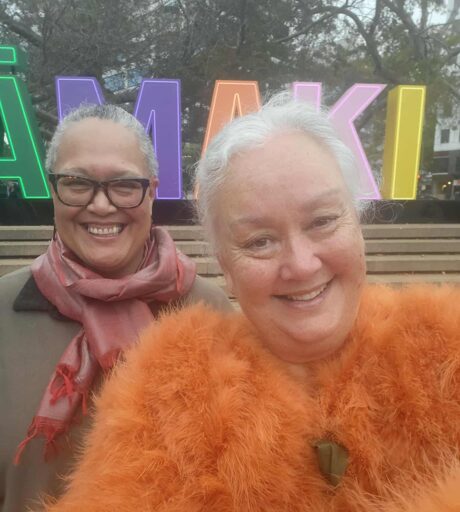

“We have a common language of shared experiences. It’s so refreshing not to have to edit myself, or appease white fragility,’ writes Aroha Gilling (left) about her new friendships with Māori colleagues, like Moana Tamaariki-Pohe (right), in Tāmaki Makaurau. (Photo supplied)
With Matariki rising, Aroha Gilling finds herself contemplating the importance of her Māori friendships.
As I careen haphazardly through the latter years of my 50s, reminding myself that I’m not 20 anymore and wondering when I can go home to bed because it’s after 9pm, I find myself reflecting on many aspects of life.
And as Matariki approaches, I’ve been thinking about friendship — probably because I moved cities at the start of this year, and I’m missing my old friends and having to make new ones. In particular, I’ve been thinking about the influence of my Māori friends on who I am.
I grew up in Dunedin in the 1970s and ‘80s. I was adopted and raised by two shy Pākehā sisters. They were loving parents, but it was a very monocultural childhood. I was one of those kids who preferred one or two intense friendships over big groups of friends at school, friendships I usually found among my Pākehā peers.
At university, I was part of a large friendship group for the first time. It was a new experience for me, and I tried hard to fit in. The girls were smart and articulate, and wore interesting op-shop clothes. The boys were witty, quirky, and already on career pathways. They romanced each other, and I watched from the sidelines in awe and astonishment. I felt part of the group but somehow apart from it too.
I realise now that I was struggling to express myself as Māori. But I didn’t have the cultural experiences, knowledge and confidence to do that, and I had no Māori role models. I was spinning on the spot, trying to create a decolonised version of myself when I had no cultural roots.
After my postgraduate studies, I took a year off and joined a conservation course based at a rural polytechnic in South Otago. The conservation students boarded in one wing of the student accommodation block, and the other block was filled with aspiring young farmers from across the country. There were no Māori on my course, but on the farming one were two wāhine Māori.
One was about my age, early to mid-20s. She was from the Far North and had a prosaic and pragmatic outlook on life. We came to an informal, unspoken agreement. She would be the spokesperson for the farming students, and she expected me to be the same for the greenies.
We were the older students among hormonal teenagers who were far from home, and between us, we managed the bad decisions, lack of hygiene, and teen angst swirling about. I got to know her well. I liked the way she presented herself — tough but caring. She was a force of nature. She took no prisoners, said what she thought, and wasn’t scared of anyone. She could make me laugh until I ached!
The other wāhine Māori on the farming course was one of those souls who often get taken advantage of. She was sweet, a bit drifty, quietly spoken and gentle. She came to me distraught one day, after being blamed for something that occurred. We had an audience with the polytechnic principal, where I accused him of biased and racist decision-making. He partially relented, but the harm was done, and the student withdrew.
It was my first experience of using my advantages — a good education and a big mouth — to challenge race-based injustice. Some friendships last, and some fade, but they all leave an impression. These wāhine, in their different ways, helped me start to make sense of my cultural standing and identity.
In my 20s after whipping through another postgrad, I got a job at a new cinema in town. An amazing feat, considering I turned up for the interview hungover, had a lopsided beehive to hide my dreads, and a split lip from a surfing accident the night before. On our first day of training, I was sitting on the stairs at lunchtime, when the only other Māori in the team, with hair straight out of a Flock of Seagulls video, came up to me and said: “I’ve got no friends. Can I sit with you?”
From that day on, we were inseparable. He was so funny, irreverent and full of life. He became the theatre’s bar manager, and we often passed ourselves off as twins because we looked alike. As it transpired, there was a reason we could pass as twins so well. He is whānau, and we didn’t know until he asked his Nan (my aunty) for his whakapapa, and we were looking through the documents. We’ve had our ups and downs over the years, but as we’ve both matured in our identities as Māori, we seem to be coming back together.

With whanaunga Jaycob Brown, who connected with Aroha while they were both working at a cinema. (Image supplied)
In my 30s and 40s, I lived in a small town and made a few Pākehā friends through my social service work. They kept telling me: “You really should meet our Māori friend. You two have so much in common.” I tend to be a bit resistant to social engineering and kept finding reasons not to go, but eventually we ended up at a dinner together. Surprise, surprise, another cousin, and one who would end up accompanying me on a journey of discovery.
That wāhine became my main supporter in the early days of getting to know my Māori birth whānau. Her outgoing personality and adventurous spirit helped me discover that side of myself, to be brave and keep going back to visit until I was comfortable.
We both grew up away from our coastie whānau, so we had some struggles that the other one understood, even though we’re very different people. She is one of the people I trust most, and I know she’ll always tell me the truth even when I don’t want to hear it.
As Matariki approaches and we remember those who’ve died, I wrote down some thoughts about a staunch wāhine Māori friend who died last year to help honour her at work. “At her tangi, many people spoke about her fierceness, and I loved her for that, particularly in our work. We need the fierce as much as, if not more than, the conciliatory personalities. She was also kind, endlessly humorous, and she had a generous spirit full of aroha ki ngā tangata.”
I concluded with these words: “Most of all, I will remember that laugh, the cheeky humour, the beautiful singing voice, and the feeling that if she had your back, you were in good hands!”
Some friendships burn bright and hard and fast until they flare out. Others flicker over decades of tomfoolery, key life events, disagreements, failures and triumphs. Then there are the ones with the quiet, steady burn of a damped fire late at night. I’ve been lucky to have a few of those over the years and count each one, past and present, as an inestimable treasure.
This year, I joined a predominantly Māori team, and I’ve never been so instantly embraced by a group of colleagues. Usually, I take a while to warm up and trust new people. Often, one of the first things people learn about me is that I don’t like being touched. My parents weren’t huggers, and over the years, touch has often been a precursor to unwelcome attention, which I’ve quickly rebuffed. But somehow my new team’s kindness and evident pleasure at my arrival has made hugging feel acceptable and something I’ve even welcomed.
We’re able to talk about all sorts of issues, from the political to the personal, with no need to justify, educate or explain. We have a common language of shared experiences. It’s so refreshing not to have to edit myself, or appease white fragility.
It’s a new experience to be able to name privilege, and instead of getting caught up in denial, minimisation, and tears, we can dive straight into the ideology and systems that support privilege and discuss how to dismantle them.
The team expresses their identity as Māori through kindness, warmth and aroha. There is a generosity of spirit and an all-encompassing manaakitanga in how they move through the world, coupled with uncompromising loyalty, strength and integrity.
They worry about one another, know all the ins and outs of each person’s whānau, and offer support, comfort or humour as appropriate. They have their own battles but seem to lack the hardened edges that older generations often had to cultivate to survive.
As I pause to acknowledge Matariki, I see the faint heartlines that connect me to all the influential Māori in my life, past and present. I see their presence in so many things I say, do, believe in, and value. And I listen for the sound of their laughter, because what a privilege it is to have known, and to know, so many wonderful tangata Māori.
Aroha Gilling (Te Whānau a Apanui) is an adviser to government departments on Te Tiriti o Waitangi and mātauranga Māori. She has a Master of Indigenous Studies from the University of Otago and a background in adult education and social work.
The post Fanning the flames of friendship at Matariki appeared first on E-Tangata.
From E-Tangata via This RSS Feed.