

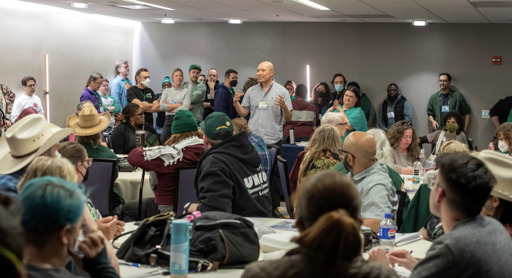
On the Thursday night before Labor Notes, my Whatsapp was blowing up. Flights delayed. Now canceled. Big storms hitting Illinois with tornado warnings, 50-mile-per-hour winds, and flash flood warnings. But inclement weather and canceled flights would not stop the 4,7000 workers from attending the Labor Notes Conference in Chicago this year. Of the nearly 50 other educators from the contingent of the Movement of Rank and File Educators (MORE) that I attended with, multiple groups arranged car caravans to make the 12-hour journey without a second thought.
I suspect that a reason attendees fought so hard to make it to the conference is because the moment we are in is particularly urgent. This year’s conference was set in the midst of economic crisis, widening inequality, growing imperialist attacks — accompanied by important episodes of working class struggle. Discussing politics and strategy with other workers from around the country and the world simply could not wait.
On Friday, I barely had a chance to drop off my backpack at the hotel room before I scurried over to the United Caucuses of Rank-and-File Educators (UCORE) Conference, where I was met with a bustling crowd of (as always) sleep-deprived educators in a vibrant sea of primary colors representing the rank-and-file caucuses within their unions. Everywhere I was surrounded by teachers, teaching assistants, paraprofessionals, counselors, cafeteria workers, school bus drivers — whether on panels and workshops or in one-on-one conversations — all eager to share about the fights they have been putting up in their schools and unions against ICE, austerity, and authoritarianism.
It’s not by chance that educators are taking a protagonist role in these struggles; it’s an expression of the role that we play in the capitalist system on an international scale — and the role we have the potential to play in uniting the working class to fight back across sectors, tiers, and borders.
Educators in Struggle Around the World
This year’s Labor Notes conference was set upon the backdrop of important battles of class struggle within the U.S. and around the world — and in every struggle, educators have been on the front lines. From the United Kingdom to Canada to Puerto Rico to the Spanish state, reflections on and connections to many of these experiences were brought by educators at UCORE and Labor Notes.
At UCORE, Eduardo Lozano, a member of the CGT in Barcelona, shared his experience as part of the strike in Catalonia and Valencia of over 100,000 educators fighting for better resources and working conditions, smaller teacher-to-student ratios, police out of schools, and classes taught in Catalan. He spoke about the importance of the assembly body that emerged from the strike that formed to reject the capitulation of the union leaderships to the government. In a struggle against both the Department of Education and the complicity of the union leaderships, educators across the Spanish state have been showing the power of self-organization through assemblies to coordinate the struggle on the local and regional level and fight for their demands without concessions.
Educators from around the country who attended Labor Notes expressed their solidarity with the educators in Mexico who went on a historic strike in the midst of the World Cup. Among the demands of the Coordinadora Nacional de Trabajadores de Educación (CNTE) was the end of a 2007 law that privatized public pensions — and raised to the national spotlight the demand for workers to retire with dignity. Despite the repression and criminalization of their struggle, teachers demonstrated their ability to shut it down in the midst of a mega-event whose primary beneficiaries are corporations and capitalists. Organizing alongside mothers searching for their missing children, residents against gentrification, students, and young people, the teachers’ strike gave visibility and united the common struggles of these sectors of Mexican society. And importantly, they exposed the refusal of the so-called progressive government of Claudia Sheinbaum to touch the interests of big financial capital and the passivity of the union bureaucracy to fight for these justified demands.
At Labor Notes, teachers from the Federación de Maestros de Puerto Rico described the fight of educators against school closures as part of the austerity policies unveiled by the colonial Financial Oversight and Management Board. Teachers from Puerto Rico talked about their struggles beating back austerity and colonialism coordinating with communities in assemblies and organizing with students to fight for better conditions, and the importance of solidarity between educators in Puerto Rico and the United States to denounce colonialism and the oppression of the Puerto Rican people at the hands of U.S. imperialism.
And in Bolivia, educators — arm in arm with miners, peasants, and youth — have been on the front lines of the counteroffensive to the right-wing wave in Latin America, showing the world how to fight the Right. Blocking highways and filling the streets, Bolivian workers are demanding the resignation of right-wing President Rodrigo Paz. Despite the state of emergency, brutal repression, and complicity of the union leaderships, Bolivian workers, Indigenous people, and women have been taking to the streets for over a month rejecting the austerity and anti-worker attacks by the government.
An important theme at the conference was the impact of AI, with workers across sectors expressing the threat of AI to our working conditions, the environment, and the quality of our lives. The state and corporation’s interest is not to engage AI in a framework of expanding, funding, and democratizing the public school system, nor to end the inequalities, precarious living conditions and fear of deportations that our students are suffering. In their hands, it’s another tool to standardize and precarize public education. As school districts impose AI in classrooms by striking profitable deals with private corporations, educators are mobilizing with students and families to combat deprofessionalization, surveillance, cognitive atrophy, and environmental degradation. And in our fight to combat AI in classrooms, we must fight with a perspective that poses the need for workers’ control over technology. Educators, students, and communities should be in charge of the decisions made at our schools and education system.
An oft-repeated and important concept that I heard is: “It’s a lie that there isn’t money for public education.” From their local contexts around the world, educators spoke about how money and resources that should go toward paraprofessional salaries, mental health resources for students, reduced class sizes, and robust arts and science programs are instead spent on cops in schools or expensive contracts with ed-tech and AI companies that impose mandated curriculum and strip educators of our curricular autonomy. And beyond that, while billionaires continue to evade taxes and make their billions off the backs of working people, it’s the working class who are forced to pay for the militarization, war, and genocide of our class siblings around the world. There is more than enough money to fund public education, universal healthcare, and to house every unhoused person living on the streets.
Drawing the connections between the local and the global helped to illuminate how these aren’t just far-away struggles to pay lip service to. From DHS to DOGE to the so-called “Donroe” Doctrine to the war on Iran and Lebanon, the Trump administration and his far-right allies have been systematically assaulting the rights of working people both within the country and around the world. Now more than ever, these struggles demand our full and active solidarity, especially from within the heart of the imperialist beast.
As Mercedes Martinez, president of the Federación de Maestros de Puerto Rico, said in an interview with Left Voice at Labor Notes: “Solidarity is international. It’s very important to fight together against capitalism and the ones who want to destroy our world. Our struggles are interconnected; it’s one working class throughout the globe.”
And as educators, we have a strategic and ideological role in fighting back.
The Bridge Between the Working Class
In the U.S. as around the world, public education has been a galvanizing issue in the revitalization of the workers’ movement to combat decades of neoliberal austerity and privatization. From the Wisconsin uprising in 2011 to the Chicago teachers’ strike in 2012 to the “red state revolt” in 2017-18, educators, together with students and communities, have rallied against the anti-worker attacks that go beyond our immediate working conditions — but that extend deep into the realities of the communities we serve.
In the Trump 2.0 era, students and educators face not only massive cuts, but also an upheaval of the unfinished but important conquests of the Civil Rights Movement. With the dismantling of the Department of Education, the Trump administration is unraveling decades of civil rights protections for students who face discrimination at school. Wholesale assaults on Diversity, Equity, and Inclusion programs at schools and universities mean students are losing critical learning opportunities and attacking longstanding programs (my Title I school, for example, is losing a college visit program because it’s considered a university DEI initiative). Slashing affirmative action is already setting in motion the intensification of an already inequitable access to higher education. All of these education-specific attacks are situated in the context of assaults on the broader community — a community composed of immigrants, trans folks, Medicaid and Medicare recipients, SNAP beneficiaries, and so many more.
When education budgets are slashed, it’s our classrooms and school buildings that are deprived of resources, staff, and programs. When rent prices skyrocket, it’s our students’ families who face housing insecurity and have to stay in shelters or double-up with relatives. When the federal government ends SNAP benefits, it’s our students who wait in long lines at food pantries or go to bed with their stomachs grumbling. When hospitals stop offering healthcare to trans youth or criminalize teachers for supporting LGBTQ+ it’s our students who suffer. When ICE unleashes terror upon our cities, it’s our students in their families who fear leaving their homes to go to work or come to school.
Educators play a key role in the social reproduction of the international working class, and as such, we are incredibly sensitive and attuned to any and all attacks unleashed upon our students and our communities. As Martinez from the FMPR said, “We have the right and the duty as educators to fight for and defend public education, fair housing, universal healthcare. To fight for the world that every child needs.”
The Twin Cities have shown that when the state refuses to provide for — or actively undermines — the needs of the community, it’s educators who will organize to meet those needs no matter the cost. On panel after panel at Labor Notes, rank-and-file educators in the Twin Cities described how they supported students, organized rent support and food distribution for families, and built connections between immigrant and non-immigrant communities during Operation Metro Surge.
That’s why in recent years, educators have been fighting beyond the bread and butter issues and bargaining for the common good — mobilizing entire communities rather than just their own members under the rallying cry, “Our working conditions are our students’ learning conditions.”
In their last two contracts, Chicago teachers won support for unhoused students, sanctuary protections for undocumented students and paid days off for immigrant staff to attend immigration appointments, protections for LGBTQ+ students and staff, as well as mandates for teaching ethnic studies, Black history, and climate science. In their 2022 contract, Los Angeles teachers won staffing and funding for community schools, financial and legal support for immigrant students and their families, support for unhoused students. Earlier this year, San Francisco teachers fought and won similar common good demands as part of their strike.
As Ivana Otero, Virginia Pescarmona and Federico Puy wrote in their reflections on the lessons from the work of Russian educational psychologist Lev Vygotsky: “Given constant attacks aimed at erasing this role and the precarization of teachers’ working conditions, it is essential that educators connect educational conflicts to broader societal struggles. Schools can become key spaces for community organization and resistance, linking teachers’ immediate demands with the material needs of working-class families and education itself.”
Because educators serve as a direct bridge between different layers of the working class, composed of Black, Brown, immigrant, queer, trans, women, and disabled workers, we are located at a critical intersection — and are uniquely positioned to lead the fight against the seemingly endless barrage of attacks that our students and their families face.
In that same way, educators are particularly vulnerable to state repression in the fight to defend our communities. Renee Good, executed by ICE while observing an immigration raid in Minneapolis, was a substitute teacher. A special education teacher — along with a college professor, a union carpenter, a health care worker, union members, and community organizers — is among the Minnesota 15 who face bogus federal charges for protecting their immigrant neighbors. We see similar escalations playing out in Prairieland. From Tom Alter at Texas State University to the CUNY Fired Fourth, professors have been targeted in neo-McCarthyist attacks for their activism in support of Palestine.
Repression cannot mean backing down. As the attacks escalate, so will the criminalization of our resistance — unless we combat it with a mass movement. It means we have to fight against these attacks by massifying our movements with defense campaigns that link the struggles to defend our communities to the struggle for our democratic rights, including the right to academic freedom and protest.
The question remains: how will we organize ourselves and with what politics?
Class Independence
Educators have concrete struggles ahead of us. We must defend public education from the attacks of Trump and the Far Right, defend the right to protest and fight back against repression, push back against AI in our schools through private corporations, and organize alongside our students — especially immigrant and queer students — to defend democratic rights.
Across the country, students have been organizing walkouts in solidarity with their immigrant classmates and communities, demanding an end to their institutions’ complicity with genocide, and so much more. Young people see with increasing clarity that capitalism has nothing to offer, and poll after poll shows that young people have dwindling faith in capitalism and increasingly view socialism favorably. As educators, our struggle is intertwined with that of our students; it’s a struggle for the broader vision of a different kind of society and a different kind of future — where freedom from oppression and exploitation would allow for the fullest expression of all of our creative potential.
In that way, our fight goes beyond the bread and butter. It is deeply connected to our students and the communities we serve. The nature of our profession makes it especially clear that we cannot separate our workplace struggles from politics. This past year, conversations around a general strike have become increasingly commonplace and tangible. From the historic general strike in Italy in solidarity with Palestine to the No Work, No School, No Shopping in solidarity with the Twin Cities earlier this year, workers are increasingly aware that as a class, we have the power to fight beyond the bread and butter to protect our communities and win political demands. While many are looking to May 2028 as a day that will unite the working class, this fight is much more urgent — and needs to challenge capitalism at the root.
And if we want to build power and win, the politics and strategy we use to build that struggle matters. The Twin Cities showed us the vast potential of community bottom-up organization and the power of the working class mobilizing in vast numbers — even posing the possibility of a strike — to fight back authoritarian attacks against our immigrant neighbors. But we can’t forget how the fullest expression of that potential was diverted by the Democratic Party and union leaderships which worked tirelessly to contain that struggle, channeling it off the streets and into the ballot box.
The recent wins of democratic socialists in NYC and across the country show that increasing numbers of workers reject the Democratic Party establishment, who are fed up with rising rents, inequality, ICE, and U.S. support for the genocide in Gaza and the Israeli war on Iran and Lebanon, and who are attracted to socialist ideas. But the struggles ahead are too great to allow them to be contained within an imperialist party that, as Les Leopold pointed out at the conference, more and more across the country people feel completely disconnected from.
While appreciating the important ideological changes that these electoral victories reveal, we can’t conflate winning elections with winning independent working-class power. We must organize in our unions, our schools, and our communities — independently of both major parties — while also fighting to build a working-class political organization capable of uniting our struggles. Such an organization must offer a perspective that challenges not only the attacks of the Far Right, but also the bipartisan policies that have been undermining public education for decades.
The question is whether we, the hundreds of educators attending the Labor Notes conference, fighting back against austerity and the Right in our workplaces and communities, will devote our efforts to rebuilding the Democratic Party — or whether we will play a role in building an independent working-class political organization that can fight all these attacks with the methods of class struggle.
The post Reflections from a Teacher on Labor Notes 2026 appeared first on Left Voice.
From Left Voice via This RSS Feed.