

By Pastor Stephannie Joy P. Mayores, AWIT-Iloilo
Zechariah 9:9-12,
Romans 7:15-25a,
Matthew 11:16-19, 25-30
In this Sunday’s Gospel reading, Jesus extends an invitation of rest.
In this fast-paced society where many of us easily experience burnout, exhaustion, weariness and fatigue, we deeply long for rest. For some, rest could mean a day of simply lying in bed and doing nothing; for others, a vacation somewhere far from work, or a day well spent with friends, family, or even just by being alone enjoying a peaceful moment of solitude. Yet, only a few have the opportunity and access for this kind of rest.
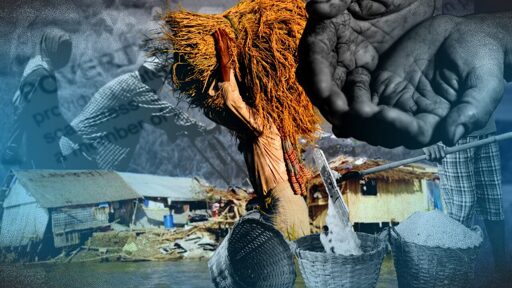
In a colonial-capitalistic system, rest has become a commodified privilege. For laborers who are bound to the “no work, no pay” scheme, a day of rest means a missed salary and a missed meal for their children. For our farmers, trapped in feudal colonial systems and a cycle of landlessness, alongside crushing debts driven by high-priced agricultural products and cheap produce, there is no pausing the toil of survival. For fisherfolk spending the night in the open ocean waiting for a small catch just to secure a meager living, the luxury of rest does not exist. For women and mothers who tirelessly work day and night, and whose labor is unrecognized and unpaid due to the systemic exploitation of the care economy, rest is weaponized as laziness or irresponsibility. The very people whose bodies are bent and whose bones are breaking to put food on our tables are the ones this system strips of the right to rest.
When Jesus said, “Come to me, and I will give you rest,” (11:28) what does it mean to our laborers, farmers, fisherfolks, women and mothers, and those whose lives were deprived of the access to rest? What does rest feel like in a body that has never been told it could pause or stop?
To shed light to Jesus’ invitation of “rest”, one must first understand what “burden” looked like in the first-century Palestine. Chapter 11 of our Gospel reading is set in a context where Palestine was under the oppressive, colonial rule of the Roman Empire. The people hearing Jesus’ invitation were not the comfortable Roman citizens and powerful leaders; rather, they were those crushed by the multiple, overlapping oppressions brought by the Empire – they were laborers, slaves, farmers, fisherfolk, women, and children.
Under the Roman Empire, burden was experienced through heavy taxation. The common people were taxed on their land, their produce, their markets, and their very existence. Resources were not only extracted from them, stripping them both of land and life. These heavy taxes then led the people to be trapped in the cycle of debt. Jesus’ parables even spoke of this economic reality – the servants who owed thousands of talents, day laborers who had no assurance of job the following day, and women who searched desperately for a single lost coin. These were not only spiritual conditions, but the daily experiences of people Jesus walked with.
This burden was also experienced in the religious spaces. The Sabbath, which was supposed to be a gift to rest, became a religious pressure to many, as purity codes and tithe obligations were heavily imposed. Alongside the colonial rule of the Roman Empire was a very rigid patriarchal system that controlled, violated, and domesticated women. These then became the “heavy burden” of the common people. Under these intersecting systems of empire and patriarchy, the first-century Palestine carried a heavy, collective burden of violence, extraction, dominion, control, and exploitation.
In this context, Jesus stepped in. And in Matthew 11, Jesus is in the middle of conflict. The religious establishment has already begun to reject him. John the Baptist, his cousin and prophetic forebear, suffers in Herod’s prison. Jesus has been accused of being a glutton, a drunkard, and a friend of sinners (11:19). He has cursed cities that refused to repent after witnessing his miracles.
In the midst of this, Jesus turned his focus not to the wise and intelligent, nor those who hold the power, but to the infants. In a decolonial feminist reading of the text, infants are not merely referred to those who are spiritually humble and obedient. Jesus using infants as to whom wisdom is revealed is subversive and political. “Infants” refers to those who are physically vulnerable, socially and legally invisible, historically erased and devalued; they represent those who embody deep relationality and dependency on community, and cannot speak the language of the empire. And to them, Jesus extends the invitation of rest.
And then Jesus offers the yoke. In the agricultural context of the first-century Palestine, a young or weak ox was often yoked together with a much older, stronger ox who did all the actual pulling and heavy lifting. By offering his yoke, Jesus is telling the tired and exhausted laborers, farmers, fisherfolk, women, children to stop pulling the heavy loads of empire and religious rigidity. The yoke Jesus offers is not like that of the empire that wounds those who carry it. Instead, the one that Jesus offers is rooted in mercy, grace, and love of kapwa. Jesus understands that the burdens the people are carrying are not only pointing to a spiritual failure, but a reflection of the systems that caused it.
Friends, the rest Jesus offers is not merely an escape from the demands and busyness of life. Rest is not just for those who have access to it and the privilege of it. Jesus’ rest is political. Jesus offers a rest that names what burdens us: the empire, colonial legacies, capitalism, and the systems that continue to commodify our bodies, lands, and lives. Jesus’ invitation to rest is not a command to be still while injustice continues. Today, rest means land reforms being enforced; it means a way of life that recognizes the labor and value of those who put food on our tables; it means labor protections; it means a land that is not exploited; it means redistribution of care work. Rest means a church and community that affirms and honors all labor, body, and lives.
And the invitation is communal. Though Jesus valued resting alone, he also found rest in community – while eating with the tax collectors, walking with the people, having conversations with women, inviting laborers and fisherfolk to join his journey, welcoming outcasts, healing the sick, feeding the hungry, and embracing children. The rest Jesus offers moves us toward healing and life in its fullness.
Balik-Tanawis a group blog of Promotion of Church People’s Response. The Lectionary Gospel reflection is an invitation for meditation, contemplation, and action. As we nurture our faith by committing ourselves to journey with the people, we also wish to nourish the perspective coming from the point of view of hope and struggle of the people. It is our constant longing that even as crisis intensifies, the faithful will continue to strengthen their commitment to love God and our neighbor by being one with the people in their dreams and aspirations. The Title of the Lectionary Reflection would be Balik –Tanaw , isang PAGNINILAY . It is about looking back (balik) or revisiting the narratives and stories from the Biblical text and seeing, reading, and reflecting on these with the current context (tanaw).
The post Balik-Tanaw | Jesus extends an invitation of rest appeared first on Bulatlat.
From Bulatlat via This RSS Feed.