

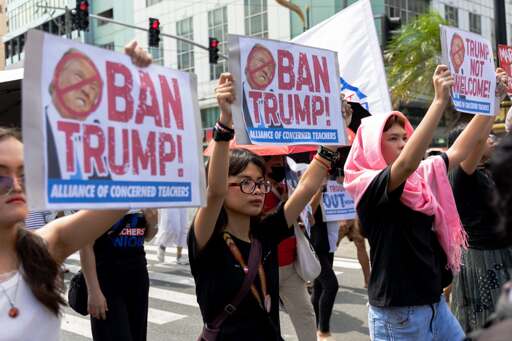
“The relationship between US imperialism and the Philippines has been forged through colonial conquest, sustained by neocolonial domination, and today deepened by worsening forms of economic plunder and military intervention.”
By Kasheena Camacho*Bulatlat.com*
MANILA — “This is not friendship but slavery!”
This is the assertion of progressive groups as the country marked the 80th year of Philippine-American Friendship Day on July 4, Saturday. Led by Bagong Alyansang Makabayan (Bayan), the protesters slammed what they described as decades of U.S. military and economic influence in the Philippines.
In a statement, Bayan criticized what they described as unprecedented U.S. military presence and intervention under the Ferdinand Marcos Jr. administration. They cited the expansion of EDCA sites, the Luzon Economic Corridor, and the U.S.-led Pax Silica initiative, arguing that the projects deepen foreign control over the Philippine economy and natural resources while contributing to land grabbing and environmental degradation. The group said these developments prioritize U.S. strategic interests over the welfare of Filipinos.
“There can be no genuine friendship between an imperialist power and its neocolony. The relationship between US imperialism and the Philippines has been forged through colonial conquest, sustained by neocolonial domination, and today deepened by worsening forms of economic plunder and military intervention,” Bayan said.
Elements of the Manila police blocked the protesters along T.M. Kalaw, a few meters away from the U.S. Embassy, but the groups continued their program behind the police barricade.
“For us, this annual celebration of Philippine-American Friendship Day is a grave insult to the lessons of history. It distorts our past. The Philippine experience with the United States has been one of exploitation, loss of sovereignty, and economic dependence. This is not genuine friendship,” Michael Pante of Tanggol Kasaysayan said in Filipino.
Pante said the country’s economic dependence on the United States continues to affect ordinary Filipinos by hindering industrial development.
“Instead of building local industries and factories that create jobs, the Philippines has remained dependent on agriculture, remittances, and the service sector. Many Filipinos cannot find decent work, and those who do often receive very low wages because we have failed to achieve genuine industrialization,” he said.
Transport workers also linked these issues to their livelihoods.
“We are here because we no longer feel that the government’s policies serve the people, especially under the Marcos administration. The government continues to accommodate imperialist interests, and it is ordinary Filipinos who suffer,” said Diony Bindoy, vice president of Piston Novaliches.
Bindoy added that foreign-backed projects continue to pose a threat to communities and workers.
“These projects do not benefit ordinary people. Instead, they make life even harder while foreign interests continue to take control of our lands,” he said.
Student leader Jasper John Quitalig of Sulong College of Public Health (CPH) of UP Manila urged young Filipinos to join campaigns opposing U.S. imperialism.
“The United States gave the Philippines what it claimed as independence, but it continues to exercise control over our country. As young people, we should stand with the people, defend our rights, and continue resisting policies that do not serve the masses,” Quitalig said.
It was on July 4, 1946 when the United States, as a colonizer, “officially recognized Philippine independence.” However, to this day, the Philippines has remained under U.S. influence, as reflected in various national policies. (AMU, RVO)
The post Friendship what? | Progressives protest continued US domination on PH soil appeared first on Bulatlat.
From Bulatlat via This RSS Feed.