

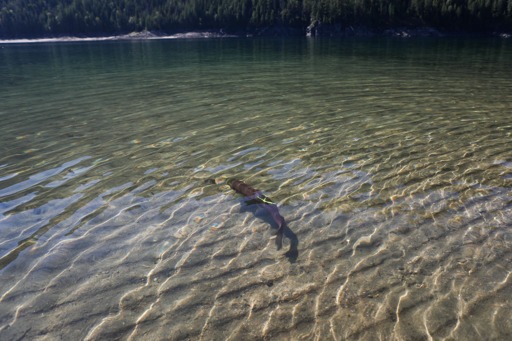
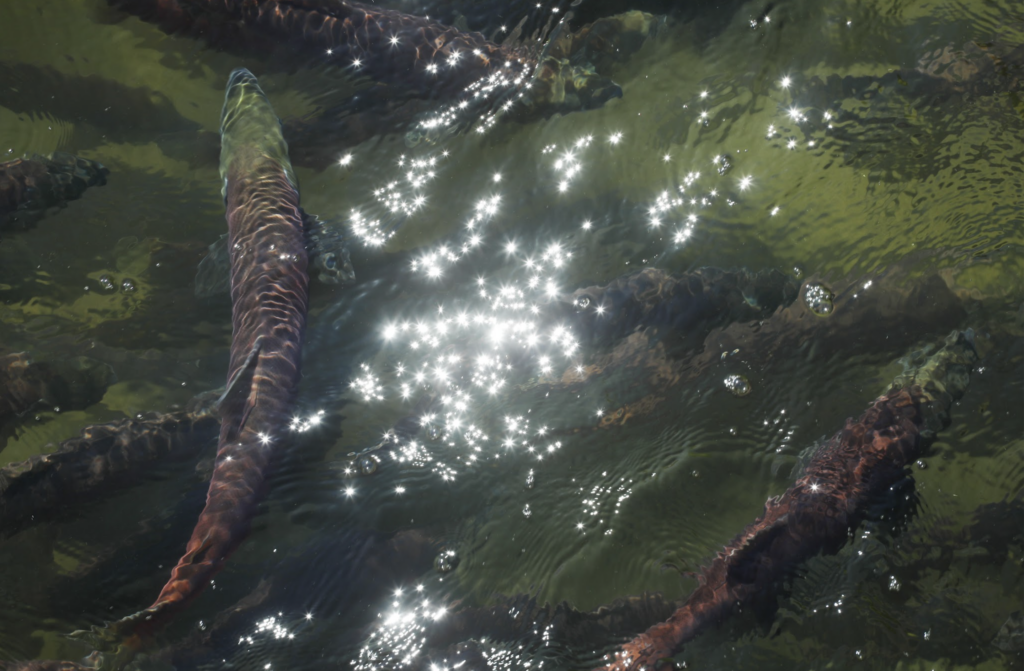
Adult sc̓win (sockeye salmon) swim near a dam at sx̌ʷəx̌ʷnitkʷ (Okanagan Falls Provincial Park) on Aug. 29, 2024. Photo by Aaron Hemens
The number of adult sc̓win (sockeye salmon) returning to spawn in Okanagan waters later this fall is expected to be low for the second consecutive year, as high temperatures and low water levels continue.
The Okanagan Nation Alliance (ONA) has informed syilx Nation members that there will once again be no economic or recreational sockeye fishery this year, nor will it be hosting a communal sockeye fishery or fish distribution events.
However, members can still harvest the fish for their own personal needs, said the ONA’s sockeye salmon return update on June 23.
“We respectfully ask that everyone take only what they need to help conserve this important resource for future generations,” ONA’s online bulletin states.
Between 4,800 and 14,500 adult sockeye migrating from the Pacific Ocean along the Columbia River are projected to reach spawning grounds in creeks, rivers and other tributaries throughout the Okanagan River system, as they pass north through Osoyoos Lake, according to ONA.
The ONA noted that these spawning habitats have the capacity to support up to 205,000 spawning sockeye.
Environmental factors — particularly high river temperatures and low water levels — are creating “difficult conditions for fish returning to spawn,” the bulletin said.
Salmon facing thermal barrier: scientist
At the end of May, ONA declared an emergency across six of its major watersheds in response to worsening droughts, declining fish populations, and growing threats to long-term water security throughout its territories.
For thousands of years, salmon has sustained generations of syilx people. The fish — revered in syilx culture as ntytyix (Chief Salmon), one of the nation’s Four Food Chiefs — is described by ONA as a “primary food mainstay of the syilx Okanagan peoples and central to our culture and trade traditions.”
Last year, warm water downstream from Osoyoos Lake at the confluence of the Columbia and the Okanagan River — known in the “U.S.” as the Okanogan River — created a natural phenomenon known as a thermal barrier. This occurs when water becomes too warm for fish to migrate through, explained ONA fisheries biologist Elinor McGrath.
“In 2025, the thermal barrier [was] consistently set up from June 30 to September 8, the longest on record,” ONA fisheries biologist Ryan Benson wrote in a June 30 email to IndigiNews.
“Typically, we consider the thermal barrier to be set up at 23 C, but even temperatures as low as 19 to 21 C can cause moderate to high stress and sub-lethal effects for migrating salmon.”
Although water temperatures in the “American” Okanogan River reached 23 C on June 17, they have not consistently remained above that threshold because of the cooling influence of recent rains, Benson said.
“We will continue to monitor because it will likely reach that critical temperature very soon,” he wrote.
A ‘shifting climate’
During a June 24 webinar on watershed drought and salmon survival, McGrath said thermal barriers in the Okanogan River historically tended to form in mid- to late July.
“But with the shifting climate toward warmer spring water temperatures and the earlier snow melt — and especially during drought years with the low snowpack, hot weather and low flows — we see the thermal barrier often setting up in early July or even late June,” McGrath said.
Climate change is already causing regional snowpacks to melt earlier in the year. At the same time, rising air temperatures are contributing to warmer water temperatures, which are projected to increase further in the future, she said.
“That’s really not good for salmon, because they’re a cold-water fish, and their metabolism works best at cooler temperatures,” she said.
“On top of this longer-term trend of warming air temperatures and earlier snowmelt, the Okanagan has experienced drought conditions much more frequently in the last decade than in the decades before that.”
The Okanagan Basin is experiencing its fourth consecutive year of drought conditions, McGrath said, adding that the drought is now “almost the norm, rather than the exception.”
“In the last 10 years, almost all years have had some sort of elevation in drought level. It’s becoming much more frequent,” she said.
On two separate occasions in the last year, Lower Similkameen Band member Lauren Terbasket, who works for the band’s Parks Working Group, has warned that the combined effects of climate change and human industry could lead to “an extinction event” for fish throughout the Okanagan Basin by 2040.
“Fish will no longer be able to live in the system. It is a risk to the whole other Columbia River fishery,” she said.
“I don’t know, given climate change, if we can reverse that. But at least we can possibly have areas where fish still live in the system.”
The post Low sockeye salmon numbers expected in the Okanagan as waters warm: ONA appeared first on Indiginews.
From Indiginews via This RSS Feed.