


Bullets:
Massive deposits of industrial metals and rare earths are over two kilometers below the earth’s surface.
Identifying the location of those reserves requires revolutionary, ultra-high-powered antennas.
Breakthroughs in boring technology and materials science are necessary to recover those metals at depth, safely and at scale.
China has monopolies on both the antennas, and the large boring machines that make the deep mining of the Earth’s lithosphere possible.
Inside China / Business is a reader-supported publication. To receive new posts and support my work, consider becoming a free or paid subscriber.
Report:
Good morning.
The whole world is now aware of the rare earth metals problem, and where they are. Three fourths of the most important raw materials that will power the rest of this century are in the Global Majority countries, and the demand for all these metals is accelerating. The BRICS bloc is growing, and so is the strategic value of their raw materials.
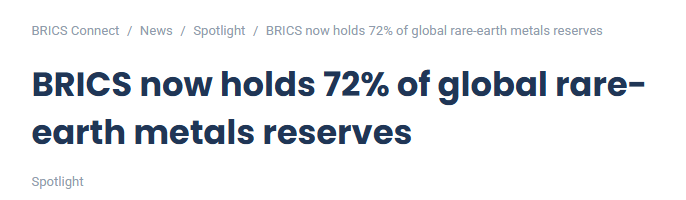
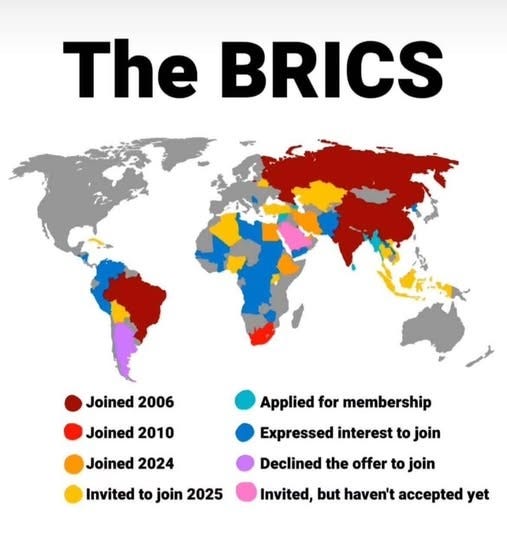
And the fact that those countries have such a dominant position in the rare earths industries means that it is they who can work together, and exchange technologies and capital, in ways that countries outside that bloc cannot. BRICS members are self-reliant, right now, and their position is only going to strengthen, over time, as new countries join.
That means that the so-called developed countries are already far behind, and are racing to catch up. At the G7 meeting that just finished, they agreed that no single country should be the source of more than 60% of their rare earth imports, and set that target for 2030. Past that, they hope to get it down to 50% as soon as possible.
Those targets were aimed at China, in particular, and in particular again on behalf of NATO weapons makers. This was the only topic that the G7 reps could agree on, given all the problems with Iran and the Hormuz closures and the trade wars. On this question though, “the members were all aligned” on the need to diversify their supplies of critical minerals.
China has firm control of the refining of these materials, with monopolies on several of them. But China is just one of those countries who, collectively, have most of the world’s reserves to begin with.
It is that problem that animates the high interest from Washington to take over Greenland. Rare earths are necessary for the manufacture of magnets, and China has a monopoly on the permanent magnets too, and makes nine times more magnets than the rest of the world, combined.
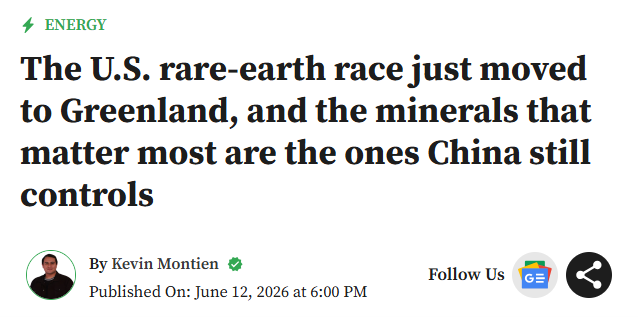
So companies are setting up in Greenland and signing mineral rights deals, in the hope of landing big Pentagon contracts. And under US law, time is running out. Six months from now, contractors cannot deliver any materials that are mined or refined or separated or melted or produced in China or in Russia or in Iran or in North Korea.
The Pentagon is doubtless going to ask for and get a waiver for that rule, just like they did for the law to “rip and replace” Huawei telecom gear from defense communications networks across the world. They’ll never make it by the 1 January deadline. But that rule makes for a traceability problem for Pentagon suppliers. They are required to know the source of every piece of metal inside every component that goes into a weapons platform.
The second problem is how to source enough new supplies, fast enough. And hauling the metal ores out of Greenland is just the first step—then comes the “messy middle”—the separating and refining – before the manufacturing process can even begin.
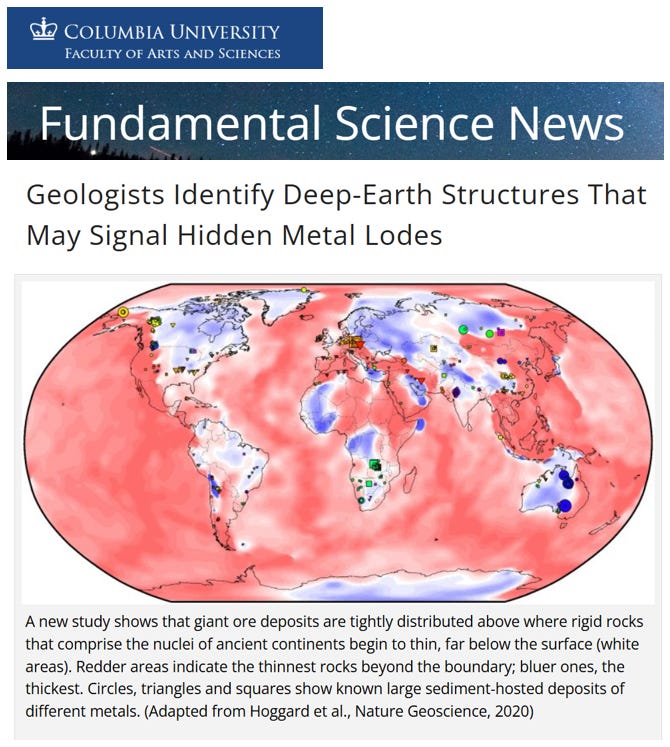
China has a problem too, though. Most of the world’s minerals aren’t near the surface of the earth, but deeper down. Geologists discovered that 85% of total deposits, and all of the largest ones, are along the fringes of the earth’s lithosphere. That is the Upper Mantle, and the crust, up to about 170 kilometers below the surface. Up until now, geologists poke around with hammers to learn where new mines are supposed to go.
But that’s not enough for what we’ll need from now on. Over the next 25 years, base metals demand will be higher than all the output from all the mines, in human history. To put that into perspective, this is the global mining output for just one single year, 2022.
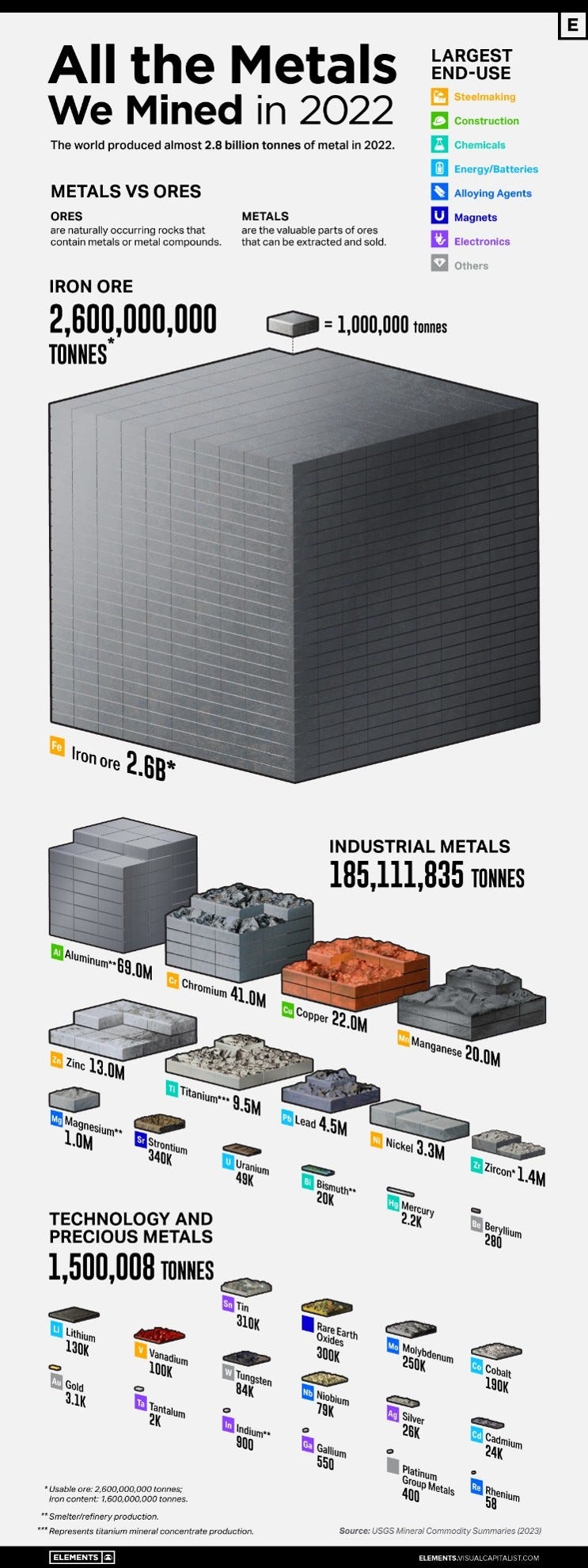
Iron ore was 2.6 billion tons. All the industrial metals totaled 185 million tons. Put another way, iron ore extraction– steelmaking – is 14 times larger than all the other industrial metals, combined. And production of all those industrial metals is 120 times greater than that of strategic and precious metals. And it is those metals that are in highest demand by heavy industry, technology, and defense contractors, and where we need to produce, again, in the next 25 years the combined historical production up to now.
And the only way to make that happen, is to go deep, to where the biggest untapped reserves are. The China Geological Survey estimates that they have over five times as much antimony up to 2 kilometers deep. In the case of tungsten, there is three times more at depth, than near the surface. That 3-to-1 ratio holds for other critical minerals, and for gold, zinc, and lead it’s four to one.
So the Chinese are building new technologies to go after them. This giant antenna is five times the size of New York city, and is used to identify ores and energy deep under the earth’s surface. So far, they’ve discovered the world’s largest deposit of gold, and vast new uranium reserves. Chinese geologists are deploying these massive wireless electromagnetic systems across the country, to find new deposits between 500 and 2,000 meters under the surface. There is a trade-off between power and accuracy, but high-powered systems are crucial to drown out the other signal interference.
All the ultra-high-powered systems in the field, globally, are in China. So the Chinese have monopolies now on the large antenna systems to find deep reserves. But that’s only half the problem.
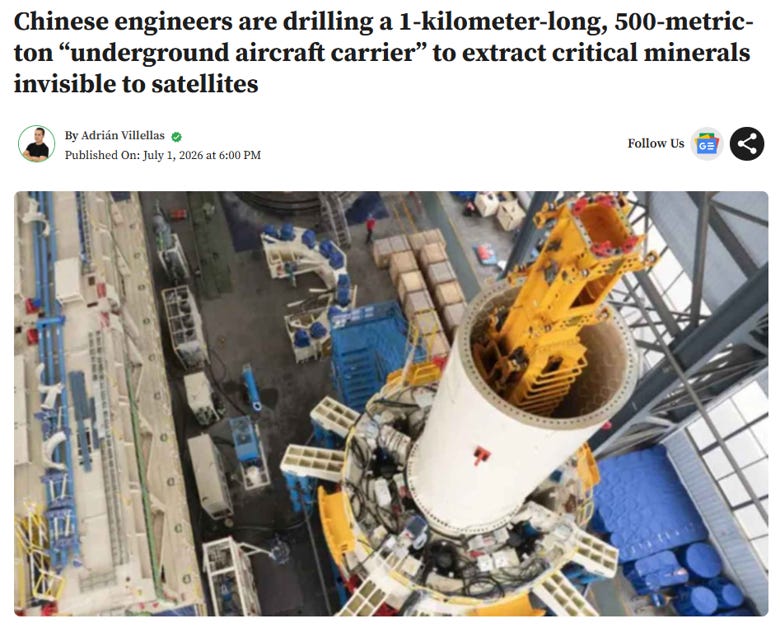
Part II is getting down there. This is a 500-ton boring machine, used to drill a kilometer down. Mining is much slower and riskier the deeper they go, so mining engineers need to invent a different way. During the testing of that machine, efficiency dropped by half when it bumped into dense rock. First idea was to go right through it, then they learned that angling the tools broke the rock open faster. Then the next problem was how to get those chunks out of the way; they need to be brought to the surface, and for six months the engineering team couldn’t figure out how to do it. Apparently, they took some time off to visit a park in Hunan, saw a 2,000-year-old irrigation system, and built one just like it at their mine. Now it hauls up the equivalent of 10 truckloads at a time.
Then they had to figure out how to keep the sidewalls from caving in. Borehole walls tend to quickly collapse on themselves, so the researchers created a system of concrete reinforcements which can be deployed from the surface, while allowing for the drill to continue its work tunneling down.
This is deep mining at industrial scale, and it’s another race all its own. The countries that can do this work safely, in high volumes, will enjoy long-lasting advantages. And here we run into Chinese monopolies again.
Chinese firms have built over 4,000 tunnel boring machines, and have 70 percent of the world’s market share. China also has all – 100% – of the ultra-high-powered antennas that can inform their geologists where to send those boring machines.
And let’s remember again the advantages these BRICS countries have, by virtue of their partnerships with each other—those are the countries that will share and use and further develop all these technologies, that China has monopolies on.
Be Good.
Resources and links:
G7 Aims to See China Supply No More Than 60% of Rare Earths
https://www.bloomberg.com/news/articles/2026-06-17/g7-aims-to-ensure-china-supplies-no-more-than-60-of-rare-earths
China is killing the race for critical minerals with the largest antenna on Earth
https://www.scmp.com/news/china/science/article/3325178/china-killing-race-critical-minerals-largest-antenna-earth
Mining revolution: China’s 500-tonne ‘underground carrier’ tunnels a kilometre to mine ore
https://www.thestar.com.my/aseanplus/aseanplus-news/2026/04/10/mining-revolution-chinas-500-tonne-underground-carrier-tunnels-a-kilometre-to-mine-ore
Tunneling machine highlights rise of Chinese manufacturing
https://english.news.cn/20251109/47a9230d643347faabc90178e82c930b/c.html
Global distribution of sediment-hosted metals controlled by craton edge stability
https://www.nature.com/articles/s41561-020-0593-2
All the metals mined in 2022
https://www.reddit.com/r/Infographics/comments/17w2ctk/all/_the/_metals/_we/_mined/_in/_2022/#lightbox
China finds uranium at ‘impossible’ depth: scientists
https://www.scmp.com/news/china/science/article/3179441/china-finds-uranium-impossible-depth-scientists
BRICS expands to 56% of world population, 44% of global GDP: Vietnam joins as partner country
https://geopoliticaleconomy.com/2025/07/04/brics-expansion-population-gdp-vietnam/
Geologists Identify Deep-Earth Structures That May Signal Hidden Metal Lodes
https://science.fas.columbia.edu/news/geologists-identify-deep-earth-structures-that-may-signal-hidden-metal-lodes/
The Pentagon and FCC have a big Huawei problem: there are no substitutes, and there’s no more money
Inside China / Business is a reader-supported publication. To receive new posts and support my work, consider becoming a free or paid subscriber.
From Inside China / Business via This RSS Feed.