

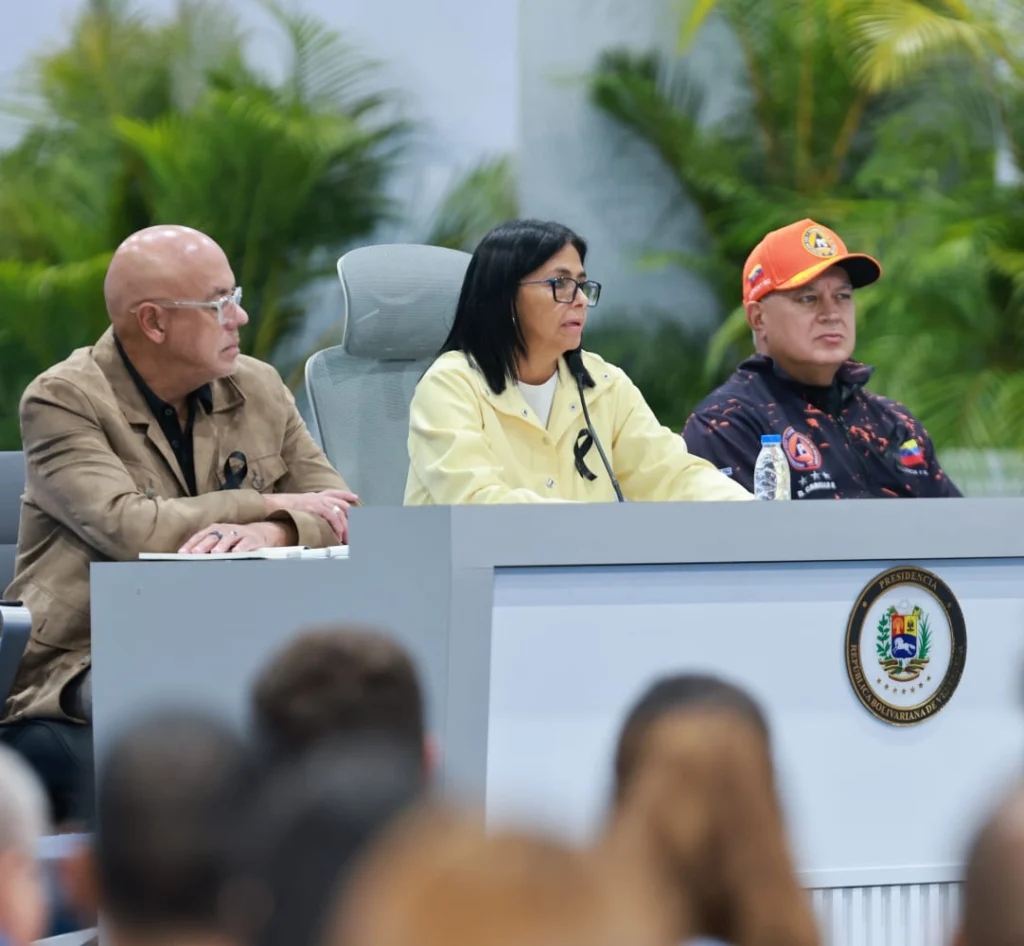
Eight days after the June 24 earthquakes, Venezuela’s Acting President Delcy Rodríguez outlined five pillars of the government’s emergency response during a briefing with foreign correspondents.
Eight days after the twin earthquakes that struck Venezuela on June 24, Venezuela’s Acting President Delcy Rodríguez presented the government’s account of its response to what she described as the country’s worst emergency under her administration.
RELATED: Venezuela Deploys Experts to Evaluate Structural Damages After Major Earthquakes
During a press briefing that lasted more than an hour, the official assessment was organized around five main areas—rescue operations, international assistance, media narratives, reconstruction and public oversight—drawing on operational figures, relief measures and documented government orders while responding to allegations that the state’s reaction had been delayed.
First Key: Rescue and Saving Lives
Acting President Delcy Rodríguez described saving lives as the government’s overriding priority, recalling that requests for specialized international rescue teams were the first appeals made to governments offering assistance. Search operations, she added, remained active more than a week after the disaster, with international crews continuing to work inside collapsed structures.
Official figures presented during the briefing put the number of people rescued alive at 6,462. Among the cases highlighted was security guard Hernán Alberto Gil Flores, who was pulled from the rubble of a shopping center in Playa Grande, La Guaira, after nearly 190 hours through a joint operation involving rescue brigades from seven countries.
According to the official assessment, the emergency deployment expanded from 4,000 civilian and military personnel during the first 24 hours to 14,000 the following day and now exceeds 19,000 responders. La Guaira was also declared a disaster zone immediately, without waiting for any external determination.
“Organize, not create chaos,” Acting President Delcy Rodríguez said, arguing that maintaining public order and security was essential to facilitate rescue operations while media narratives encouraged people to travel to La Guaira during the emergency.
Second Key: International Assistance
International cooperation formed the second pillar of the government’s response, which Acting President Delcy Rodríguez described as assistance provided without political conditions.
“147 countries have shown solidarity with Venezuela,” she said, adding that she received calls from 72 heads of state or government within hours of the earthquakes and told each of them that saving lives remained the government’s immediate priority.
Support came from countries across five continents as well as 31 international and multilateral organizations, according to the official briefing. Acting President Delcy Rodríguez also announced the creation of the Venezuela Recovery and Reconstruction Fund at CAF to receive donations for rebuilding homes.
The official assessment reported that more than 12,400 injured people were treated through public and private healthcare networks and field hospitals provided by dozens of countries. By July 1, 13,942 patients had been discharged, while more than five million liters of drinking water had been distributed across affected communities.
Acting President Delcy Rodríguez also contrasted the current response with the 1999 Vargas tragedy, noting that international assistance had been broadly accepted during the present emergency.
Third Key: The Battle Over Early Narratives
The political dimension of the briefing focused on what Acting President Delcy Rodríguez described as media narratives circulating during the first hours after the earthquakes.
“The first narrative created in media laboratories was ‘Everyone should go down to La Guaira to create chaos,'” she said.
According to her account, those messages encouraged people to travel to the hardest-hit state, disrupting rescue operations and prompting the deployment of additional security forces in La Guaira.
Acting President Delcy Rodríguez also criticized what she described as the politicization of a humanitarian emergency, recalling that the disaster claimed the lives of state government directors, security officials and the president of the Caracas Metro. Those losses, she said, did not interrupt the government’s emergency response.
Fourth Key: Housing, Victim Identification and Reconstruction
Addressing one of the issues that drew the greatest public scrutiny, Acting President Delcy Rodríguez reported that 80 percent of the buildings that collapsed were part of private developments. According to the official assessment, 189 buildings were completely destroyed while hundreds more sustained damage.
The heaviest destruction affected vacation housing developments in Caraballeda, Los Corales and Playa Grande, in La Guaira, following the magnitude 7.2 and 7.5 earthquakes that struck less than one minute apart.
A presidential commission bringing together specialists from universities, public institutions and private companies is assessing damaged infrastructure through a traffic-light classification system, with dozens of buildings in Caracas already designated as unsafe.
The government’s response also includes a central command to coordinate assistance, the expansion of temporary camps for displaced families and the development of new housing projects.
On the management of fatalities, authorities relied on fingerprint and dental identification in coordination with CENAMEC, the Attorney General’s Office and the Civil Registry, Acting President Delcy Rodríguez said, ruling out the use of mass graves and leaving each family to decide between burial and cremation.
The verification process also corrected several identification errors, including five people initially reported dead who were later confirmed alive after their fingerprints were recorded at subsidized fuel stations following the earthquakes.
Reconstruction measures include an initial US$200 million fund, relief supply centers, financial assistance for affected communities, exemptions from notarial and property registration fees, negotiations with banks on housing loans, and temporary camps currently sheltering more than 11,000 people with psychological support services.
Fifth Key: Opening the Response to Public Scrutiny
Concluding the briefing, Acting President Delcy Rodríguez defended what she described as Venezuela’s broadest international openness and its immediate coordination with the United Nations humanitarian coordinator.
“Anyone who wants to audit the reality is welcome, because all those orders are in writing,” she said.
Acting President Delcy Rodríguez maintained that every decision taken during the emergency has been documented, while international rescue teams continue searching collapsed structures more than a week after the earthquakes.
From teleSUR English via This RSS Feed.