

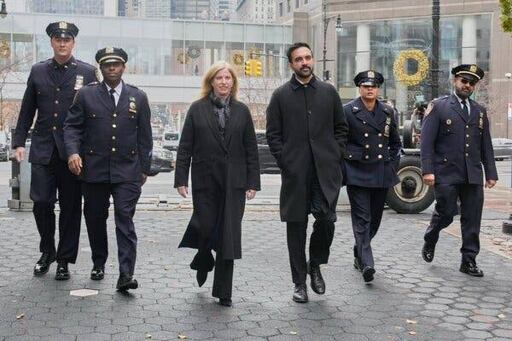
Mayor Zohran Mamdani’s administration had proposed adding roughly 580 officers to the New York Police Department (NYPD) — an increase that would have required tens of millions in additional spending. But earlier this week, he abandoned the plans after a controversy erupted within the Democratic Socialists of America (DSA), whose leadership put out a statement alongside other organizations criticizing Mamdani for the move.
On the surface, this appears to reflect a win for working-class communities, protesters, and movements for racial justice and Palestine, who have been on the forefront of the fight against police repression and for years have called to “defund” the police. But the outcome also makes clear the limits of this kind of “victory.”
The final budget still maintains a NYPD headcount of roughly 35,000 officers, costing over $6 billion, within a city budget of approximately $125.8 billion. In other words, the decision did not meaningfully alter the scale, let alone the function, of policing in New York City. It preserved the status quo: one of the largest police forces in the country, if not the world, with all its existing capacities for surveillance, repression, and enforcement of social inequality intact. The Left, including DSA, needs to go much further, building a struggle against policing that is independent of the very state and institutions that depend on policing to function.
Mamdani’s Campaign Promises Run Into Political Reality
This latest flashpoint is only the newest entry in a pattern stretching back to the campaign trail: Mamdani built his political rise in part on calling to defund the NYPD and branding it racist, anti-queer, and a danger to public safety, only to spend his first year in office walking each of those positions back.
By fall 2025 he was touring precincts offering to apologize to the NYPD for his previous remarks, and upon taking office he chose to keep Jessica Tisch on as police commissioner. Just weeks into his term, the NYPD’s Special Response Group (SRG) carried out its first mass arrest under his watch, sweeping up anti-ICE protesters. That same winter, he quietly restarted the homeless encampment sweeps he’d promised to end, and by spring, he’d softened his commitment to dismantle the department’s racist “gang database” and declined to follow through on disbanding the SRG unit at the center of repeated protest crackdowns, defending Tisch’s approach instead.
These policies are not simply the choices of one individual — they expose the political limits and contradictions of attempting to transform society while remaining inside the Democratic Party and administering institutions built to defend capitalist rule.
Any left project that seeks to govern through the Democratic Party inevitably confronts the institutions of the capitalist state. Those institutions — the police, the courts, city hall, the financial interests that shape municipal policy — are not politically neutral. They exist to preserve the existing social order. Rather than mobilizing workers and the oppressed independently against those institutions, elected officials operating within them are continually pressured to reconcile conflicting interests: the expectations of their social base on one side and the demands of business interests, the political establishment, and the state apparatus on the other.
Given Mamdani’s trajectory, and the very real potential for a reactionary offensive from the NYPD in response to even this modest retreat, there is little reason to think this will be the last time the question of Mamdani’s relationship to the police resurfaces, and every reason to treat it with urgency now rather than waiting for the next reversal to force the issue.
If Mamdani Won’t Confront the Police, Who Will?
DSA, for its part, has talked about the need for a grassroots movement that puts candidates in check, but what would it mean for the DSA to actually organize the kind of response that could meaningfully confront the NYPD?
Imagine if the response to Mamdani’s proposal had gone beyond issuing statements. Imagine if NYC-DSA — the organization’s largest and most influential branch — and allied organizations had called citywide assemblies, organized workplace and campus meetings, coordinated demonstrations, and united the thousands of labor militants, students, tenants, and neighborhood organizations around demands to reduce police spending, abolish the SRG, eliminate the gang database, and redirect resources toward housing, healthcare, schools, transit, and community services.
Such a campaign would not simply seek to persuade one elected official to change course. It would begin building the independent power necessary to challenge the institutions that reproduce policing in the first place.
Instead, the leadership of the NYC-DSA has made moves in the opposite direction, starting with their decision to make it harder to criticize Mamdani on the heels of his election, the decision to discipline the Anti-War Working Group on the heels of the war with Iran (unsurprisingly, over the question of imperialism, which is another strategic red line for the Democratic Party), and their defense of the homeless encampment sweeps. And curiously, they only criticized Mamdani over the NYPD’s expansion right before the primary elections that relied on constituencies shaped by the Black Lives Matter (BLM) movement and the movement against the genocide in Palestine — people for whom policing is not an abstract budget issue but a lived political reality of raids, repression, and criminalization.
For these constituencies, these debates should not remain confined to closed-door leadership discussions. They should become opportunities to build democratic assemblies and organizing committees where members, workers, students, tenants, and community organizations can collectively debate strategy and determine how to fight.
Yet, as long as the political horizon remains administering the existing capitalist state through the Democratic Party, every confrontation with the police will reproduce the same dilemma: pressure from below will collide with the institutional pressures to preserve the existing order.
The retreat on police expansion should therefore be understood not as the resolution of the debate, but as its beginning. The next confrontation over policing is inevitable. The question is whether the Left will be better prepared — not simply with stronger statements, but with stronger organizations capable of fighting for a real break with the politics of policing and the capitalist state that depends on it.
The post Mamdani Halts NYPD Expansion, But NYC’s Repressive Machine Remains Intact appeared first on Left Voice.
From Left Voice via This RSS Feed.